eBook - ePub
Feeding the Nation in World War II
Rationing, Digging for Victory & Unusual Food
- 208 pages
- English
- ePUB (mobile friendly)
- Available on iOS & Android
eBook - ePub
About this book
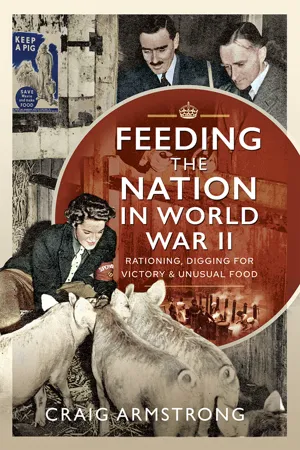
One of the main dangers to Britain during the Second World War was the possibility of the country being starved out of the war. Indeed, it was what Churchill feared the most. Before the war, Britain was hugely dependent upon foreign imports of food and supplies, but with unrestricted submarine warfare these lifelines were in danger of being cut and the amount of imports hugely reduced. Britain was not unprepared. Lessons had been learned during the First World War, when people had been encouraged to grow more of their own food. The Ministry of Food, in particular, had detailed plans in the event of a future war and the 'Dig for Victory' campaign rightly went down in history as one of the great successes of the British Home Front. For the farmers of Britain the war meant a massive upheaval, as the government ordered them to plough up millions of acres of land to grow valuable arable crops. Meanwhile, with rationing a daily and inescapable part of life, the people of Britain had to get used to different foodstuffs, including powdered egg, Spam and even whale meat. Incredibly, the diets of many British people actually improved during the war and the fact that the country avoided starvation demonstrated not only the success of government planning, but also the determination and ingenuity of the wartime generation.
Information
Subtopic
Modern British HistoryIndex
HistoryTable of contents
- Cover
- Dedication
- Title
- Copyright
- Contents
- Introduction
- Chapter 1 Organised Commercial Agriculture
- Chapter 2 Dig for Victory
- Chapter 3 Rationing, Shortages and Controls
- Chapter 4 Food, Morale and Society in Wartime Britain
- Chapter 5 Communal Feeding and the British Restaurants
- Aftermath
- Epilogue
- Appendix I Recipes
- Appendix II A Brief Timeline of Rationing
- Endnotes
Trusted by 375,005 students
Access to over 1.5 million titles for a fair monthly price.
Study more efficiently using our study tools.
Frequently asked questions
Yes, you can cancel anytime from the Subscription tab in your account settings on the Perlego website. Your subscription will stay active until the end of your current billing period. Learn how to cancel your subscription
No, books cannot be downloaded as external files, such as PDFs, for use outside of Perlego. However, you can download books within the Perlego app for offline reading on mobile or tablet. Learn how to download books offline
Perlego offers two plans: Essential and Complete
- Essential is ideal for learners and professionals who enjoy exploring a wide range of subjects. Access the Essential Library with 800,000+ trusted titles and best-sellers across business, personal growth, and the humanities. Includes unlimited reading time and Standard Read Aloud voice.
- Complete: Perfect for advanced learners and researchers needing full, unrestricted access. Unlock 1.5M+ books across hundreds of subjects, including academic and specialized titles. The Complete Plan also includes advanced features like Premium Read Aloud and Research Assistant.
We are an online textbook subscription service, where you can get access to an entire online library for less than the price of a single book per month. With over 1.5 million books across 990+ topics, we’ve got you covered! Learn about our mission
Look out for the read-aloud symbol on your next book to see if you can listen to it. The read-aloud tool reads text aloud for you, highlighting the text as it is being read. You can pause it, speed it up and slow it down. Learn more about Read Aloud
Yes! You can use the Perlego app on both iOS and Android devices to read anytime, anywhere — even offline. Perfect for commutes or when you’re on the go.
Please note we cannot support devices running on iOS 13 and Android 7 or earlier. Learn more about using the app
Please note we cannot support devices running on iOS 13 and Android 7 or earlier. Learn more about using the app
Yes, you can access Feeding the Nation in World War II by Craig Armstrong in PDF and/or ePUB format, as well as other popular books in History & Modern British History. We have over 1.5 million books available in our catalogue for you to explore.