Flinders Petrie undertook excavation and survey of ancient Egyptian towns in the Faiyum oasis, south-west of Cairo, in 1888–90. The work included opening of a pyramid at Illahun and excavation of a nearby cemetery, excavation and planning of over 2000 chambers of the city of Kahun, excavation of a Ptolemaic cemetery at Gurob, and work at the temple site at Medinet Gurob. This facsimile volume presents brief descriptions of the work with a focus on the artifacts and inscriptions recovered and recorded with an attempt to establish a chronology of occupation in the oasis.
The entrance to the pyramid at Illahun, its peculiar structure and exploration of its various internal passages and chambers are described, including the sepulchre containing the red granite sarcophagus of Usertesen II, accompanied by a table of offerings. A series of nearby tombs produced a wealth of artifacts associated with burials, wooden coffins and cartonnages, including glazed objects, amulets, scarabs, beads, silver cowries, carved and inscribed wooden objects and statuettes. At Kahun the complete surviving plan of the ancient town revealed a regular layout thought by Petrie to be the work of a single architect. He identified the acropolis, at least eight great houses, dwelling houses, rubbish heaps, and storerooms arranged along numerous narrow ‘workmen’s’ streets with drainage channels. Much evidence for construction materials and techniques and house fittings, wall plaster and paint was recovered. Portable objects included decorated pottery, some of it imported; pottery trays of offerings; stonework; wooden carvings; flint sickles and knives; inscribed stelae; a variety of copper tools; scarabs and clay seals; stone weights and many tools, including several workshop groups. A family tomb in the cellar beneath one house contained 12 coffins, each containing several bodies with grave offerings buried in succession, two baby boxes and a heap of offerings. At Gurob, the plan of the main temple and surrounding enclosures, within which were contained most of the houses, was established and an outline of its history determined. An unusual practice of burning personal belongings in pits beneath the houses was identified and the groups of objects and inscriptions discussed. The nearby cemetery was also investigated with pit-like tombs producing undecorated coffins but finely painted cartonnages, badly decomposed papyri and a few funerary objects. A discussion of the wider urban landscape concludes the narrative. There are specialist reports on the papyri and stone implements.
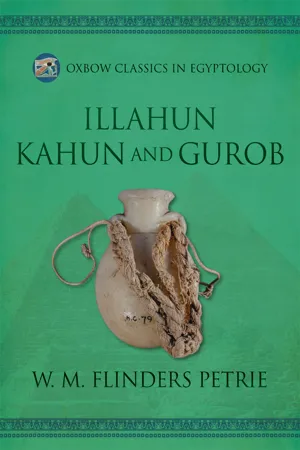
- 98 pages
- English
- ePUB (mobile friendly)
- Available on iOS & Android
eBook - ePub
Illahun, Kahun and Gurob
About this book
Information
Subtopic
Egyptian Ancient HistoryIndex
Social SciencesTable of contents
- Cover
- Title
- Copyright
- CONTENTS
- INTRODUCTORY.
- CHAPTER I. PYRAMIDS OF ILLAHUN.
- CHAPTER II. THE TOWN OF KAHUN.
- CHAPTER III. THE ANTIQUITIES OF KAHUN.
- CHAPTER IV. MEDINET GUROB.
- CHAPTER V. THE TOMB OF MAKET.
- CHAPTER VI. ILLAHUN IN THE XXII. DYN.
- CHAPTER VII. PTOLEMAIC CEMETERY, GUROB.
- CHAPTER VIII. PTOLEMAIS AND LATE SITES
- CHAPTER IX. THE GREEK PAPYRI.
- CHAPTER X. THE HIERATIC PAPYRI.
- CHAPTER XI. THE STONE IMPLEMENTS.
- Plates
Trusted by 375,005 students
Access to over 1.5 million titles for a fair monthly price.
Study more efficiently using our study tools.
Frequently asked questions
Yes, you can cancel anytime from the Subscription tab in your account settings on the Perlego website. Your subscription will stay active until the end of your current billing period. Learn how to cancel your subscription
No, books cannot be downloaded as external files, such as PDFs, for use outside of Perlego. However, you can download books within the Perlego app for offline reading on mobile or tablet. Learn how to download books offline
Perlego offers two plans: Essential and Complete
- Essential is ideal for learners and professionals who enjoy exploring a wide range of subjects. Access the Essential Library with 800,000+ trusted titles and best-sellers across business, personal growth, and the humanities. Includes unlimited reading time and Standard Read Aloud voice.
- Complete: Perfect for advanced learners and researchers needing full, unrestricted access. Unlock 1.5M+ books across hundreds of subjects, including academic and specialized titles. The Complete Plan also includes advanced features like Premium Read Aloud and Research Assistant.
We are an online textbook subscription service, where you can get access to an entire online library for less than the price of a single book per month. With over 1.5 million books across 990+ topics, we’ve got you covered! Learn about our mission
Look out for the read-aloud symbol on your next book to see if you can listen to it. The read-aloud tool reads text aloud for you, highlighting the text as it is being read. You can pause it, speed it up and slow it down. Learn more about Read Aloud
Yes! You can use the Perlego app on both iOS and Android devices to read anytime, anywhere — even offline. Perfect for commutes or when you’re on the go.
Please note we cannot support devices running on iOS 13 and Android 7 or earlier. Learn more about using the app
Please note we cannot support devices running on iOS 13 and Android 7 or earlier. Learn more about using the app
Yes, you can access Illahun, Kahun and Gurob by W.M. Flinders Petrie in PDF and/or ePUB format, as well as other popular books in Social Sciences & Egyptian Ancient History. We have over 1.5 million books available in our catalogue for you to explore.