Circumventing the Law probes the rabbinic logic behind the use of loopholes, the legal phenomenon of finding and using gaps within law to achieve otherwise illegal outcomes. The logic of ha'aramah, a subset of rabbinic legal circumventions mostly defined as a tool for private life, underpins both well-known circumventions, such as selling leaven before Passover, and lesser-known mechanisms, such as designating an animal intended for sacrifice "blemished" before birth to allow it to be slaughtered for food instead. Elana Stein Hain traces the development of these loopholes over time, revealing that rabbinic literature does not consistently accept or reject loopholes. Instead, rabbinic Judaism applies categories of evasion (prohibited), avoidance (permitted), and avoision (contested) to loopholes on a case-by-case basis. The intended outcome of a given loophole determines its classification, as does the legal integrity of the circumventive process in question.
Yet these understandings of loopholes are not static—instead, rabbinic attitudes toward loopholing change over time. Early works display an objective, performative understanding of the self and of intention, but evolve over time to reflect more subjective and intimate understanding of the self and intention. This evolution redefines what legal integrity means in Jewish legal philosophy.
Circumventing the Law brings readers through the Second Temple period to the modern era to see how loopholing has evolved over millennia. With a focus on late antiquity, Stein Hain explores tannaitic literature, the Palestinian Talmud, and contemporaneous Greco-Roman and Persian thought to show that when warranted, Jewish rhetoric and philosophy around understandings of loopholes was a unique phenomenon that relied on changes in understanding the definition of integrity itself, a key finding for scholars of Jewish Studies and of religious and of secular law writ large.
eBook - ePub
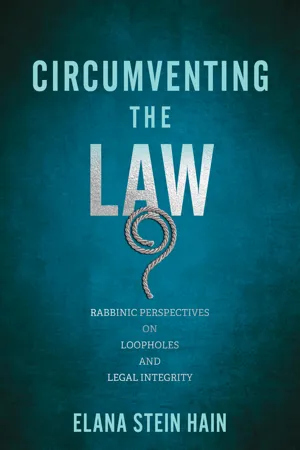
Circumventing the Law
Rabbinic Perspectives on Loopholes and Legal Integrity
- 240 pages
- English
- ePUB (mobile friendly)
- Available on iOS & Android
eBook - ePub
About this book
Information
Table of contents
- Cover
- Series Page
- Title Page
- Copyright
- Dedication
- Contents
- Introduction
- Chapter 1. (When) Do Circumventions Disrespect the Law?
- Chapter 2. Being Explicit About Legal Values and Integrity
- Chapter 3. Romans as Jurists, Rabbis as Lawyers
- Chapter 4. Ha’aramah and Intention
- Chapter 5. Ha’aramah in the Bavli: Discomfort with Ritualized Intention
- Chapter 6. Ha’aramah and Contemporary Legal Theory
- Epilogue. Ha’aramah and Takkanot
- Appendix. Comparing the Yerushalmi’s and the Bavli’s Use of Ha’aramah Terminology and Concept
- Notes
- Bibliography
- Index
- Acknowledgments
Trusted by 375,005 students
Access to over 1.5 million titles for a fair monthly price.
Study more efficiently using our study tools.
Frequently asked questions
Yes, you can cancel anytime from the Subscription tab in your account settings on the Perlego website. Your subscription will stay active until the end of your current billing period. Learn how to cancel your subscription
No, books cannot be downloaded as external files, such as PDFs, for use outside of Perlego. However, you can download books within the Perlego app for offline reading on mobile or tablet. Learn how to download books offline
Perlego offers two plans: Essential and Complete
- Essential is ideal for learners and professionals who enjoy exploring a wide range of subjects. Access the Essential Library with 800,000+ trusted titles and best-sellers across business, personal growth, and the humanities. Includes unlimited reading time and Standard Read Aloud voice.
- Complete: Perfect for advanced learners and researchers needing full, unrestricted access. Unlock 1.5M+ books across hundreds of subjects, including academic and specialized titles. The Complete Plan also includes advanced features like Premium Read Aloud and Research Assistant.
We are an online textbook subscription service, where you can get access to an entire online library for less than the price of a single book per month. With over 1.5 million books across 990+ topics, we’ve got you covered! Learn about our mission
Look out for the read-aloud symbol on your next book to see if you can listen to it. The read-aloud tool reads text aloud for you, highlighting the text as it is being read. You can pause it, speed it up and slow it down. Learn more about Read Aloud
Yes! You can use the Perlego app on both iOS and Android devices to read anytime, anywhere — even offline. Perfect for commutes or when you’re on the go.
Please note we cannot support devices running on iOS 13 and Android 7 or earlier. Learn more about using the app
Please note we cannot support devices running on iOS 13 and Android 7 or earlier. Learn more about using the app
Yes, you can access Circumventing the Law by Elana Stein Hain in PDF and/or ePUB format, as well as other popular books in History & Jewish History. We have over 1.5 million books available in our catalogue for you to explore.