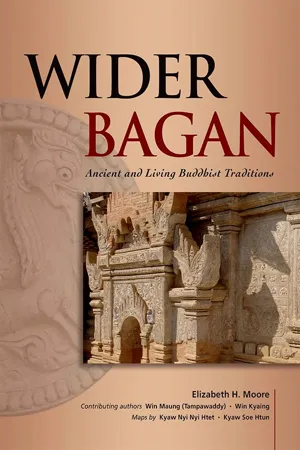
Wider Bagan: Ancient and Living Buddhist Traditions is the first book to define the area outside the renowned Buddhist capital where vestiges of Bagan era cultural traditions can be found. From nearly six hundred attributes inventoried in Wider Bagan, thematic and geographical analysis of the Wider Bagan data reveals a related but different trajectory from that of the capital. The Sasan? of the court was honoured, and though its economy profited many places across Wider Bagan, local resilience was foremost. While the capital and Wider Bagan existed in relation to each other, their aims and narratives differed. Much has been written about Bagan, but little attention on the ground has been devoted to areas beyond the capital. These places have stories to tell—ones of the past and of the present—that are narrated in this book.
"Wider Bagan is the most important recent publication on Myanmar's past. Tracing Bagan's ideational and material legacies, it recovers how this kingdom's successors related to their heritages. Meticulously researched, beautifully illustrated, studded with clear maps, tables and outlines—Wider Bagan reveals these legacies' custodians—inhabiting territories stretching as far as Yunnan and Bengal. Multiple topics are examined also in light of local scholarship, often ignored due to linguistic limitations. The resulting evocations of times and places make Wider Bagan an enduring guide to people's lives—also in the larger scheme of things—like the community tracing its founding to the Buddha Gotama's grandfather. No one interested in Myanmar's complex past and fractious present can ignore the author's conclusions."—Lilian Handlin, Member of the Harvard Faculty of Arts and Sciences CAMLab.
"In her detailed survey of hundreds of sites in the Ayeyarwady River basin, Moore and her collaborators have revealed a long-suspected, but hitherto undocumented, rural cultural landscape with origins well before and persisting long after the political heyday of metropolitan Bagan in the eleventh through thirteenth centuries. During their investigations, the authors had numerous encounters with local scholar-archaeologists who identified frequently overlooked physical attributes that define the local cultural landscape. In mapping these attributes, the authors reconstructed a narrative of local resilience that speaks to a long local history of diversity and adaptability over an extensive region, where other scholars—working mainly from historical chronicles—had observed only a rigid hegemony emanating from the political centre at Bagan.
Moore's innovative methodology breaks new ground for the study of early urban formations, not only in Myanmar but throughout mainland Southeast Asia. This research contributes to a building body of evidence that suggests a fresh paradigm to replace the long-standing concentric circle model most often used to explain state formation throughout the region. In this new paradigm, the contradiction between urban and rural settlements is dismantled as the stories of the smaller villages and towns re-enact the iterative process between places, communities of users, and social memory of Wider Bagan, demonstrating, in the process, an ecology of resilient settlement that has endured through generations of political, social and economic upheaval."—Richard A. Engelhardt, UNESCO Chair Professor of Cultural Heritage Management and Regional Advisor for Culture in Asia and the Pacific