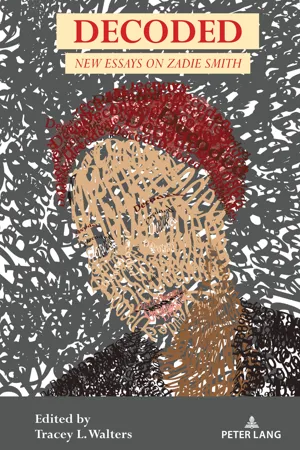
Decoded: New Essays on Zadie Smith examines the middle period of Zadie Smith's illustrious career as a dynamic, experimental novelist of contemporary Black British writing. The five new essays in Decoded, written by innovative scholars in the fields of British literature and African Diasporic studies, bring together the most original and current analysis of Smith's novels and literary criticism since the release of Smith's NW (2012). Decoded includes discussions of NW, Swing Time, The Embassy of Cambodia, Grand Union, Changing My Mind, Feel Free, and Intimations. The essays delve into Smith's philosophy about the role and responsibility of the artist, her ardent defense of the function of the novel in the digital age, and the connection between writers and readers. Also illuminated is Smith's growth as a writer, her reconceptualization of racial identity, and shifting literary techniques from hysterical realism to social realism. Finally, the book discusses Smith's role as a public intellectua, and her evolution from an optimistic champion of multiculturalism to a subdued, austere realist who has broadened her social critique from the local to the global arena.
- 116 pages
- English
- PDF
- Available on iOS & Android
eBook - PDF
About this book
Table of contents
- Cover
- Table of Contents
- Introduction
- 1. Modelling Citizens: From a Digital to a Literary Public Sphere in NW and Swing Time (Daniel South)
- 2. Zadie Smith’s George Eliot’s Spinoza: The Ethics of Austere Realism (James Arnett)
- 3. Transmodern Identity Construction in Later Zadie Smith (Matthias Stephan)
- 4. “[U]nder the Sign of Love”: Blackface Minstrelsy’s Trauma, Racial Exploitation, and Kinaesthetic Hauntologies in Zadie Smi h’s Swing Time (Dr. Alberto Fernández Carbajal)
- 5. The Quest for Knowledge: The Intellectual Woman in Zadie Smith’s Novels (Tracey L. Walters)
- Contributors
Trusted by 375,005 students
Access to over 1.5 million titles for a fair monthly price.
Study more efficiently using our study tools.
Frequently asked questions
Yes, you can cancel anytime from the Subscription tab in your account settings on the Perlego website. Your subscription will stay active until the end of your current billing period. Learn how to cancel your subscription
No, books cannot be downloaded as external files, such as PDFs, for use outside of Perlego. However, you can download books within the Perlego app for offline reading on mobile or tablet. Learn how to download books offline
Perlego offers two plans: Essential and Complete
- Essential is ideal for learners and professionals who enjoy exploring a wide range of subjects. Access the Essential Library with 800,000+ trusted titles and best-sellers across business, personal growth, and the humanities. Includes unlimited reading time and Standard Read Aloud voice.
- Complete: Perfect for advanced learners and researchers needing full, unrestricted access. Unlock 1.5M+ books across hundreds of subjects, including academic and specialized titles. The Complete Plan also includes advanced features like Premium Read Aloud and Research Assistant.
We are an online textbook subscription service, where you can get access to an entire online library for less than the price of a single book per month. With over 1.5 million books across 990+ topics, we’ve got you covered! Learn about our mission
Look out for the read-aloud symbol on your next book to see if you can listen to it. The read-aloud tool reads text aloud for you, highlighting the text as it is being read. You can pause it, speed it up and slow it down. Learn more about Read Aloud
Yes! You can use the Perlego app on both iOS and Android devices to read anytime, anywhere — even offline. Perfect for commutes or when you’re on the go.
Please note we cannot support devices running on iOS 13 and Android 7 or earlier. Learn more about using the app
Please note we cannot support devices running on iOS 13 and Android 7 or earlier. Learn more about using the app
Yes, you can access Decoded by Tracey L. Walters in PDF and/or ePUB format, as well as other popular books in Literature & African Literary Collections. We have over 1.5 million books available in our catalogue for you to explore.