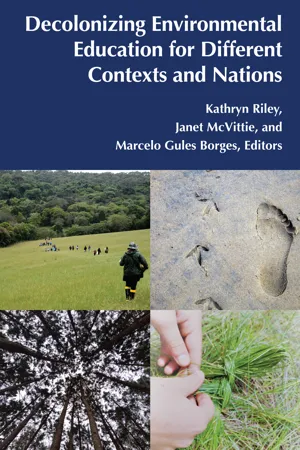
As Dominant Western Worldviews (DWWs) proliferate through ongoing structures of globalization, neoliberalism, extractive capitalism, and colonialism, they inevitably marginalize those deemed as 'Other' (Indigenous, Black, Minority Ethnic, non-Western communities and non-human 'Others', including animals, plants, technologies, and energies). Environmental Education (EE) is well-positioned to trouble and minimize the harmful human impacts on social and ecological systems, yet the field is susceptible to how DWWs constrain and discipline what counts as viable knowledge, with a consequence of this being the loss of situated knowledges. To understand the relationships between DWW and situated knowledges and to thread an assemblage of ontological views that exist in unique contexts and nations, authors in this book take up decolonizing methodologies that expand across theories of Indigenous Knowledges (IK), Traditional Ecological Knowledges (TEK), two-eyed seeing, hybridity, and posthumanism. As EE opens to emplaced and situated socio-cultural and material stories, it opens to opportunities to attend more meaningfully to planetary social and ecological crisis narratives through contingent, contextualised, and relevant actions.
eBook - PDF
Decolonizing Environmental Education for Different Contexts and Nations
- 274 pages
- English
- PDF
- Available on iOS & Android
eBook - PDF
Decolonizing Environmental Education for Different Contexts and Nations
About this book
Information
Table of contents
- Cover
- Table of Contents
- List of Figures
- Note from the Series Editors
- Acknowledgments
- Abbreviations
- Decolonizing Environmental Education for Different Contexts and Nations (Janet McVittie)
- A Global Assemblage (Zuzana Morog)
- 1. Integrating Social and Ecological Justice Inquiry (Vince Anderson)
- Water Deep (Sky McKenzie)
- 2. Mutually Entangled Futures in/for Environmental Education (Kathryn Riley)
- Ahora Adentro (Araceli Leon Torrijos)
- 3. Decolonial Pedagogy, Agroecology, and Environmental Education: Repositioning Science Education in Rural Teacher Education in Brazil (Marcelo Gules Borges)
- 4. Taking Learning Outside (Alice Johnston)
- Walking Gently … Through a Cultural Lens … (Kylie Clarke)
- 5. Decolonizing Education for Sustainable Development (Roseann Kerr)
- 6. Decolonizing Environmental Education in Ghana (John B. Acharibasam)
- Earth Sorrow (Elsa McKenzie)
- 7. Naturalized Places, Indigenous Epistemology, and Learning to Value (Janet McVittie / Marcelo Gules Borges)
- 8. Environmental Education through Indigenous Land-Based Learning (Ranjan Datta)
- Escolas Marginalizadas e Educação Ambiental/Marginalized Schools and Environmental Education (Julio Karpen)
- 9. “From the Stars in the Sky to the Fish in the Sea” (Kai Orca)
- Epilogue
- About the Authors
- Index
Trusted by 375,005 students
Access to over 1.5 million titles for a fair monthly price.
Study more efficiently using our study tools.
Frequently asked questions
Yes, you can cancel anytime from the Subscription tab in your account settings on the Perlego website. Your subscription will stay active until the end of your current billing period. Learn how to cancel your subscription
No, books cannot be downloaded as external files, such as PDFs, for use outside of Perlego. However, you can download books within the Perlego app for offline reading on mobile or tablet. Learn how to download books offline
Perlego offers two plans: Essential and Complete
- Essential is ideal for learners and professionals who enjoy exploring a wide range of subjects. Access the Essential Library with 800,000+ trusted titles and best-sellers across business, personal growth, and the humanities. Includes unlimited reading time and Standard Read Aloud voice.
- Complete: Perfect for advanced learners and researchers needing full, unrestricted access. Unlock 1.5M+ books across hundreds of subjects, including academic and specialized titles. The Complete Plan also includes advanced features like Premium Read Aloud and Research Assistant.
We are an online textbook subscription service, where you can get access to an entire online library for less than the price of a single book per month. With over 1.5 million books across 990+ topics, we’ve got you covered! Learn about our mission
Look out for the read-aloud symbol on your next book to see if you can listen to it. The read-aloud tool reads text aloud for you, highlighting the text as it is being read. You can pause it, speed it up and slow it down. Learn more about Read Aloud
Yes! You can use the Perlego app on both iOS and Android devices to read anytime, anywhere — even offline. Perfect for commutes or when you’re on the go.
Please note we cannot support devices running on iOS 13 and Android 7 or earlier. Learn more about using the app
Please note we cannot support devices running on iOS 13 and Android 7 or earlier. Learn more about using the app
Yes, you can access Decolonizing Environmental Education for Different Contexts and Nations by Kathryn Riley,Janet McVittie,Marcelo Gules Borges, Márcia Aparecida Amador Mascia,Hongyan Chen,Silvia Grinberg,Michalis Kontopodis in PDF and/or ePUB format, as well as other popular books in Education & Computer Science General. We have over 1.5 million books available in our catalogue for you to explore.