Design thinking is an innovative problem-solving framework. This introduction is the first book to apply its methodology to student affairs and, in doing so, points the way to its potentially wider value to higher education as a whole.With its focus on empathy, which is the need to thoroughly understand users' experiences, design thinking is user-centered, similar to how student affairs is student-centered. Because the focus of design thinking is to design with users, not for users, it aligns well with student affairs practice. In addition, its focus on empathy makes design thinking a more equitable approach to problem-solving than other methods because all users' experiences—not just the experiences of majority or "average" student—need to be understood. Centering empathy in problem-solving processes can be a tool to disrupt higher education systems and practices.Design thinking is a framework to foster innovation, and, by its nature, innovation is about responding to change factors with creativity. In an organization, design thinking is inherently connected to organizational change and culture because the process is really about changing people to help them rally around a disruptive idea. Implementing design thinking on a campus may in itself be disruptive and require a change management process. The beauty of using design thinking is that it can also act as a framework to support organizational culture change.Design thinking approaches, with their focus on stakeholder needs (as opposed to systemic norms), collaborative solutions building, and structured empathy activities can offer a concrete tool to disrupt harmful systems of power and oppression. Design thinking as a process is not a magic solution to equity problems, though it can be a powerful tool to approach the development of solutions that can address inequity. Design thinking is data-driven and considers both qualitative and quantitative data as necessary to gain most complete picture of an issue and its possible solutions, whether a product, program, or service.Design thinking has numerous benefits to afford students affairs. Chapter 1 outlines a case for design thinking in student affairs. Chapter 2 discusses a brief history of design thinking, noting its germination and evolution to current practice. Chapter 3 provides a detailed description of each step of the design thinking model with pertinent examples to make the steps clearer. Chapter 4 explains the intersection of equity and design thinking while chapter 5 explores the use of design thinking for organizational change. Chapter 6 presents a new model for design thinking assessment. Chapter 7 addresses the challenges and limitations of the process. Chapter 8 concludes the book by discussing the alignment of design thinking and student affairs and outlining next steps.Design thinking is an innovative process that can change the way higher education and student affairs operates, realizing the potential it offers.
eBook - ePub
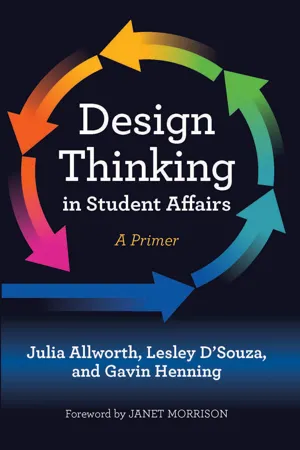
Design Thinking in Student Affairs
A Primer
- 250 pages
- English
- ePUB (mobile friendly)
- Available on iOS & Android
eBook - ePub
About this book
Information
Table of contents
- Cover
- Half Title
- Title Page
- Copyright Page
- Dedication
- Table of Contents
- Foreword
- Preface
- Acknowledgments
- 1 The Case For Design Thinking in Higher Education and Student Affairs
- 2 Design Thinking
- 3 Design Thinking Model
- 4 Equity and Design Thinking
- 5 Designing for Organizational Change
- 6 Design Thinking Assessment Application of Design Thinking to Student Affairs Assessment
- 7 Discussion of Challenges and Limitations
- 8 Pulling the Pieces Together Alignment of Design Thinking and Student Affairs
- References
- About the Authors
- Index
Trusted by 375,005 students
Access to over 1.5 million titles for a fair monthly price.
Study more efficiently using our study tools.
Frequently asked questions
Yes, you can cancel anytime from the Subscription tab in your account settings on the Perlego website. Your subscription will stay active until the end of your current billing period. Learn how to cancel your subscription
No, books cannot be downloaded as external files, such as PDFs, for use outside of Perlego. However, you can download books within the Perlego app for offline reading on mobile or tablet. Learn how to download books offline
Perlego offers two plans: Essential and Complete
- Essential is ideal for learners and professionals who enjoy exploring a wide range of subjects. Access the Essential Library with 800,000+ trusted titles and best-sellers across business, personal growth, and the humanities. Includes unlimited reading time and Standard Read Aloud voice.
- Complete: Perfect for advanced learners and researchers needing full, unrestricted access. Unlock 1.5M+ books across hundreds of subjects, including academic and specialized titles. The Complete Plan also includes advanced features like Premium Read Aloud and Research Assistant.
We are an online textbook subscription service, where you can get access to an entire online library for less than the price of a single book per month. With over 1.5 million books across 990+ topics, we’ve got you covered! Learn about our mission
Look out for the read-aloud symbol on your next book to see if you can listen to it. The read-aloud tool reads text aloud for you, highlighting the text as it is being read. You can pause it, speed it up and slow it down. Learn more about Read Aloud
Yes! You can use the Perlego app on both iOS and Android devices to read anytime, anywhere — even offline. Perfect for commutes or when you’re on the go.
Please note we cannot support devices running on iOS 13 and Android 7 or earlier. Learn more about using the app
Please note we cannot support devices running on iOS 13 and Android 7 or earlier. Learn more about using the app
Yes, you can access Design Thinking in Student Affairs by Julia Allworth,Lesley D'Souza,Gavin W. Henning in PDF and/or ePUB format, as well as other popular books in Education & Education Administration. We have over 1.5 million books available in our catalogue for you to explore.