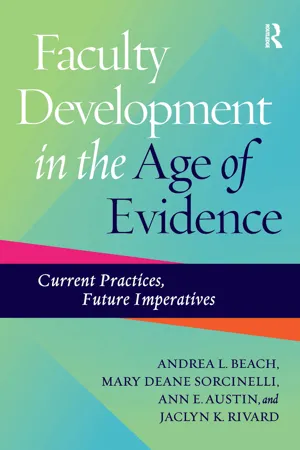
The first decade of the 21st century brought major challenges to higher education, all of which have implications for and impact the future of faculty professional development. This volume provides the field with an important snapshot of faculty development structures, priorities and practices in a period of change, and uses the collective wisdom of those engaged with teaching, learning, and faculty development centers and programs to identify important new directions for practice. Building on their previous study of a decade ago, published under the title of Creating the Future of Faculty Development, the authors explore questions of professional preparation and pathways, programmatic priorities, collaboration, and assessment. Since the publication of this earlier study, the pressures on faculty development have only escalated—demands for greater accountability from regional and disciplinary accreditors, fiscal constraints, increasing diversity in types of faculty appointments, and expansion of new technologies for research and teaching. Centers have been asked to address a wider range of institutional issues and priorities based on these challenges. How have they responded and what strategies should centers be considering? These are the questions this book addresses.For this new study the authors re-surveyed faculty developers on perceived priorities for the field as well as practices and services offered. They also examined more deeply than the earlier study the organization of faculty development, including characteristics of directors; operating budgets and staffing levels of centers; and patterns of collaboration, re-organization and consolidation. In doing so they elicited information on centers' "signature programs," and the ways that they assess the impact of their programs on teaching and learning and other key outcomes. What emerges from the findings are what the authors term a new Age of Evidence, influenced by heightened stakeholder interest in the outcomes of undergraduate education and characterized by a focus on assessing the impact of instruction on student learning, of academic programs on student success, and of faculty development in institutional mission priorities. Faculty developers are responding to institutional needs for assessment, at the same time as they are being asked to address a wider range of institutional priorities in areas such as blended and online teaching, diversity, and the scale-up of evidence-based practices. They face the need to broaden their audiences, and address the needs of part-time, non-tenure-track, and graduate student instructors as well as of pre-tenure and post-tenure faculty. They are also feeling increased pressure to demonstrate the "return on investment" of their programs.This book describes how these faculty development and institutional needs and priorities are being addressed through linkages, collaborations, and networks across institutional units; and highlights the increasing role of faculty development professionals as organizational "change agents" at the department and institutional levels, serving as experts on the needs of faculty in larger organizational discussions.
eBook - ePub
Faculty Development in the Age of Evidence
Current Practices, Future Imperatives
- 176 pages
- English
- ePUB (mobile friendly)
- Available on iOS & Android
eBook - ePub
Faculty Development in the Age of Evidence
Current Practices, Future Imperatives
About this book
Information
Table of contents
- Cover Page
- Half Title page
- Title Page
- Copyright Page
- Dedication
- Contents
- Tables
- Introduction
- 1 Who are We?
- 2 What Guides Our Work?
- 3 Where and with Whom Do We Work?
- 4 Services We Focus On
- 5 Our Approaches to Faculty Development
- 6 Where are We Going?
- 7 How Does Assessment Fit in Our Work?
- 8 What have We Learned?
- Appendix A: Survey Instrument
- Appendix B: Services Tables by Institution Type
- Appendix C: Top Issues Faculty Development Should Address in the Next Five Years
- References
- About the Authors
- Index
Trusted by 375,005 students
Access to over 1.5 million titles for a fair monthly price.
Study more efficiently using our study tools.
Frequently asked questions
Yes, you can cancel anytime from the Subscription tab in your account settings on the Perlego website. Your subscription will stay active until the end of your current billing period. Learn how to cancel your subscription
No, books cannot be downloaded as external files, such as PDFs, for use outside of Perlego. However, you can download books within the Perlego app for offline reading on mobile or tablet. Learn how to download books offline
Perlego offers two plans: Essential and Complete
- Essential is ideal for learners and professionals who enjoy exploring a wide range of subjects. Access the Essential Library with 800,000+ trusted titles and best-sellers across business, personal growth, and the humanities. Includes unlimited reading time and Standard Read Aloud voice.
- Complete: Perfect for advanced learners and researchers needing full, unrestricted access. Unlock 1.5M+ books across hundreds of subjects, including academic and specialized titles. The Complete Plan also includes advanced features like Premium Read Aloud and Research Assistant.
We are an online textbook subscription service, where you can get access to an entire online library for less than the price of a single book per month. With over 1.5 million books across 990+ topics, we’ve got you covered! Learn about our mission
Look out for the read-aloud symbol on your next book to see if you can listen to it. The read-aloud tool reads text aloud for you, highlighting the text as it is being read. You can pause it, speed it up and slow it down. Learn more about Read Aloud
Yes! You can use the Perlego app on both iOS and Android devices to read anytime, anywhere — even offline. Perfect for commutes or when you’re on the go.
Please note we cannot support devices running on iOS 13 and Android 7 or earlier. Learn more about using the app
Please note we cannot support devices running on iOS 13 and Android 7 or earlier. Learn more about using the app
Yes, you can access Faculty Development in the Age of Evidence by Andrea L. Beach,Mary Deane Sorcinelli,Ann E. Austin,Jaclyn K. Rivard in PDF and/or ePUB format, as well as other popular books in Education & Higher Education. We have over 1.5 million books available in our catalogue for you to explore.