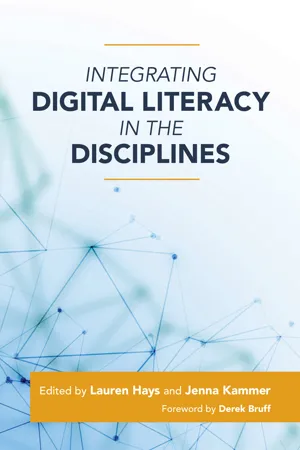
Digital literacy has become the vital competency that students need to master before graduating. This book provides rich examples of how to integrate it in disciplinary courses.While many institutions are developing introductory courses to impart universal literacy (skills students need to know) and creative literacy (skills for creating new content), discipline-specific skills (skills needed to succeed within a specific discipline) are a vital extension to their learning and ability to apply digital literacy in different contexts. This book provides examples of how to integrate digital literacy across a wide variety of courses spanning many domains.Rather than a wholly new core institutional outcome, digital literacy adds to the development of critical thinking, communication, problem-solving, and teamwork skills by building students' capacities to assess online information so they can ethically share, communicate, or repurpose it through the appropriate use of available digital technologies. In short, it provides the vital digital dimension to their learning and the literacy skills which will be in increasing demand in their future lives.Following introductory chapters providing context and a theoretical framework, the contributing authors from different disciplines share the digital competencies and skills needed within their fields, the strategies they use to teach them, and insights about the choices they made. What shines through the examples is that, regardless of the specificity of the disciplinary examples, they offer all readers a commonality of approach and a trove of ideas that can be adapted to other contexts.This book constitutes a practical introduction for faculty interested in including opportunities to apply digital literacy to discipline-specific content. The book will benefit faculty developers and instructional designers who work with disciplinary faculty to integrate digital literacy. The book underscores the importance of preparing students at the course level to create, and be assessed on, digital content as fields are modernizing and delivery formats of assignments are evolving.Domains covered include digital literacy in teacher education, writing, musicology, indigenous literary studies, communications, journalism, business information technology, strategic management, chemistry, biology, health sciences, optometry, school librarianship, and law.The book demonstrates a range of approaches that can used to teach digital literacy skills in the classroom, including:·Progressing from digital literacy to digital fluency ·Increasing digital literacy by creating digital content · Assessment of digital literacy ·Identifying ethical considerations with digital literacy ·Sharing digital content outside of the classroom ·Identifying misinformation in digital communications ·Digitizing instructional practices, like lab notes and essays ·Reframing digital literacy from assumption to opportunity ·Preparing students to teach digital literacy to others ·Collaborating with other departments on campus to support digital literacy instruction ·Incorporating media into digital literacy (digital media literacy) ·Using digital storytelling and infographics to teach content knowledge] ·Weaving digital literacy throughout the curriculum of a program, and with increasing depth
eBook - ePub
Integrating Digital Literacy in the Disciplines
- 276 pages
- English
- ePUB (mobile friendly)
- Available on iOS & Android
eBook - ePub
Integrating Digital Literacy in the Disciplines
About this book
Information
Table of contents
- Cover
- Half Title Page
- Title Page
- Copyright Page
- Endorsement
- Frontispiece
- Dedication
- Contents
- FOREWORD
- ACKNOWLEDGMENTS
- INTRODUCTION
- 1 DIGITAL LITERACY IN THE ACADEMY
- PART ONE: EDUCATION
- PART TWO: HUMANITIES
- PART THREE: COMMUNICATION AND MEDIA STUDIES
- PART FOUR: BUSINESS
- PART FIVE: SCIENCE
- PART SIX: HEALTH SCIENCES
- PART SEVEN: PROFESSIONAL DEGREES
- EDITORS AND CONTRIBUTORS
- INDEX
Trusted by 375,005 students
Access to over 1.5 million titles for a fair monthly price.
Study more efficiently using our study tools.
Frequently asked questions
Yes, you can cancel anytime from the Subscription tab in your account settings on the Perlego website. Your subscription will stay active until the end of your current billing period. Learn how to cancel your subscription
No, books cannot be downloaded as external files, such as PDFs, for use outside of Perlego. However, you can download books within the Perlego app for offline reading on mobile or tablet. Learn how to download books offline
Perlego offers two plans: Essential and Complete
- Essential is ideal for learners and professionals who enjoy exploring a wide range of subjects. Access the Essential Library with 800,000+ trusted titles and best-sellers across business, personal growth, and the humanities. Includes unlimited reading time and Standard Read Aloud voice.
- Complete: Perfect for advanced learners and researchers needing full, unrestricted access. Unlock 1.5M+ books across hundreds of subjects, including academic and specialized titles. The Complete Plan also includes advanced features like Premium Read Aloud and Research Assistant.
We are an online textbook subscription service, where you can get access to an entire online library for less than the price of a single book per month. With over 1.5 million books across 990+ topics, we’ve got you covered! Learn about our mission
Look out for the read-aloud symbol on your next book to see if you can listen to it. The read-aloud tool reads text aloud for you, highlighting the text as it is being read. You can pause it, speed it up and slow it down. Learn more about Read Aloud
Yes! You can use the Perlego app on both iOS and Android devices to read anytime, anywhere — even offline. Perfect for commutes or when you’re on the go.
Please note we cannot support devices running on iOS 13 and Android 7 or earlier. Learn more about using the app
Please note we cannot support devices running on iOS 13 and Android 7 or earlier. Learn more about using the app
Yes, you can access Integrating Digital Literacy in the Disciplines by Lauren Hays, Jenna Kammer, Lauren Hays,Jenna Kammer in PDF and/or ePUB format, as well as other popular books in Education & Higher Education. We have over 1.5 million books available in our catalogue for you to explore.