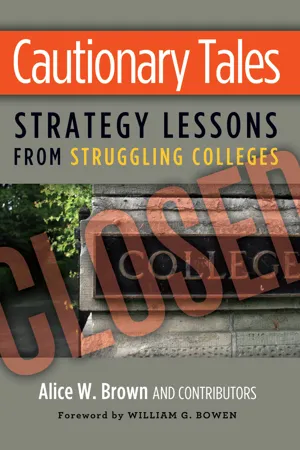
Scarcely a week goes by without a headline about the unsustainability of higher education as we know it, under threat from new models, for-profits, or online education. Most threatened are small liberal arts colleges – with commentators predicting the demise of colleges with fewer than 1,000, or even 1,500 students. Are these trends inevitable, or can they be overcome?Through a unique case study approach to examining and analyzing colleges that have struggled, Alice Brown reveals the steps that can lead to a sustainable operation and, when closure is inevitable, the steps to do so with orderliness and dignity. Rather than expounding on trends, or management theory and prescriptions, Brown focuses on narrative examples of survival and closure, recounted by real people in actual colleges, and reports the lessons they learned. Here are examples of strategies involving mergers, partnerships, or "going it alone", and their outcomes, that illustrate principles that can serve as guides for fragile colleges struggling to address their social and economic challenges.Added to Brown's six carefully researched and extended case studies, her own insights and analyses of decisions made and actions taken, this book offers guidance by seasoned scholars and administrators on issues as varied as leadership, the roles of the president, governing boards, faculty and staff, in articulating and implementing mission and strategies for survival, and on the changing landscape of higher education. The references to the literature on college survival strategies constitute an education in themselves.While this book is of immediate practical value for trustees and leaders of small colleges as they look toward and plan for the future and for anyone aspiring to an administrative positions in higher education, the examples constitute a microcosm of the interplay between the external constituencies, governance structures and internal forces that sustain or undermine institutional health, and which are hard to observe clearly in larger, more decentralized environments.
- 280 pages
- English
- ePUB (mobile friendly)
- Available on iOS & Android
eBook - ePub
About this book
Information
Table of contents
- Cover
- Half Title
- Title Page
- Copyright Page
- Dedication
- Table of Contents
- Foreword
- Preface
- Introduction
- 1. Early History
- 2. Twentieth Century
- 3. Twenty-First Century
- Part One: Turning Around
- Part Two: Going It Alone
- Part Three: Merging with Another College or University
- Part Four: Partnering with a For-Profit
- Part Five: Lessons Learned
- Conclusions
- Afterword
- Endnote
- References
- About the Contributors
- Index
Trusted by 375,005 students
Access to over 1.5 million titles for a fair monthly price.
Study more efficiently using our study tools.
Frequently asked questions
Yes, you can cancel anytime from the Subscription tab in your account settings on the Perlego website. Your subscription will stay active until the end of your current billing period. Learn how to cancel your subscription
No, books cannot be downloaded as external files, such as PDFs, for use outside of Perlego. However, you can download books within the Perlego app for offline reading on mobile or tablet. Learn how to download books offline
Perlego offers two plans: Essential and Complete
- Essential is ideal for learners and professionals who enjoy exploring a wide range of subjects. Access the Essential Library with 800,000+ trusted titles and best-sellers across business, personal growth, and the humanities. Includes unlimited reading time and Standard Read Aloud voice.
- Complete: Perfect for advanced learners and researchers needing full, unrestricted access. Unlock 1.5M+ books across hundreds of subjects, including academic and specialized titles. The Complete Plan also includes advanced features like Premium Read Aloud and Research Assistant.
We are an online textbook subscription service, where you can get access to an entire online library for less than the price of a single book per month. With over 1.5 million books across 990+ topics, we’ve got you covered! Learn about our mission
Look out for the read-aloud symbol on your next book to see if you can listen to it. The read-aloud tool reads text aloud for you, highlighting the text as it is being read. You can pause it, speed it up and slow it down. Learn more about Read Aloud
Yes! You can use the Perlego app on both iOS and Android devices to read anytime, anywhere — even offline. Perfect for commutes or when you’re on the go.
Please note we cannot support devices running on iOS 13 and Android 7 or earlier. Learn more about using the app
Please note we cannot support devices running on iOS 13 and Android 7 or earlier. Learn more about using the app
Yes, you can access Cautionary Tales by Alice W. Brown in PDF and/or ePUB format, as well as other popular books in Didattica & Istruzione superiore. We have over 1.5 million books available in our catalogue for you to explore.