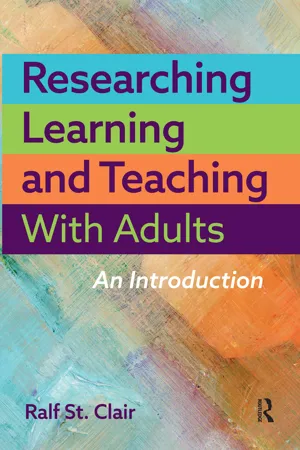
Designed to help the reader move through an empirical research project, this book describes how they can think like a researcher. Methods and methodologies are presented as pragmatic tools to address research questions. Research into adult learning is different from educational research more broadly as it recognizes and applies the power of narrative and experience. Adult learning is a localized and highly diverse endeavor, and inevitably reflects the life experiences and identity of those involved, making their stories essential. There is a fundamental link between adult learning and the lifeworld of those who are involved in that learning. Whether we are considering a community project supporting adults to tell their immigration stories in a new language, a university instructor encouraging students to think about the assumptions behind the economics curriculum, a group working to re-establish an Indigenous language in a community, or a corporate trainer delivering anti-harassment sessions, the vast majority of education for adults does not fit the taken for granted assumptions of school-centered educational research. One implication is the need for researchers in adult learning to apply the tools differently.The book is organized in four parts. A satisfying research project has coherence across the various parts (research question, methodology, methods, claim to knowledge) and the parts of the book reflect these four areas. Part 1 is about learning to think like a researcher, including ethical guidelines and how to work out the details of a research question. Part 2 discusses methods in a concrete way, to give readers a sense of what the activity of researching looks like. This book looks at a range of qualitative approaches but does not shy away from research with numbers as a way to generate knowledge. Part 3 discusses methodologies for connecting the data generated by methods to findings. Part 4 deals with communicating findings, and also looks at research proposals. A glossary helps readers encountering new terminology, and appendices include a sample research proposal and a sample consent form, as well as resources to learn more about the topic.
- 286 pages
- English
- ePUB (mobile friendly)
- Available on iOS & Android
eBook - ePub
About this book
Information
Table of contents
- Cover
- Half Title
- Section
- Title Page
- Copyright Page
- Dedication
- Table of Contents
- Introduction
- Part One: Thinking Like a Researcher
- 1 Entering Into Research
- 2 Research Objects and Research Questions
- 3 Ethics in Research, or Doing the Right Thing
- 4 Acknowledging Knowledge
- Part Two: Creating Data
- 5 Learning From Data
- 6 Doing Good Work
- 7 Interviews
- 8 Observations
- 9 Documents and Other Existing Cultural Resources
- 10 Surveys
- 11 Focus Groups
- 12 Self-Reporting Methods
- 13 Secondary Data
- Part Three: From Data to Knowledge
- 14 Descriptive Methodologies
- 15 Relational Methodologies
- 16 Causational Methodologies
- 17 Representing Research
- Glossary
- Appendix A: Example Research Proposal
- Appendix B: Example Consent Form
- Appendix C: Statistical Results
- Appendix D: To Learn More
- References
- About the Author
- Index
Trusted by 375,005 students
Access to over 1.5 million titles for a fair monthly price.
Study more efficiently using our study tools.
Frequently asked questions
Yes, you can cancel anytime from the Subscription tab in your account settings on the Perlego website. Your subscription will stay active until the end of your current billing period. Learn how to cancel your subscription
No, books cannot be downloaded as external files, such as PDFs, for use outside of Perlego. However, you can download books within the Perlego app for offline reading on mobile or tablet. Learn how to download books offline
Perlego offers two plans: Essential and Complete
- Essential is ideal for learners and professionals who enjoy exploring a wide range of subjects. Access the Essential Library with 800,000+ trusted titles and best-sellers across business, personal growth, and the humanities. Includes unlimited reading time and Standard Read Aloud voice.
- Complete: Perfect for advanced learners and researchers needing full, unrestricted access. Unlock 1.5M+ books across hundreds of subjects, including academic and specialized titles. The Complete Plan also includes advanced features like Premium Read Aloud and Research Assistant.
We are an online textbook subscription service, where you can get access to an entire online library for less than the price of a single book per month. With over 1.5 million books across 990+ topics, we’ve got you covered! Learn about our mission
Look out for the read-aloud symbol on your next book to see if you can listen to it. The read-aloud tool reads text aloud for you, highlighting the text as it is being read. You can pause it, speed it up and slow it down. Learn more about Read Aloud
Yes! You can use the Perlego app on both iOS and Android devices to read anytime, anywhere — even offline. Perfect for commutes or when you’re on the go.
Please note we cannot support devices running on iOS 13 and Android 7 or earlier. Learn more about using the app
Please note we cannot support devices running on iOS 13 and Android 7 or earlier. Learn more about using the app
Yes, you can access Researching Learning and Teaching with Adults by Ralf St. Clair in PDF and/or ePUB format, as well as other popular books in Education & Adult Education. We have over 1.5 million books available in our catalogue for you to explore.