This is the first scholarly work to deal solely with the Adam Smith problem, namely the apparent contradiction between Adam Smith's most famous works, "The Theory of Moral Sentiments" and "The Nature and Causes of the Wealth of Nations". Since the 1840s scholars have puzzled over and attempted to explain the fact that these works offer two fundamentally different and contradictory concepts of human nature. In this radical new approach Do an Gocmen argues that there are, indeed, two different concepts of human nature; in "The Theory of Moral Sentiments", Smith advocates a broad synchronization of human intention and behaviour under a beneficent providence in a system of mutual sympathy, whereas "Wealth of Nations" is a critical account of the human situation of the individual and is an egoistic description of human beings in commercial society. Gocmen argues that Smith does indeed put forward two different and varied ideas, arguing that the ethical position articulated in "The Theory of Moral Sentiments" can be, and was intended by Smith to be, applied as a basis for criticising the commercial society analysed in the "Wealth of Nations".
Gocmen argues that this ethical position points to the character of its ideal future replacement, that of Adam Smith's Utopia. Gocmen therefore dismisses as short-sighted and oversimple the common assumption that Adam Smith's Utopia consists merely of 'the invisible hand', the idea that markets would regulate everything if left to their own dynamics. This book challenges the traditional approach to Adam Smith and is the first contribution to the solution of a long-standing debate, making it essential reading for anyone wanting to understand the moral philosophy, political economy and utopian thought of Adam Smith.
eBook - PDF
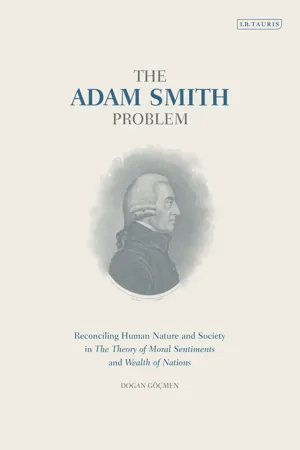
The Adam Smith Problem
Reconciling Human Nature and Society in ‘The Theory of Moral Sentiments’ and ‘Wealth of Nations’
- 199 pages
- English
- PDF
- Available on iOS & Android
eBook - PDF
The Adam Smith Problem
Reconciling Human Nature and Society in ‘The Theory of Moral Sentiments’ and ‘Wealth of Nations’
About this book
Information
Table of contents
- Contents
- Acknowledgements
- Introduction
- 1. Social Individuality in The Theory of Moral Sentiments
- 2. The Situation of the Self in The Wealth of Nations
- 3. The Critiques of Commercial Society and Smith's Utopia
- Conclusion
- Notes and References
- Bibliography
- Index
Trusted by 375,005 students
Access to over 1.5 million titles for a fair monthly price.
Study more efficiently using our study tools.
Frequently asked questions
Yes, you can cancel anytime from the Subscription tab in your account settings on the Perlego website. Your subscription will stay active until the end of your current billing period. Learn how to cancel your subscription
No, books cannot be downloaded as external files, such as PDFs, for use outside of Perlego. However, you can download books within the Perlego app for offline reading on mobile or tablet. Learn how to download books offline
Perlego offers two plans: Essential and Complete
- Essential is ideal for learners and professionals who enjoy exploring a wide range of subjects. Access the Essential Library with 800,000+ trusted titles and best-sellers across business, personal growth, and the humanities. Includes unlimited reading time and Standard Read Aloud voice.
- Complete: Perfect for advanced learners and researchers needing full, unrestricted access. Unlock 1.5M+ books across hundreds of subjects, including academic and specialized titles. The Complete Plan also includes advanced features like Premium Read Aloud and Research Assistant.
We are an online textbook subscription service, where you can get access to an entire online library for less than the price of a single book per month. With over 1.5 million books across 990+ topics, we’ve got you covered! Learn about our mission
Look out for the read-aloud symbol on your next book to see if you can listen to it. The read-aloud tool reads text aloud for you, highlighting the text as it is being read. You can pause it, speed it up and slow it down. Learn more about Read Aloud
Yes! You can use the Perlego app on both iOS and Android devices to read anytime, anywhere — even offline. Perfect for commutes or when you’re on the go.
Please note we cannot support devices running on iOS 13 and Android 7 or earlier. Learn more about using the app
Please note we cannot support devices running on iOS 13 and Android 7 or earlier. Learn more about using the app
Yes, you can access The Adam Smith Problem by Dogan Göçmen in PDF and/or ePUB format, as well as other popular books in Philosophy & Economic Theory. We have over 1.5 million books available in our catalogue for you to explore.