Have you ever questioned our economic model? Wondered how the financial crash was able to happen? Thought about what we can do stop it happening again?
Modern economics bases its view of the world on assumptions Adam Smith made about nature and people nearly three hundred years ago, in a time when people travelled by horse and carriage and wrote by the light of candles. We now live in a globally connected, post-industrial world of digital communication and advanced technology – and yet, our economic model remains stuck in the past.
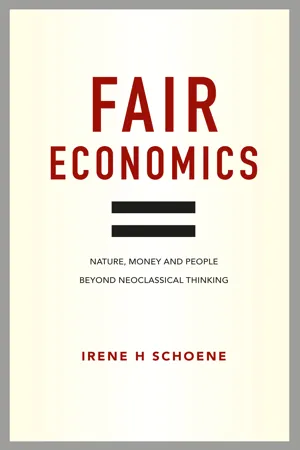
Taking a thorough look at economics, including the history and how we reached our current way of thinking, Irene Schoene puts forward an alternative economics that is not only relevant to our modern world of technology and industry, but which also shows an awareness of environmental considerations.
Read this to be enlightened about how economics can be considerate of our environmental situation.
- 480 pages
- English
- PDF
- Available on iOS & Android
eBook - PDF
About this book
Information
Table of contents
- Front cover
- Title page
- Copyright page
- Contents
- 1. Prologue
- 2. Introduction
- 3. “Adam Smith could save the world," they claim.
- 3.1. Some data about Adam Smith
- 3.2. Adam Smith as author of classical economics
- 3.3. Political economics versus value-free and neutral economic theory
- 4. From Aristotle to Adam Smith
- 4.1. Economics or chrematistics
- 4.2. Natural order or cultural invention
- 4.2.1. Nature is a machine created by a supernatural being
- 4.3. Self-interest rules
- 4.4. Man's nature as social animal
- 4.5. Male is the norm
- 4.6. The two functions of goods
- 4.6.1. Slaves as goods
- 4.7. Agriculture is the heart of the economy
- 4.8. The two functions of money
- 5. Adam Smith's extraordinary new ideas
- 5.1. Exchange is the basic principle
- 5.2. The history of money
- 5.3. The relativity of prices in time or the continually changing buying power of money
- 5.4. Production is only one side of the economy
- 5.5. Land and labour produce the real wealth of a nation
- 5.5.1. Land
- 5.5.2. Labour
- 5.6. The state or the people's elected government
- 5.6.1. Business interests and their influence on politics
- 5.6.2. Liberate markets, free enterprise
- 5.6.3. The necessity of regulating banks
- 5.6.4. The necessity of paying taxes
- 5.6.5. Governing the American colonies
- 5.7. The impartial spectator
- 5.8. What to take into the 21st century
- 6. A few spotlights on today's crises
- 6.1. Economics is in crisis. But why aren't political scientists and sociologists offering an alternative view?
- 6.2. Pitiless Samaritans
- 6.3. Banking wasn't meant to be like this
- 6.4. Battle is joined on bonuses – and high time too
- 6.5. High-frequency trading drives cable contest
- 6.6. Where Did the Good Jobs Go?
- 6.7. High street shops offer fresh produce and personal service
- 6.8. Our digital masters must themselves be watched
- 6.9. UK's £1.5 bn for climate change aid
- 6.10. We can't afford cut in pollution – Spelman
- 6.11. Market forces are the spanners in Whitehall's works
- 6.12. A better way to hit the rich
- 6.13. Alcohol: should we put the price up?
- 6.14. Who is making the money as private firms move in on the public sector?
- 6.15. Sheila Dillon interviewed Fuchsia Dunlop from Shanghai
- 6.16. A tax on your conservatory will be just the beginning
- 6.17. Outsource to easyCouncil? Not in our name
- 6.18. Tackling the energy 'trilemma'
- 6.19. How to escape the zombies
- 6.20. Starbucks: time for a consumer boycott
- 6.21. America's dirtiest war
- 6.22. Expensive helplines
- 6.23. The Republicans need a dose of Lincoln's human factor
- 6.24. Market and Family
- 6.25. Hello, 999, this prostitute is so ugly it's criminal
- 6.26. Selling off our utilities to foreign governments
- 6.27. Orthodox economists have failed their own market test
- 6.28. The left is too silent on the clunking fist of state power
- 6.29. Editorial
- 6.30. Why we fear Google
- 6.31. HSBC files
- 7. On course for a modern culteconomic theory
- 7.1. The modern understanding of 'land' and 'labour' = nature and people and the interaction between them
- 7.2. Widening the perspective – from object to process
- 7.3. The process of direct natural recoprocal interaction
- 7.3.1. The process of reciprocal interaction in the private household
- 7.3.2. The process of reciprocal interaction in the public household
- 7.4.The process of reciprocal interaction mediated by money and market
- 8. Reciprocal interaction and what money has to do with it
- 8.1. Reciprocal interaction and religious ritual
- 8.2. Replacing reciprocal interaction with a symbol
- 8.3. Reciprocal interaction alive
- 9. Reciprocal interaction in the three economic sectors
- 9.1. The primary sector: Agricultural goods
- 9.2. The secondary sector: Industrial commodities
- 9.3. The tertiary sector: Intangible services
- 9.4. The shift in relative shares
- 9.4.1. The shift in employment
- 9.4.2. The shift in the Gross Domestic Product
- 9.4.3. The shift in the use of natural resources
- 9.5. Quantitative and qualitative explanations
- 9.5.1. Quantitative explanations
- 9.5.2. Qualitative explanations
- 9.5.3. Banking – a typical service
- 9.5.3.1. The importance of financial services
- 9.5.3.2. Reasons for the banking crisis
- 9.5.3.3. From banking crisis to government crisis
- 9.5.3.4. Shadow banking
- 10. Understanding the environmental crisis and the quest for ecology
- 10.1. What is the 'environmental' crisis?
- 10.2. The environmental crisis as seen by environmental economists
- 10.3. ... as seen by dual economists
- 10.4. ... as seen by ecological economists
- 10.5. Conclusion
- 11. Short-term improvements
- 11.1. Nature has self-value
- 11.1.1. The BASE
- 11.1.1.1. Air
- 11.1.1.2. Water
- 11.1.1.3. External energy
- 11.1.1.4. Food – the internal energy
- 11.2. Humans have self-value
- 11.2.1. People and their work are one
- 11.2.2. People are active, self-involving and participating
- 11.2.3. People and their data are one
- 11.3. Qualifying and extending Data
- 11.3.1. Respecting the differentiations between products typical for the three economic sectors
- 11.3.2. Implementing differentiations in the Gross Domestic Product (GDP)
- 11.3.3. Make Integrated Balancing the law
- 11.4. On the MEANS of human activity
- 11.4.1. A transparent concept for public service payment
- 12. The long view
- 12.1. The written Constitution for a democracy
- 12.2. The modern understanding of nature
- 12.3. The modern understanding of a person
- Bibliography
- Index
Trusted by 375,005 students
Access to over 1.5 million titles for a fair monthly price.
Study more efficiently using our study tools.
Frequently asked questions
Yes, you can cancel anytime from the Subscription tab in your account settings on the Perlego website. Your subscription will stay active until the end of your current billing period. Learn how to cancel your subscription
No, books cannot be downloaded as external files, such as PDFs, for use outside of Perlego. However, you can download books within the Perlego app for offline reading on mobile or tablet. Learn how to download books offline
Perlego offers two plans: Essential and Complete
- Essential is ideal for learners and professionals who enjoy exploring a wide range of subjects. Access the Essential Library with 800,000+ trusted titles and best-sellers across business, personal growth, and the humanities. Includes unlimited reading time and Standard Read Aloud voice.
- Complete: Perfect for advanced learners and researchers needing full, unrestricted access. Unlock 1.5M+ books across hundreds of subjects, including academic and specialized titles. The Complete Plan also includes advanced features like Premium Read Aloud and Research Assistant.
We are an online textbook subscription service, where you can get access to an entire online library for less than the price of a single book per month. With over 1.5 million books across 990+ topics, we’ve got you covered! Learn about our mission
Look out for the read-aloud symbol on your next book to see if you can listen to it. The read-aloud tool reads text aloud for you, highlighting the text as it is being read. You can pause it, speed it up and slow it down. Learn more about Read Aloud
Yes! You can use the Perlego app on both iOS and Android devices to read anytime, anywhere — even offline. Perfect for commutes or when you’re on the go.
Please note we cannot support devices running on iOS 13 and Android 7 or earlier. Learn more about using the app
Please note we cannot support devices running on iOS 13 and Android 7 or earlier. Learn more about using the app
Yes, you can access Fair Economics by Irene Schoene in PDF and/or ePUB format, as well as other popular books in Economics & Business General. We have over 1.5 million books available in our catalogue for you to explore.