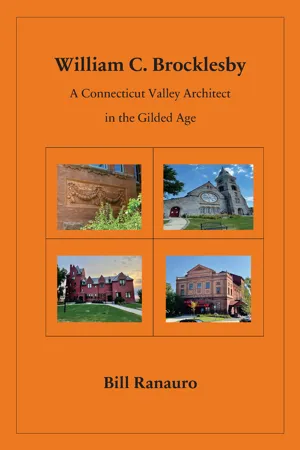
The late nineteenth century, known commonly as the "Gilded Age," produced some of the most beautiful yet controversial architecture in America's history. The great influencers of the period, including Richard Upjohn, Henry Hobson Richardson, and Charles McKim, each spread the gospel of his own architectural style. The result was an eclectic mix of styles that some detested but that others embraced. Caught in the struggle to find an architecture America could claim as its own, Hartford, Connecticut architect William Brocklesby carved out his own stylistic path. In an age when the taste for ostentation and pretension was adopted by many, William Brocklesby produced some of the most dignified and beautiful architecture in the Connecticut Valley. His churches, libraries, and theaters remain as artistic landmarks throughout western New England, and his work at colleges from Hartford to Amherst, Massachusetts make for some of the most picturesque college campuses in America. This book serves as a companion to the author's earlier book, Asher Benjamin, American Architect, Author, Artist. Taken together, the two books provide a view of developments in American architecture from 1790 to 1910.
The Architecture of William C. Brocklesby
Hailing from Hartford, Connecticut, architect William C. Brocklesby (1847-1910) spent his career designing beautiful yet dignified churches, libraries, and public buildings throughout the Connecticut River Valley and western New England. Working in an age when ostentation was the rule rather than the exception, Brocklesby maintained a restrained hand in the application of ornament. His design ofForbes Library in Northampton, Massachusetts stands out as a monument to his ability as a design architect.
In addition, William Brocklesby was among a handful of nineteenth century architects who made the Connecticut River Valley the birthplace of the prototypical American college campus. Working largely within the vision of the famed American landscape architects Andrew Jackson Downing and Frederick Law Olmstead, Brocklesby and others built campuses that were meant to mimic the traditional New England village.
“Through the designs of the college buildings by Peabody and Stearns and William Brocklesby, Smith College's architectural history traces the development of late nineteenth-century styles.”
- National Register of Historic Places Inventory