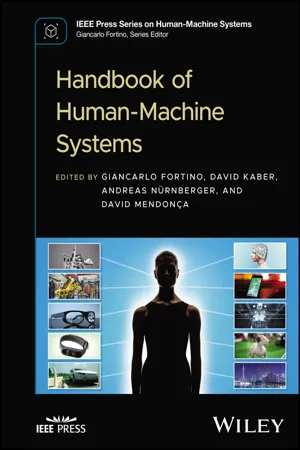
Handbook of Human-Machine Systems
eBook - ePub

Handbook of Human-Machine Systems

  1. English
  2. ePUB (mobile friendly)
  3. Available on iOS & Android
eBook - ePub

About this book

Handbook of Human-Machine Systems

Insightful and cutting-edge discussions of recent developments in human-machine systems

In Handbook of Human-Machine Systems, a team of distinguished researchers delivers a comprehensive exploration of human-machine systems (HMS) research and development from a variety of illuminating perspectives. The book offers a big picture look at state-of-the-art research and technology in the area of HMS. Contributing authors cover Brain-Machine Interfaces and Systems, including assistive technologies like devices used to improve locomotion. They also discuss advances in the scientific and engineering foundations of Collaborative Intelligent Systems and Applications.

Companion technology, which combines trans-disciplinary research in fields like computer science, AI, and cognitive science, is explored alongside the applications of human cognition in intelligent and artificially intelligent system designs, human factors engineering, and various aspects of interactive and wearable computers and systems. The book also includes:

  • A thorough introduction to human-machine systems via the use of emblematic use cases, as well as discussions of potential future research challenges
  • Comprehensive explorations of hybrid technologies, which focus on transversal aspects of human-machine systems
  • Practical discussions of human-machine cooperation principles and methods for the design and evaluation of a brain-computer interface

Perfect for academic and technical researchers with an interest in HMS, Handbook of Human-Machine Systems will also earn a place in the libraries of technical professionals practicing in areas including computer science, artificial intelligence, cognitive science, engineering, psychology, and neurobiology.

Frequently asked questions

Yes, you can cancel anytime from the Subscription tab in your account settings on the Perlego website. Your subscription will stay active until the end of your current billing period. Learn how to cancel your subscription.
No, books cannot be downloaded as external files, such as PDFs, for use outside of Perlego. However, you can download books within the Perlego app for offline reading on mobile or tablet. Learn more here.
Perlego offers two plans: Essential and Complete
  • Essential is ideal for learners and professionals who enjoy exploring a wide range of subjects. Access the Essential Library with 800,000+ trusted titles and best-sellers across business, personal growth, and the humanities. Includes unlimited reading time and Standard Read Aloud voice.
  • Complete: Perfect for advanced learners and researchers needing full, unrestricted access. Unlock 1.4M+ books across hundreds of subjects, including academic and specialized titles. The Complete Plan also includes advanced features like Premium Read Aloud and Research Assistant.
Both plans are available with monthly, semester, or annual billing cycles.
We are an online textbook subscription service, where you can get access to an entire online library for less than the price of a single book per month. With over 1 million books across 1000+ topics, we’ve got you covered! Learn more here.
Look out for the read-aloud symbol on your next book to see if you can listen to it. The read-aloud tool reads text aloud for you, highlighting the text as it is being read. You can pause it, speed it up and slow it down. Learn more here.
Yes! You can use the Perlego app on both iOS or Android devices to read anytime, anywhere — even offline. Perfect for commutes or when you’re on the go.
Please note we cannot support devices running on iOS 13 and Android 7 or earlier. Learn more about using the app.
Yes, you can access Handbook of Human-Machine Systems by Giancarlo Fortino,David Kaber,Andreas Nürnberger,David Mendonça in PDF and/or ePUB format, as well as other popular books in Computer Science & Artificial Intelligence (AI) & Semantics. We have over one million books available in our catalogue for you to explore.

Table of contents

  1. Cover
  2. Table of Contents
  3. Title Page
  4. Copyright
  5. Editors Biography
  6. List of Contributors
  7. Preface
  8. 1 Introduction
  9. 2 Brain–Computer Interfaces: Recent Advances, Challenges, and Future Directions
  10. 3 Brain–Computer Interfaces for Affective Neurofeedback Applications
  11. 4 Pediatric Brain–Computer Interfaces: An Unmet Need
  12. 5 Brain–Computer Interface-based Predator–Prey Drone Interactions
  13. 6 Levels of Cooperation in Human–Machine Systems: A Human–BCI–Robot Example
  14. 7 Human–Machine Social Systems: Test and Validation via Military Use Cases
  15. 8 The Role of Multimodal Data for Modeling Communication in Artificial Social Agents
  16. 9 Modeling Interactions Happening in People-Driven Collaborative Processes
  17. 10 Transparent Communications for Human–Machine Teaming
  18. 11 Conversational Human–Machine Interfaces
  19. 12 Interaction-Centered Design: An Enduring Strategy and Methodology for Sociotechnical Systems
  20. 13 Human–Machine Computing: Paradigm, Challenges, and Practices
  21. 14 Companion Technology
  22. 15 A Survey on Rollator-Type Mobility Assistance Robots
  23. 16 A Wearable Affective Robot
  24. 17 Visual Human–Computer Interactions for Intelligent Vehicles
  25. 18 Intelligent Collaboration Between Humans and Robots
  26. 19 To Be Trustworthy and To Trust: The New Frontier of Intelligent Systems
  27. 20 Decoding Humans' and Virtual Agents' Emotional Expressions
  28. 21 Intelligent Computational Edge: From Pervasive Computing and Internet of Things to Computing Continuum
  29. 22 Implementing Context Awareness in Autonomous Vehicles
  30. 23 The Augmented Workforce: A Systematic Review of Operator Assistance Systems
  31. 24 Cognitive Performance Modeling
  32. 25 Advanced Driver Assistance Systems: Transparency and Driver Performance Effects
  33. 26 RGB-D Based Human Action Recognition: From Handcrafted to Deep Learning
  34. 27 Hybrid Intelligence: Augmenting Employees' Decision-Making with AI-Based Applications
  35. 28 Human Factors in Driving
  36. 29 Wearable Computing Systems: State-of-the-Art and Research Challenges
  37. 30 Multisensor Wearable Device for Monitoring Vital Signs and Physical Activity
  38. 31 Integration of Machine Learning with Wearable Technologies
  39. 32 Gesture-Based Computing
  40. 33 EEG-based Affective Computing
  41. 34 Security of Human Machine Systems
  42. 35 Integrating Innovation: The Role of Standards in Promoting Responsible Development of Human–Machine Systems
  43. 36 Situation Awareness in Human-Machine Systems
  44. 37 Modeling, Analyzing, and Fostering the Adoption of New Technologies: The Case of Electric Vehicles
  45. Index
  46. End User License Agreement