The disparagement of multilingualism is a European development of the 18th and 19th centuries in which one national language and national literature were advocated, established and institutionalised. Multilingual writers made use of the creative potential of several languages even then. However, they often adapted to an increasingly monolingual book market, which made their individual multilingualism invisible.
This is evident in literary historiography which established a monolingual national canon.
Researching hidden multilingualism is often difficult: since multilingual texts by multilingual writers were often not published or were published in a monolingual version, sources are scarce. Literary histories of the time often do not mention multilingualism. Furthermore, many multilingual writers were members of minority groups (women, Jewish, Non-European) and thus often neglected.
The volume offers methods and theories to systematically approach this hidden material, as well as case studies on authors and national literatures in a multilingual context. It thus contributes to the restructuring of a multilingual transnational literary history that is applicable to different philologies.
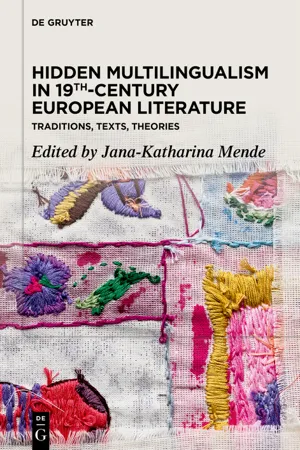
eBook - ePub
Hidden Multilingualism in 19th-Century European Literature
Traditions, Texts, Theories
- 334 pages
- English
- ePUB (mobile friendly)
- Available on iOS & Android
eBook - ePub
Hidden Multilingualism in 19th-Century European Literature
Traditions, Texts, Theories
About this book
Information
Table of contents
- Title Page
- Copyright
- Contents
- Open-Access-Transformation in Linguistics
- Introduction: Hidden and Invisible Multilingualism in 19th-Century European Literature: Theory and Practices
- Part 1: Multilingual Histories of National Literatures
- Part 2: National Authors as Covert Multilinguals
- Part 3: Hidden Multilingualism: Typologies and Theoretical Approaches
- Index
Trusted by 375,005 students
Access to over 1.5 million titles for a fair monthly price.
Study more efficiently using our study tools.
Frequently asked questions
Yes, you can cancel anytime from the Subscription tab in your account settings on the Perlego website. Your subscription will stay active until the end of your current billing period. Learn how to cancel your subscription
No, books cannot be downloaded as external files, such as PDFs, for use outside of Perlego. However, you can download books within the Perlego app for offline reading on mobile or tablet. Learn how to download books offline
We are an online textbook subscription service, where you can get access to an entire online library for less than the price of a single book per month. With over 1.5 million books across 990+ topics, we’ve got you covered! Learn about our mission
Look out for the read-aloud symbol on your next book to see if you can listen to it. The read-aloud tool reads text aloud for you, highlighting the text as it is being read. You can pause it, speed it up and slow it down. Learn more about Read Aloud
Yes! You can use the Perlego app on both iOS and Android devices to read anytime, anywhere — even offline. Perfect for commutes or when you’re on the go.
Please note we cannot support devices running on iOS 13 and Android 7 or earlier. Learn more about using the app
Please note we cannot support devices running on iOS 13 and Android 7 or earlier. Learn more about using the app
Yes, you can access Hidden Multilingualism in 19th-Century European Literature by Jana-Katharina Mende in PDF and/or ePUB format, as well as other popular books in Languages & Linguistics & Historical & Comparative Linguistics. We have over 1.5 million books available in our catalogue for you to explore.