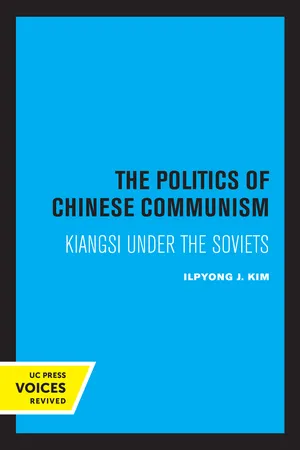
The political system established by the Chinese Communist Party in 1949 had its origins, in many respects, in the Chinese Soviet Republic of 1931–1934, based in southern Kiangsi province about 400 miles southwest of Shanghai. The Kiangsi period was important because it gave the Chinese Communists their first opportunity to govern an extensive area and a large population, and in so doing to develop methods of mass mobilization as well as new techniques for conducting party and government affairs. Kim explores the evolution of the Chinese Communist movement during the Kiangsi soviet period, especially its organizational concepts, behavioral patterns, and development techniques of "mass line" politics. He seeks answers to several questions: What notions of organization shaped the Kiangsi political system? Who formulated the policies? How were they implemented at the rice-roots level of government? By analyzing Mao Tse-tung's writings on organization and comparing them with those of other Chinese Communist theoreticians, he achieves fresh insights into Mao's approach to administration and bureaucratic organization. The distinct contribution of this book lies in its focus on such issues as how the Chinese Communist leaders viewed organizational problems within their movement, especially following the failure of the 1947 revolution; how they responded to these problems; and how they maintained a balance of power among the party, the government, and the Red Army while administering the expanding territorial base and managing complex organizations. This title is part of UC Press's Voices Revived program, which commemorates University of California Press's mission to seek out and cultivate the brightest minds and give them voice, reach, and impact. Drawing on a backlist dating to 1893, Voices Revived makes high-quality, peer-reviewed scholarship accessible once again using print-on-demand technology. This title was originally published in 1973.
Many titles in the Voices Revived program are also newly available as ebooks, offered at a discounted price to support wider access to scholarly work.
- 244 pages
- English
- ePUB (mobile friendly)
- Available on iOS & Android
eBook - ePub
About this book
Information
Publisher
University of California PressYear
1973Print ISBN
9780520304727
Edition
1eBook ISBN
9780520309869
Table of contents
- Cover
- Title
- Copyright
- CONTENTS 1
- ACKNOWLEDGMENT
- INTRODUCTION
- I TOWARD MAO’S THEORIES OF ADMINISTRATION AND ORGANIZATION
- II STRUCTURE AND FUNCTION OF THE SOVIET GOVERNMENT IN KIANGSI
- III LEADERSHIP STRUCTURE AND ADMINISTRATIVE CONTROL
- IV POLICY-MAKING AND LEADERSHIP BEHAVIOR
- V MASS MOBILIZATION POLICIES AND ORGANIZATIONAL TECHNIQUES*
- VI LOCAL GOVERNMENT AND ADMINISTRATIVE PROCESSES
- VII NEW CONCEPTS OF LEADERSHIP AND CADRE EDUCATION67
- CONCLUSION
- GLOSSARY OF CHINESE TERMS AND NAMES
- BIBLIOGRAPHY
- INDEX
Trusted by 375,005 students
Access to over 1.5 million titles for a fair monthly price.
Study more efficiently using our study tools.
Frequently asked questions
Yes, you can cancel anytime from the Subscription tab in your account settings on the Perlego website. Your subscription will stay active until the end of your current billing period. Learn how to cancel your subscription
No, books cannot be downloaded as external files, such as PDFs, for use outside of Perlego. However, you can download books within the Perlego app for offline reading on mobile or tablet. Learn how to download books offline
Perlego offers two plans: Essential and Complete
- Essential is ideal for learners and professionals who enjoy exploring a wide range of subjects. Access the Essential Library with 800,000+ trusted titles and best-sellers across business, personal growth, and the humanities. Includes unlimited reading time and Standard Read Aloud voice.
- Complete: Perfect for advanced learners and researchers needing full, unrestricted access. Unlock 1.5M+ books across hundreds of subjects, including academic and specialized titles. The Complete Plan also includes advanced features like Premium Read Aloud and Research Assistant.
We are an online textbook subscription service, where you can get access to an entire online library for less than the price of a single book per month. With over 1.5 million books across 990+ topics, we’ve got you covered! Learn about our mission
Look out for the read-aloud symbol on your next book to see if you can listen to it. The read-aloud tool reads text aloud for you, highlighting the text as it is being read. You can pause it, speed it up and slow it down. Learn more about Read Aloud
Yes! You can use the Perlego app on both iOS and Android devices to read anytime, anywhere — even offline. Perfect for commutes or when you’re on the go.
Please note we cannot support devices running on iOS 13 and Android 7 or earlier. Learn more about using the app
Please note we cannot support devices running on iOS 13 and Android 7 or earlier. Learn more about using the app
Yes, you can access The Politics of Chinese Communism by Ilpyong J. Kim in PDF and/or ePUB format, as well as other popular books in Politics & International Relations & Communism, Post-Communism & Socialism. We have over 1.5 million books available in our catalogue for you to explore.