Caste and Kinship in Central India: A Village and Its Region offers an in-depth exploration of the intricate social dynamics within a multi-caste village and its surrounding region. The book delves into the pivotal role of caste as the foundational axis of political, economic, and kinship structures in Indian village life. It meticulously unpacks the layered relationships between caste, subcaste, and kinship, emphasizing the local and regional frameworks within which these social units operate. The analysis reveals three levels of caste membership—the kindred of cooperation, kindred of recognition, and broader subcaste—all of which influence individuals' social roles and interactions. Through this nuanced lens, the study sheds light on the mechanisms of social control, marriage alliances, and group interactions, providing a comprehensive account of how caste functions both within and beyond the village boundaries. This scholarly work also addresses the broader implications of caste in regional and inter-village contexts, challenging the conventional notion of the village as a self-contained entity. By distinguishing between intra-caste (subcaste-based) and inter-caste dynamics, the book highlights how individuals navigate their dual identities as members of both caste and subcaste, influenced by patrilineal and exogamous practices. The study's innovative approach bridges local and regional analyses, offering a fresh perspective on caste systems as both static and adaptive entities within India's socio-cultural landscape. This book is an essential resource for scholars of anthropology, sociology, and South Asian studies seeking a deeper understanding of caste's multifaceted role in shaping community life. This title is part of UC Press's Voices Revived program, which commemorates University of California Press's mission to seek out and cultivate the brightest minds and give them voice, reach, and impact. Drawing on a backlist dating to 1893, Voices Revived makes high-quality, peer-reviewed scholarship accessible once again using print-on-demand technology. This title was originally published in 1960.
Many titles in the Voices Revived program are also newly available as ebooks, offered at a discounted price to support wider access to scholarly work.
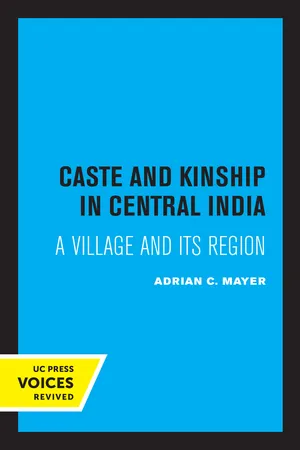
- 311 pages
- English
- ePUB (mobile friendly)
- Available on iOS & Android
eBook - ePub
About this book
Information
Table of contents
- Cover
- Title
- Copyright
- CONTENTS 1
- PREFACE
- NOTE ON TRANSLITERATION
- PART I The Background
- I INTRODUCTION
- II THE BACKGROUND
- III CASTE MEMBERSHIP
- PART II Inter-caste Relations
- IV CASTE AND RITUAL STATUS
- V ECONOMIC ASPECTS OF CASTE
- VI CASTE AND VILLAGE LEADERSHIP
- VII THE VILLAGE AS A UNIT
- PART III The Constitution of the Caste
- VIII INTERNAL STRUCTURE OF THE CASTE
- IX THE PLACE OF THE UNILINEAL DESCENT GROUP
- x THE PATTERN OF MARRIAGE
- XI INTERPERSONAL RELATIONS BETWEEN KIN
- XII SOCIAL CONTROL IN THE SUBCASTE
- XIII CONCLUSION
- REFERENCES
- GLOSSARY
- INDEX
Trusted by 375,005 students
Access to over 1.5 million titles for a fair monthly price.
Study more efficiently using our study tools.
Frequently asked questions
Yes, you can cancel anytime from the Subscription tab in your account settings on the Perlego website. Your subscription will stay active until the end of your current billing period. Learn how to cancel your subscription
No, books cannot be downloaded as external files, such as PDFs, for use outside of Perlego. However, you can download books within the Perlego app for offline reading on mobile or tablet. Learn how to download books offline
Perlego offers two plans: Essential and Complete
- Essential is ideal for learners and professionals who enjoy exploring a wide range of subjects. Access the Essential Library with 800,000+ trusted titles and best-sellers across business, personal growth, and the humanities. Includes unlimited reading time and Standard Read Aloud voice.
- Complete: Perfect for advanced learners and researchers needing full, unrestricted access. Unlock 1.5M+ books across hundreds of subjects, including academic and specialized titles. The Complete Plan also includes advanced features like Premium Read Aloud and Research Assistant.
We are an online textbook subscription service, where you can get access to an entire online library for less than the price of a single book per month. With over 1.5 million books across 990+ topics, we’ve got you covered! Learn about our mission
Look out for the read-aloud symbol on your next book to see if you can listen to it. The read-aloud tool reads text aloud for you, highlighting the text as it is being read. You can pause it, speed it up and slow it down. Learn more about Read Aloud
Yes! You can use the Perlego app on both iOS and Android devices to read anytime, anywhere — even offline. Perfect for commutes or when you’re on the go.
Please note we cannot support devices running on iOS 13 and Android 7 or earlier. Learn more about using the app
Please note we cannot support devices running on iOS 13 and Android 7 or earlier. Learn more about using the app
Yes, you can access Caste and Kinship in Central India by Adrian Mayer in PDF and/or ePUB format, as well as other popular books in Scienze sociali & Antropologia culturale e sociale. We have over 1.5 million books available in our catalogue for you to explore.