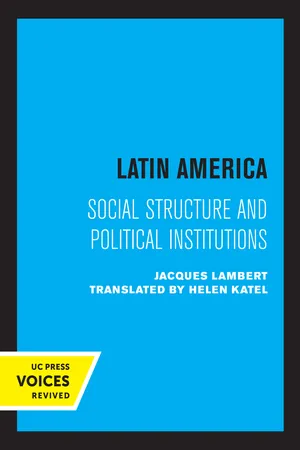
Latin America: Social Structure and Political Institutions examines the region's historical, social, and political evolution from the colonial era to the modern day. The book traces Latin America's unique trajectory, marked by its early colonial development, the delayed progress of its nation-states post-independence, and the complex interplay between social hierarchies and political structures. The colonial legacy of Iberian rule, characterized by rigid social stratification, concentrated land ownership, and economic dependency, laid a foundation that hindered post-independence progress. Even as independence movements in the 19th century fragmented the region into sovereign states, they failed to dismantle the entrenched colonial social fabric, delaying economic diversification and democratic governance. The book further explores Latin America's tumultuous political history, highlighting cycles of dictatorship, revolution, and reform. The region's regimes, often modeled after U.S.-style presidential systems, evolved uniquely to address local challenges, balancing the need for centralized authority with efforts to uphold democratic principles. Economic potential, fueled by vast natural resources and growing populations, underscores the region's importance on the global stage. Despite setbacks, including political instability and social inequality, the text emphasizes Latin America's persistent quest for balanced development. It argues that the region's ongoing political experiments, blending elements of democratic and authoritarian governance, could offer valuable insights into the challenges of modern nation-building. This title is part of UC Press's Voices Revived program, which commemorates University of California Press's mission to seek out and cultivate the brightest minds and give them voice, reach, and impact. Drawing on a backlist dating to 1893, Voices Revived makes high-quality, peer-reviewed scholarship accessible once again using print-on-demand technology. This title was originally published in 1967.
Many titles in the Voices Revived program are also newly available as ebooks, offered at a discounted price to support wider access to scholarly work.
eBook - ePub
Latin America
Writings on Architecture, Landscape, and the Environment, 1876-1925
- 426 pages
- English
- ePUB (mobile friendly)
- Available on iOS & Android
eBook - ePub
About this book
Information
Table of contents
- Cover
- Title
- Copyright
- Contents 1
- Introduction
- PART I General Features of Latin American Social Structure
- 1. Classification of Latin American Countries
- 2. Political Effects of Independence
- 3. The Latifundio: The Large Estate in Latin America
- 4. Responsibility of the Latifundios for Lags in Social Development
- 5. Survival of Motivations Peculiar to an Aristocratic Colonial Society
- PART II Contradictions in Political Life
- 6. Contradictions Between Advanced Political Ideologies and Backward Social Structures
- 7. Contradictions in Political Life Within Dual Societies
- PART III Political Forces and Political Parties
- 8. Caciquismo and Caudillismo
- 9. Survival of Prenational Political Forces and the Traditional Political Parties
- 10. Rise of Modern Political Forces in the Cities: The Labor Movement
- 11. The New Political Parties, Populism, and Christian Democracy
- 12. Middle-Class Pressures, Student Agitation, and Military Interventions
- PART IV Political Institutions
- 13. The Evolution Toward Centralization and Presidential Dominance
- 14. Declarations of Rights and Court Protection
- 15. Form of the State: Centralization, Federalism, and Local Administration
- 16. Form of the Government: Presidential Dominance
- 17. Subservience of Congress under Regimes of Presidential Dominance
- 18. Social Causes of Presidential Dominance: The Crisis of Democracy
- Bibliography
- Index
Trusted by 375,005 students
Access to over 1.5 million titles for a fair monthly price.
Study more efficiently using our study tools.
Frequently asked questions
Yes, you can cancel anytime from the Subscription tab in your account settings on the Perlego website. Your subscription will stay active until the end of your current billing period. Learn how to cancel your subscription
No, books cannot be downloaded as external files, such as PDFs, for use outside of Perlego. However, you can download books within the Perlego app for offline reading on mobile or tablet. Learn how to download books offline
Perlego offers two plans: Essential and Complete
- Essential is ideal for learners and professionals who enjoy exploring a wide range of subjects. Access the Essential Library with 800,000+ trusted titles and best-sellers across business, personal growth, and the humanities. Includes unlimited reading time and Standard Read Aloud voice.
- Complete: Perfect for advanced learners and researchers needing full, unrestricted access. Unlock 1.5M+ books across hundreds of subjects, including academic and specialized titles. The Complete Plan also includes advanced features like Premium Read Aloud and Research Assistant.
We are an online textbook subscription service, where you can get access to an entire online library for less than the price of a single book per month. With over 1.5 million books across 990+ topics, we’ve got you covered! Learn about our mission
Look out for the read-aloud symbol on your next book to see if you can listen to it. The read-aloud tool reads text aloud for you, highlighting the text as it is being read. You can pause it, speed it up and slow it down. Learn more about Read Aloud
Yes! You can use the Perlego app on both iOS and Android devices to read anytime, anywhere — even offline. Perfect for commutes or when you’re on the go.
Please note we cannot support devices running on iOS 13 and Android 7 or earlier. Learn more about using the app
Please note we cannot support devices running on iOS 13 and Android 7 or earlier. Learn more about using the app
Yes, you can access Latin America by Jacques Lambert in PDF and/or ePUB format, as well as other popular books in Architecture & Urban Planning & Landscaping. We have over 1.5 million books available in our catalogue for you to explore.