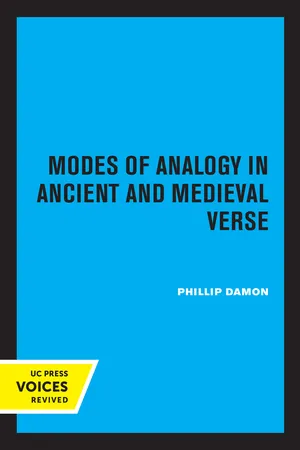
Modes of Analogy in Ancient and Medieval Verse delves into the evolution of poetic conventions, focusing on how established tropes in ancient and medieval literature were reimagined to meet shifting intellectual and rhetorical demands. Drawing on R. P. Blackmur's idea of "translation" in literary history, the book examines the transformation of three key devices: the Homeric long simile, the personified landscapes of Roman pastoral, and the nature parallelism in medieval love lyrics. By exploring classic examples of these tropes and contrasting them with later iterations, the author illuminates how changes in cultural and conceptual frameworks reshaped the analogical functions of natural imagery in poetry. Rather than providing a broad historical survey, the book adopts a focused approach, analyzing a select number of pivotal texts to uncover the nuanced stylistic shifts within these conventions. Inspired by Erich Auerbach's method in Mimesis, the author treats these texts as "test cases" to trace the dynamic interplay between tradition and innovation in poetic expression. Through its critical exploration of these transformations, Modes of Analogy in Ancient and Medieval Verse offers a compelling study of how poets navigated the tension between inherited forms and evolving imaginative needs, enriching our understanding of literary continuity and change. This title is part of UC Press's Voices Revived program, which commemorates University of California Press's mission to seek out and cultivate the brightest minds and give them voice, reach, and impact. Drawing on a backlist dating to 1893, Voices Revived makes high-quality, peer-reviewed scholarship accessible once again using print-on-demand technology. This title was originally published in 1961.
Many titles in the Voices Revived program are also newly available as ebooks, offered at a discounted price to support wider access to scholarly work.
- 82 pages
- English
- ePUB (mobile friendly)
- Available on iOS & Android
eBook - ePub
Modes of Analogy in Ancient and Medieval Verse
About this book
Information
Table of contents
- Cover
- Title
- Copyright
- CONTENTS 1
- CHAPTER I HOMER’S SIMILES AND THE USES OF IRRELEVANCE
- CHAPTER II SAPPHO’S SIMILES AND THE USES OF HOMER
- CHAPTER III THE IMAGO VOCIS IN VERGILIAN PASTORAL
- CHAPTER IV ECHOES AND OTHER NOISES IN THE LATER PASTORAL
- CHAPTER V THE TROUBADOUR NATURE INTRODUCTION AND SOME OTHER DESCRIPTIVE TRADITIONS
- CHAPTER VI DANTE AND THE VERACE INTENDIMENTO OF THE NATURE INTRODUCTION
- APPENDIX
- APPENDIX DANTE’S CANZONI AND THE “ALLEGORY OF POETS”
Trusted by 375,005 students
Access to over 1.5 million titles for a fair monthly price.
Study more efficiently using our study tools.
Frequently asked questions
Yes, you can cancel anytime from the Subscription tab in your account settings on the Perlego website. Your subscription will stay active until the end of your current billing period. Learn how to cancel your subscription
No, books cannot be downloaded as external files, such as PDFs, for use outside of Perlego. However, you can download books within the Perlego app for offline reading on mobile or tablet. Learn how to download books offline
Perlego offers two plans: Essential and Complete
- Essential is ideal for learners and professionals who enjoy exploring a wide range of subjects. Access the Essential Library with 800,000+ trusted titles and best-sellers across business, personal growth, and the humanities. Includes unlimited reading time and Standard Read Aloud voice.
- Complete: Perfect for advanced learners and researchers needing full, unrestricted access. Unlock 1.5M+ books across hundreds of subjects, including academic and specialized titles. The Complete Plan also includes advanced features like Premium Read Aloud and Research Assistant.
We are an online textbook subscription service, where you can get access to an entire online library for less than the price of a single book per month. With over 1.5 million books across 990+ topics, we’ve got you covered! Learn about our mission
Look out for the read-aloud symbol on your next book to see if you can listen to it. The read-aloud tool reads text aloud for you, highlighting the text as it is being read. You can pause it, speed it up and slow it down. Learn more about Read Aloud
Yes! You can use the Perlego app on both iOS and Android devices to read anytime, anywhere — even offline. Perfect for commutes or when you’re on the go.
Please note we cannot support devices running on iOS 13 and Android 7 or earlier. Learn more about using the app
Please note we cannot support devices running on iOS 13 and Android 7 or earlier. Learn more about using the app
Yes, you can access Modes of Analogy in Ancient and Medieval Verse by Phillip Damon in PDF and/or ePUB format, as well as other popular books in Letteratura & Critica letteraria antica e classica. We have over 1.5 million books available in our catalogue for you to explore.