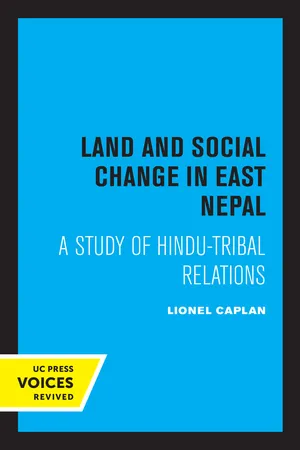
Land and Social Change in East Nepal: A Study of Hindu-Tribal Relations explores the intricate dynamics between the indigenous Limbu population and Hindu settlers in East Nepal, with a particular focus on the contentious struggle over land. Set in the context of Nepal's unification under a Hindu monarchy in the late 18th century, the book examines the kipat system of collective tribal land ownership, a cornerstone of Limbu identity, and its tension with the raikar system introduced by the state, which facilitated land acquisition by Hindu immigrants. This conflict reveals broader themes of cultural division and economic interdependence, as the Limbus and Hindus coexist in roles of creditors, debtors, landlords, and laborers. By linking land tenure to kinship structures and political hierarchies, the author provides a vivid account of how land disputes have shaped the socio-political landscape of the region. Through meticulous fieldwork, archival research, and comparative analysis, the study situates the Limbu experience within the broader South Asian context of Hindu-tribal relations. It highlights how economic pressures, state policies, and migration have marginalized indigenous communities while simultaneously sparking movements to defend cultural identity and ancestral lands. This work offers valuable insights into the resilience of the Limbus and the enduring ties between culture and politics in a rapidly changing environment. It is an essential resource for scholars of anthropology, history, and South Asian studies, offering a compelling narrative of adaptation, resistance, and survival. This title is part of UC Press's Voices Revived program, which commemorates University of California Press's mission to seek out and cultivate the brightest minds and give them voice, reach, and impact. Drawing on a backlist dating to 1893, Voices Revived makes high-quality, peer-reviewed scholarship accessible once again using print-on-demand technology. This title was originally published in 1970.
Many titles in the Voices Revived program are also newly available as ebooks, offered at a discounted price to support wider access to scholarly work.
- 250 pages
- English
- ePUB (mobile friendly)
- Available on iOS & Android
eBook - ePub
About this book
Information
Publisher
University of California PressYear
1970Print ISBN
9780520366442
Edition
1eBook ISBN
9780520324749
Table of contents
- Cover
- Title
- Copyright
- Contents 1
- Preface
- Transliteration
- Chapter I Introductory
- Chapter 2 The setting Ilam district
- The Indreni Cluster
- Chapter 3 Land and kin groups
- Clan and local clan segment
- Lineage
- Household
- Limbus without kipat
- Conclusion
- Chapter 4 Limbus and Brahmans: the cleavage
- Government land policy
- Brahman manipulation of government land policy
- Cultural differences
- The caste hierarchy
- Conclusion
- Chapter 5 Interdependence: the economic context
- The food gap
- Recurrent expenditures
- Contingent expenditures: mortuary rites
- Contingent expenditures: marriage
- Mortgages
- Other kinds of credit
- The exploitation of kipat ownership
- Distribution of mortgages
- Tenancy
- The ‘commercial’ economy: local sources
- The ‘commercial’ economy: military service
- Conclusion
- Chapter 6 Interdependence: the political context
- The leadership hierarchy
- Disputes over compensation
- informal mediation of intra-Cluster disputes
- Factions
- The Panchayat
- The intercalary position of Limbu Notables
- Chapter 7 Land, culture and politics
- The Limbu movement94
- The political role of culture
- Conclusion
- Chapter 8 Conclusion
- Appendix A The measurement of land
- Appendix В Agricultural income
- References
- Glossary*
- Index
Trusted by 375,005 students
Access to over 1.5 million titles for a fair monthly price.
Study more efficiently using our study tools.
Frequently asked questions
Yes, you can cancel anytime from the Subscription tab in your account settings on the Perlego website. Your subscription will stay active until the end of your current billing period. Learn how to cancel your subscription
No, books cannot be downloaded as external files, such as PDFs, for use outside of Perlego. However, you can download books within the Perlego app for offline reading on mobile or tablet. Learn how to download books offline
Perlego offers two plans: Essential and Complete
- Essential is ideal for learners and professionals who enjoy exploring a wide range of subjects. Access the Essential Library with 800,000+ trusted titles and best-sellers across business, personal growth, and the humanities. Includes unlimited reading time and Standard Read Aloud voice.
- Complete: Perfect for advanced learners and researchers needing full, unrestricted access. Unlock 1.5M+ books across hundreds of subjects, including academic and specialized titles. The Complete Plan also includes advanced features like Premium Read Aloud and Research Assistant.
We are an online textbook subscription service, where you can get access to an entire online library for less than the price of a single book per month. With over 1.5 million books across 990+ topics, we’ve got you covered! Learn about our mission
Look out for the read-aloud symbol on your next book to see if you can listen to it. The read-aloud tool reads text aloud for you, highlighting the text as it is being read. You can pause it, speed it up and slow it down. Learn more about Read Aloud
Yes! You can use the Perlego app on both iOS and Android devices to read anytime, anywhere — even offline. Perfect for commutes or when you’re on the go.
Please note we cannot support devices running on iOS 13 and Android 7 or earlier. Learn more about using the app
Please note we cannot support devices running on iOS 13 and Android 7 or earlier. Learn more about using the app
Yes, you can access Land and Social Change in East Nepal by Lionel Caplan in PDF and/or ePUB format, as well as other popular books in Social Sciences & Anthropology. We have over 1.5 million books available in our catalogue for you to explore.