Confucianism and Autocracy: Professional Elitesin the Founding of the Ming Dynasty explores the profound social and political transformations that shaped China during the collapse of the Yuan dynasty and the establishment of the Ming dynasty (1368-1644). This pivotal era marked the rise of an unprecedented level of imperial autocracy, a system that defined China's political landscape for centuries. The book delves into the complex interplay between Confucian professional elites, their sociopolitical philosophies, and the structural centralization that underpinned Ming governance. Rejecting notions of the Ming state as either a military dictatorship or a peasant-driven revolution, it positions the Confucian literati as central agents in constructing the autocratic framework, motivated by their vision of societal reform and moral regeneration. Drawing on extensive primary sources, including 128 collected works from 1340 to 1400, the author examines how Confucian professionals navigated the national crises of the 1350s, offering theoretical and practical responses that laid the groundwork for the Ming's authoritarian structure. The text analyzes the philosophical underpinnings of early Ming autocracy and the Confucian emphasis on ethical governance, revealing how the pursuit of professional ideals intertwined with the brutal centralization of power. From the socio-moral reforms of the dynasty's founder to the eventual ideological shifts within Confucianism, this book offers a nuanced perspective on how Confucian elites shaped the Ming dynasty and China's broader historical trajectory. This title is part of UC Press's Voices Revived program, which commemorates University of California Press's mission to seek out and cultivate the brightest minds and give them voice, reach, and impact. Drawing on a backlist dating to 1893, Voices Revived makes high-quality, peer-reviewed scholarship accessible once again using print-on-demand technology. This title was originally published in 1983.
Many titles in the Voices Revived program are also newly available as ebooks, offered at a discounted price to support wider access to scholarly work.
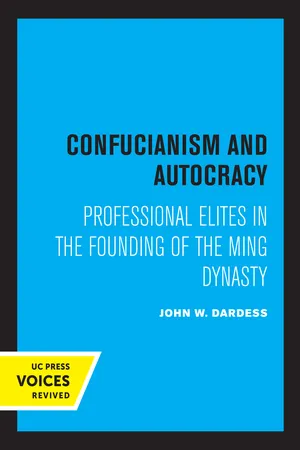
eBook - ePub
Confucianism and Autocracy
Professional Elites in the Founding of the Ming Dynasty
- 370 pages
- English
- ePUB (mobile friendly)
- Available on iOS & Android
eBook - ePub
About this book
Information
Publisher
University of California PressYear
1983Print ISBN
9780520327559
Edition
1eBook ISBN
9780520327573
Table of contents
- Cover
- Title
- Copyright
- Contents 1
- Acknowledgments
- Introduction
- 1 Confucianism as a Profession in Fourteenth-Century China
- 2 Confucianism in the Yuan-Ming Transition
- The Che-tung Confucian Elite and the Idea of “World-Salvation”
- Ming Тai-tsu: The Theory and Practice of Despotism
- Confucianism’s Response to Ming Tai-tsu
- Abbreviations Used in Bibliography and Notes
- Notes
- Glossary
- Bibliography
- Index
Trusted by 375,005 students
Access to over 1.5 million titles for a fair monthly price.
Study more efficiently using our study tools.
Frequently asked questions
Yes, you can cancel anytime from the Subscription tab in your account settings on the Perlego website. Your subscription will stay active until the end of your current billing period. Learn how to cancel your subscription
No, books cannot be downloaded as external files, such as PDFs, for use outside of Perlego. However, you can download books within the Perlego app for offline reading on mobile or tablet. Learn how to download books offline
Perlego offers two plans: Essential and Complete
- Essential is ideal for learners and professionals who enjoy exploring a wide range of subjects. Access the Essential Library with 800,000+ trusted titles and best-sellers across business, personal growth, and the humanities. Includes unlimited reading time and Standard Read Aloud voice.
- Complete: Perfect for advanced learners and researchers needing full, unrestricted access. Unlock 1.5M+ books across hundreds of subjects, including academic and specialized titles. The Complete Plan also includes advanced features like Premium Read Aloud and Research Assistant.
We are an online textbook subscription service, where you can get access to an entire online library for less than the price of a single book per month. With over 1.5 million books across 990+ topics, we’ve got you covered! Learn about our mission
Look out for the read-aloud symbol on your next book to see if you can listen to it. The read-aloud tool reads text aloud for you, highlighting the text as it is being read. You can pause it, speed it up and slow it down. Learn more about Read Aloud
Yes! You can use the Perlego app on both iOS and Android devices to read anytime, anywhere — even offline. Perfect for commutes or when you’re on the go.
Please note we cannot support devices running on iOS 13 and Android 7 or earlier. Learn more about using the app
Please note we cannot support devices running on iOS 13 and Android 7 or earlier. Learn more about using the app
Yes, you can access Confucianism and Autocracy by John W. Dardess in PDF and/or ePUB format, as well as other popular books in Politics & International Relations & Political Ideologies. We have over 1.5 million books available in our catalogue for you to explore.