Religion and State in Iran, 1785–1906 offers the first sustained study of the political role of the ulama during the Qajar dynasty, a period that culminated in the Constitutional Revolution of 1906. Hamid Algar traces the emergence of the ulama as the central counterweight to the monarchy, showing how their authority grew in response to foreign encroachment, economic concessions, and the efforts of successive shahs to consolidate power. Through detailed analysis of key episodes—from the murder of the Russian envoy Griboyedov in 1829, to the rise of Babi and Baha'i movements, to the mass mobilization against the 1890 tobacco concession—the book demonstrates that the ulama consistently served as defenders of Islamic law, communal identity, and national autonomy. More than a chronicle of political events, the book explores the theoretical and practical dimensions of Shi'i religious authority in a time of crisis and transformation. It situates the ulama within the broader context of Shi'i Islam, highlighting their unique position as scholars without priestly hierarchy yet endowed with immense influence. Algar also illuminates the evolving relationship between religious leadership and secular rulers, comparing developments in Qajar Iran to those in the Ottoman Empire. By examining the ulama's response to Western military, economic, and ideological pressures, the study sheds light on how clerical authority shaped Iran's trajectory toward constitutionalism. Drawing on Persian and European sources, it provides both a meticulous reconstruction of nineteenth-century politics and a framework for understanding the enduring entanglement of religion and state in modern Iran. This title is part of UC Press's Voices Revived program, which commemorates University of California Press's mission to seek out and cultivate the brightest minds and give them voice, reach, and impact. Drawing on a backlist dating to 1893, Voices Revived makes high-quality, peer-reviewed scholarship accessible once again using print-on-demand technology. This title was originally published in 1969.
Many titles in the Voices Revived program are also newly available as ebooks, offered at a discounted price to support wider access to scholarly work.
eBook - ePub
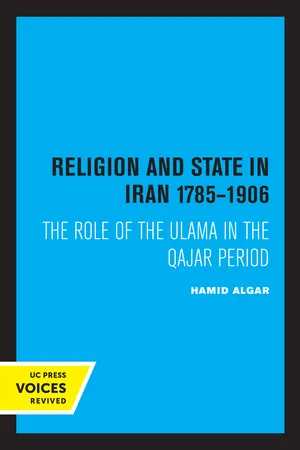
Religion and State in Iran 1785-1906
The Role of the Ulama in the Qajar Period
- 306 pages
- English
- ePUB (mobile friendly)
- Available on iOS & Android
eBook - ePub
About this book
Information
Table of contents
- Cover
- Title
- Copyright
- Contents 1
- I The Foundations of Clerical Influence
- II The Eve of Qajar Rule
- III
- IV ‘Abbâs Mlrzà, Qâ’im Maqâm, and the Ulama
- V
- VI
- VII
- IX
- X
- XI
- XII
- XIII
- XIV
- Glossary
- Bibliography
- Index
Trusted by 375,005 students
Access to over 1.5 million titles for a fair monthly price.
Study more efficiently using our study tools.
Frequently asked questions
Yes, you can cancel anytime from the Subscription tab in your account settings on the Perlego website. Your subscription will stay active until the end of your current billing period. Learn how to cancel your subscription
No, books cannot be downloaded as external files, such as PDFs, for use outside of Perlego. However, you can download books within the Perlego app for offline reading on mobile or tablet. Learn how to download books offline
Perlego offers two plans: Essential and Complete
- Essential is ideal for learners and professionals who enjoy exploring a wide range of subjects. Access the Essential Library with 800,000+ trusted titles and best-sellers across business, personal growth, and the humanities. Includes unlimited reading time and Standard Read Aloud voice.
- Complete: Perfect for advanced learners and researchers needing full, unrestricted access. Unlock 1.5M+ books across hundreds of subjects, including academic and specialized titles. The Complete Plan also includes advanced features like Premium Read Aloud and Research Assistant.
We are an online textbook subscription service, where you can get access to an entire online library for less than the price of a single book per month. With over 1.5 million books across 990+ topics, we’ve got you covered! Learn about our mission
Look out for the read-aloud symbol on your next book to see if you can listen to it. The read-aloud tool reads text aloud for you, highlighting the text as it is being read. You can pause it, speed it up and slow it down. Learn more about Read Aloud
Yes! You can use the Perlego app on both iOS and Android devices to read anytime, anywhere — even offline. Perfect for commutes or when you’re on the go.
Please note we cannot support devices running on iOS 13 and Android 7 or earlier. Learn more about using the app
Please note we cannot support devices running on iOS 13 and Android 7 or earlier. Learn more about using the app
Yes, you can access Religion and State in Iran 1785-1906 by Hamid Algar in PDF and/or ePUB format, as well as other popular books in Theology & Religion & Islamic Theology. We have over 1.5 million books available in our catalogue for you to explore.