Aristotle's classification of animals, and indeed his approach to biology, challenges modern assumptions about scientific progress. Historians often view Aristotle's attempts at classification as incomplete precursors to the rigorous taxonomies of later scientists, such as Linnaeus, but this perspective may impose a retrospective, evolution-based understanding of science onto Aristotle's distinct worldview. While it's clear that Aristotle categorized animals based on their parts, characteristics, and behaviors, his classifications were not necessarily intended to function as comprehensive taxonomies. Instead, Aristotle's groupings reflect his philosophical quest to understand the essence of living things and the order of nature rather than a systematic effort to codify all species in a rigid structure. In his approach, classification served to illustrate larger principles and relationships rather than to build a finalized biological hierarchy. Moreover, Aristotle's classificatory efforts differ fundamentally from later biological taxonomies in their conceptual basis and purpose. Modern commentators, including Georges Cuvier, acknowledge Aristotle's influence on fields like comparative anatomy but note that Aristotle did not apply a structured taxonomic system as his successors did. Instead, Aristotle's categories were flexible, reflecting his ideas on the "essence" and "form" of living beings rather than any fixed biological grid. This distinction becomes crucial when interpreting Aristotle's work: rather than regarding it as an incomplete taxonomy, we might view it as a philosophical framework that integrates observations with conceptual exploration of life's diversity and order. This approach, which seeks to understand each organism within a broader natural order, is less about classifying individual species and more about investigating the fundamental nature of life. This title is part of UC Press's Voices Revived program, which commemorates University of California Press's mission to seek out and cultivate the brightest minds and give them voice, reach, and impact. Drawing on a backlist dating to 1893, Voices Revived makes high-quality, peer-reviewed scholarship accessible once again using print-on-demand technology. This title was originally published in 1986.
Many titles in the Voices Revived program are also newly available as ebooks, offered at a discounted price to support wider access to scholarly work.
eBook - ePub
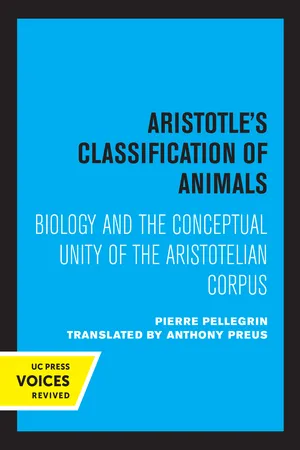
Aristotle's Classification of Animals
Biology and the Conceptual Unity of the Aristotelian Corpus
- 256 pages
- English
- ePUB (mobile friendly)
- Available on iOS & Android
eBook - ePub
Aristotle's Classification of Animals
Biology and the Conceptual Unity of the Aristotelian Corpus
About this book
Information
Publisher
University of California PressYear
1986Print ISBN
9780520330405
Edition
1eBook ISBN
9780520330412
Table of contents
- Cover
- Title
- Copyright
- CONTENTS 10
- TRANSLATOR’S NOTE
- PREFACE
- ABBREVIATIONS
- INTRODUCTION
- DIVISION AND DEFINITION IN ARISTOTLE THE MEANING AND THE LIMITS OF THE CRITIQUE OF PLATONISM
- GENUS, SPECIES, AND SPECIFIC DIFFERENCE FROM LOGIC TO ZOOLOGY
- THE STATUS AND FUNCTIONS OF ARISTOTLE’S ZOOLOGICAL CLASSIFICATIONS
- CONCLUSION
- NOTES
- BIBLIOGRAPHY
- GENERAL INDEX
- INDEX OF PASSAGES CITED FROM ARISTOTLE’S WORKS
Trusted by 375,005 students
Access to over 1.5 million titles for a fair monthly price.
Study more efficiently using our study tools.
Frequently asked questions
Yes, you can cancel anytime from the Subscription tab in your account settings on the Perlego website. Your subscription will stay active until the end of your current billing period. Learn how to cancel your subscription
No, books cannot be downloaded as external files, such as PDFs, for use outside of Perlego. However, you can download books within the Perlego app for offline reading on mobile or tablet. Learn how to download books offline
Perlego offers two plans: Essential and Complete
- Essential is ideal for learners and professionals who enjoy exploring a wide range of subjects. Access the Essential Library with 800,000+ trusted titles and best-sellers across business, personal growth, and the humanities. Includes unlimited reading time and Standard Read Aloud voice.
- Complete: Perfect for advanced learners and researchers needing full, unrestricted access. Unlock 1.5M+ books across hundreds of subjects, including academic and specialized titles. The Complete Plan also includes advanced features like Premium Read Aloud and Research Assistant.
We are an online textbook subscription service, where you can get access to an entire online library for less than the price of a single book per month. With over 1.5 million books across 990+ topics, we’ve got you covered! Learn about our mission
Look out for the read-aloud symbol on your next book to see if you can listen to it. The read-aloud tool reads text aloud for you, highlighting the text as it is being read. You can pause it, speed it up and slow it down. Learn more about Read Aloud
Yes! You can use the Perlego app on both iOS and Android devices to read anytime, anywhere — even offline. Perfect for commutes or when you’re on the go.
Please note we cannot support devices running on iOS 13 and Android 7 or earlier. Learn more about using the app
Please note we cannot support devices running on iOS 13 and Android 7 or earlier. Learn more about using the app
Yes, you can access Aristotle's Classification of Animals by Pierre Pellegrin in PDF and/or ePUB format, as well as other popular books in Biological Sciences & Ecology. We have over 1.5 million books available in our catalogue for you to explore.