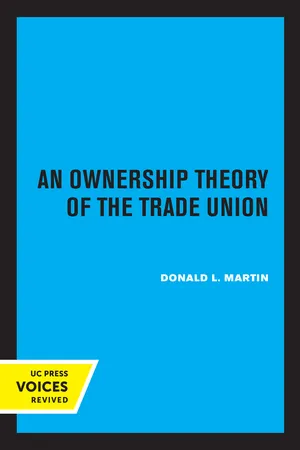
An Ownership Theory of the Trade Union explores the economic theories behind trade union behavior, analyzing the historical struggle to define what unions maximize. Despite various theories suggesting unions aim to maximize wage rates, membership benefits, or organizational survival, a consistent economic model for unions has been elusive. The book critiques previous models, highlighting the need for an ownership-based approach to better explain unions' objectives. By examining the structure of property rights within unions, the book argues that a theory of union behavior must take into account the specific rights and incentives facing union members and leaders. The author introduces two contrasting models: one assuming private-property rights that allow union members to share in the capital value of future union gains, and another based on nonproprietary assumptions where members lack individual claims to union rents. These models offer differing predictions for union policies on wages, benefits, and membership, influenced by whether union members have a vested interest in the union's capitalized wealth. The book asserts that analyzing the union's structure of property rights provides valuable insights into the practical incentives that drive union policies, which are often inconsistent with wealth-maximization assumptions in traditional economic models. The book's chapters address specific elements of union organization, including the role of union leaders, monitoring costs, and membership pricing and rationing. Through this analysis, it reveals how the ownership structure within unions shapes their economic decisions, contrasting proprietary and nonproprietary models in terms of membership access, wage policies, and managerial discretion. By focusing on property rights and institutional incentives, An Ownership Theory of the Trade Union aims to offer a more precise and testable model of union behavior, aligning it more closely with broader economic theories. This title is part of UC Press's Voices Revived program, which commemorates University of California Press's mission to seek out and cultivate the brightest minds and give them voice, reach, and impact. Drawing on a backlist dating to 1893, Voices Revived makes high-quality, peer-reviewed scholarship accessible once again using print-on-demand technology. This title was originally published in 1980.
Many titles in the Voices Revived program are also newly available as ebooks, offered at a discounted price to support wider access to scholarly work.
- 170 pages
- English
- ePUB (mobile friendly)
- Available on iOS & Android
eBook - ePub
An Ownership Theory of the Trade Union
About this book
Information
Publisher
University of California PressYear
1980Print ISBN
9780520330429
Edition
1eBook ISBN
9780520330436
Table of contents
- Cover
- Title
- Copyright
- Contents 1
- Preface
- 1 Introduction
- 2 A Critique of the Theoretical Literature
- 3 An Ownership Profile of the Trade Union
- 4 The Basic Model in a Proprietary Paradigm
- 5 The Nonproprietary Union
- 6 Managerial Discretion Within The Union
- 7 Price and Nonprice Rationing of Union Memberships
- Notes
- References
- Index
Trusted by 375,005 students
Access to over 1.5 million titles for a fair monthly price.
Study more efficiently using our study tools.
Frequently asked questions
Yes, you can cancel anytime from the Subscription tab in your account settings on the Perlego website. Your subscription will stay active until the end of your current billing period. Learn how to cancel your subscription
No, books cannot be downloaded as external files, such as PDFs, for use outside of Perlego. However, you can download books within the Perlego app for offline reading on mobile or tablet. Learn how to download books offline
Perlego offers two plans: Essential and Complete
- Essential is ideal for learners and professionals who enjoy exploring a wide range of subjects. Access the Essential Library with 800,000+ trusted titles and best-sellers across business, personal growth, and the humanities. Includes unlimited reading time and Standard Read Aloud voice.
- Complete: Perfect for advanced learners and researchers needing full, unrestricted access. Unlock 1.5M+ books across hundreds of subjects, including academic and specialized titles. The Complete Plan also includes advanced features like Premium Read Aloud and Research Assistant.
We are an online textbook subscription service, where you can get access to an entire online library for less than the price of a single book per month. With over 1.5 million books across 990+ topics, we’ve got you covered! Learn about our mission
Look out for the read-aloud symbol on your next book to see if you can listen to it. The read-aloud tool reads text aloud for you, highlighting the text as it is being read. You can pause it, speed it up and slow it down. Learn more about Read Aloud
Yes! You can use the Perlego app on both iOS and Android devices to read anytime, anywhere — even offline. Perfect for commutes or when you’re on the go.
Please note we cannot support devices running on iOS 13 and Android 7 or earlier. Learn more about using the app
Please note we cannot support devices running on iOS 13 and Android 7 or earlier. Learn more about using the app
Yes, you can access An Ownership Theory of the Trade Union by Donald L. Martin in PDF and/or ePUB format, as well as other popular books in Business & Business General. We have over 1.5 million books available in our catalogue for you to explore.