Pindar's poetry, although revered, remains one of the least read among great classical works, even within classical scholarship. His epinikion, or victory ode, is an unfamiliar genre, largely represented only by Pindar himself. Engaging with his work requires facing the challenges of his complex language, thought process, and narrative style. Despite such obstacles, Pindar has long been acknowledged as an essential poet, a symbol of inspiration and originality whose work has provided a model for poets seeking a break from conventional "classical" forms. Yet, Pindar's reputation as both a bold innovator and a flatterer of elite athletes has created a dual image of his character and work. In this study, the focus shifts from Pindar as a historical figure to the lasting significance of his poetic mode, which extends to modern works. Pindar's work is frequently invoked in discussions of lyric poetry to illustrate that lyricism can be more than subjective or inward; his poetry demonstrates a communal voice, albeit one that arises not from a predefined community but through the act of poetic resistance. By modeling community as an agon, or contest, the study explores how poetry can reflect communal forces rather than fixed groups. This approach contrasts with perspectives that interpret lyric poetry through individualistic or self-contained struggles, as seen in the theories of Harold Bloom and certain deconstructive readings, positioning the poetic voice instead as a dynamic, communal force. The analysis here extends beyond Pindar's ancient Greek context to examine the Pindaric mode's influence on the English ode and in the poetry of figures such as Hölderlin, as well as others like Claudel in French literature. While considering historical influences, this work does not aim to trace direct literary lineages; instead, it highlights shared problematics and poetic strategies. Through close readings, this study reframes the Pindaric tradition, not as a set of stylistic clichés but as a source of complex, communal expression within the broader field of lyric and odic poetry. This title is part of UC Press's Voices Revived program, which commemorates University of California Press's mission to seek out and cultivate the brightest minds and give them voice, reach, and impact. Drawing on a backlist dating to 1893, Voices Revived makes high-quality, peer-reviewed scholarship accessible once again using print-on-demand technology. This title was originally published in 1987.
Many titles in the Voices Revived program are also newly available as ebooks, offered at a discounted price to support wider access to scholarly work.
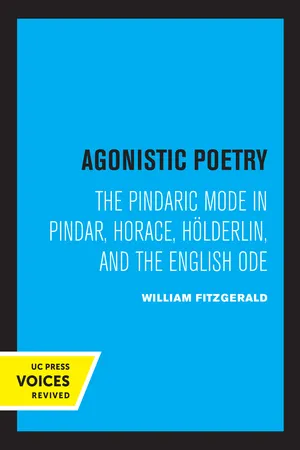
eBook - ePub
Agonistic Poetry
The Pindaric Mode in Pindar, Horace, Hölderlin, and the English Ode
- 258 pages
- English
- ePUB (mobile friendly)
- Available on iOS & Android
eBook - ePub
Agonistic Poetry
The Pindaric Mode in Pindar, Horace, Hölderlin, and the English Ode
About this book
Information
Table of contents
- Cover
- Title
- Copyright
- Contents 10
- Preface
- 1 Poetry and Agon
- 2 The Poetry of Reception
- 3 Vertical and Horizontal Pindar’s Olympian 3 and Holderlin’s ‘'Patmos"
- 4 Progress and Fall
- 5 The Hero’s Extension Pindar’s Olympian 10, Dryden’s “Alexander's Feast,” and Holderlin’s “Der Rhein”
- 6 Order and Violence Pythian 1, Horace’s “Cleopatra Ode,” and Marvell’s “Horatian Ode"
- 7 Form and Force
- Conclusion
- Appendix: The Text of Olympians 3 and 10 and Pythian 1
- Notes
- Bibliography
- Index
Trusted by 375,005 students
Access to over 1.5 million titles for a fair monthly price.
Study more efficiently using our study tools.
Frequently asked questions
Yes, you can cancel anytime from the Subscription tab in your account settings on the Perlego website. Your subscription will stay active until the end of your current billing period. Learn how to cancel your subscription
No, books cannot be downloaded as external files, such as PDFs, for use outside of Perlego. However, you can download books within the Perlego app for offline reading on mobile or tablet. Learn how to download books offline
Perlego offers two plans: Essential and Complete
- Essential is ideal for learners and professionals who enjoy exploring a wide range of subjects. Access the Essential Library with 800,000+ trusted titles and best-sellers across business, personal growth, and the humanities. Includes unlimited reading time and Standard Read Aloud voice.
- Complete: Perfect for advanced learners and researchers needing full, unrestricted access. Unlock 1.5M+ books across hundreds of subjects, including academic and specialized titles. The Complete Plan also includes advanced features like Premium Read Aloud and Research Assistant.
We are an online textbook subscription service, where you can get access to an entire online library for less than the price of a single book per month. With over 1.5 million books across 990+ topics, we’ve got you covered! Learn about our mission
Look out for the read-aloud symbol on your next book to see if you can listen to it. The read-aloud tool reads text aloud for you, highlighting the text as it is being read. You can pause it, speed it up and slow it down. Learn more about Read Aloud
Yes! You can use the Perlego app on both iOS and Android devices to read anytime, anywhere — even offline. Perfect for commutes or when you’re on the go.
Please note we cannot support devices running on iOS 13 and Android 7 or earlier. Learn more about using the app
Please note we cannot support devices running on iOS 13 and Android 7 or earlier. Learn more about using the app
Yes, you can access Agonistic Poetry by William Fitzgerald in PDF and/or ePUB format, as well as other popular books in Letteratura & Critica letteraria inglese. We have over 1.5 million books available in our catalogue for you to explore.