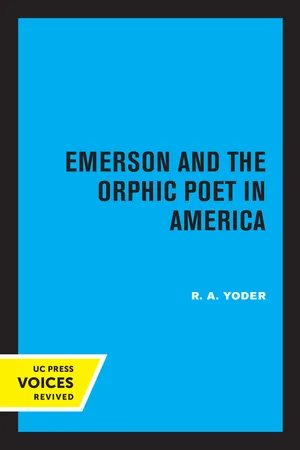
In Emerson and the Orphic Poet in America, the author explores Ralph Waldo Emerson's conception of poetry and the poet within the context of a larger Romantic tradition. Emerson's work represents a critical shift in American thought, merging European Romantic ideals with an American voice. At the heart of his vision is the idea of the poet as both a visionary and a liberator of truth, a concept that Emerson inherited from a variety of traditions, including Blake's notion of the "universal man" and the Logos of Platonism. Emerson's invocation of the Orphic poet in his 1836 work Nature marks a departure from traditional American thought, positioning the poet as the one who speaks eternal truths, a voice that transcends the limitations of time and geography. His work incorporates a syncretic method, drawing from both European influences and American independence, while advocating for a return to the primal source of truth. This conception places the poet at the center of life's order, a figure capable of transcending ordinary experience to reveal deeper, universal truths. The study further delves into the development of Emerson's own poetic practice, noting the evolution from the grand Orphic figure in Nature to a more modest poet in his later works. Emerson initially saw poetry as a prophetic and divine gift, but over time his work became more focused on the human and accessible aspects of poetry. His later writings reflect a poet who, though aware of the grandeur of Orphic ideals, recognizes the limitations of his own work, describing his voice as husky and imperfect. Despite this, Emerson still aligns himself with the greater tradition of poetic bards, finding satisfaction in their immortal melodies. The book concludes with an analysis of how Emerson's modifications of the Orphic tradition have shaped American poetry, preserving its core inquiries while adapting it to a distinctly American context. Through his evolving poetic practice, Emerson's work continues to resonate, influencing generations of American poets. This title is part of UC Press's Voices Revived program, which commemorates University of California Press's mission to seek out and cultivate the brightest minds and give them voice, reach, and impact. Drawing on a backlist dating to 1893, Voices Revived makes high-quality, peer-reviewed scholarship accessible once again using print-on-demand technology. This title was originally published in 1978.
Many titles in the Voices Revived program are also newly available as ebooks, offered at a discounted price to support wider access to scholarly work.
- 258 pages
- English
- ePUB (mobile friendly)
- Available on iOS & Android
eBook - ePub
Emerson and the Orphic Poet in America
About this book
Information
Publisher
University of California PressYear
1978Print ISBN
9780520365308
Edition
1eBook ISBN
9780520338531
Table of contents
- Cover
- Title
- Copyright
- Contents 1
- Acknowledgments
- Abbreviations
- Introduction
- PART ONE: Prelude
- I The Growth of an Orphic Mind
- II High Arguments in the Negative Way
- III Orpheus in the Mid-World
- PART TWO: The Major Poems
- IV First Poetic Fruits
- V Fables of Apocalypse
- VI Metamorphoses; or, The Beautiful Changes
- VII Toward the Titmouse Dimension
- PART THREE: Legacy
- VIII Orpheus Descending
- Notes
- Index
Trusted by 375,005 students
Access to over 1.5 million titles for a fair monthly price.
Study more efficiently using our study tools.
Frequently asked questions
Yes, you can cancel anytime from the Subscription tab in your account settings on the Perlego website. Your subscription will stay active until the end of your current billing period. Learn how to cancel your subscription
No, books cannot be downloaded as external files, such as PDFs, for use outside of Perlego. However, you can download books within the Perlego app for offline reading on mobile or tablet. Learn how to download books offline
Perlego offers two plans: Essential and Complete
- Essential is ideal for learners and professionals who enjoy exploring a wide range of subjects. Access the Essential Library with 800,000+ trusted titles and best-sellers across business, personal growth, and the humanities. Includes unlimited reading time and Standard Read Aloud voice.
- Complete: Perfect for advanced learners and researchers needing full, unrestricted access. Unlock 1.5M+ books across hundreds of subjects, including academic and specialized titles. The Complete Plan also includes advanced features like Premium Read Aloud and Research Assistant.
We are an online textbook subscription service, where you can get access to an entire online library for less than the price of a single book per month. With over 1.5 million books across 990+ topics, we’ve got you covered! Learn about our mission
Look out for the read-aloud symbol on your next book to see if you can listen to it. The read-aloud tool reads text aloud for you, highlighting the text as it is being read. You can pause it, speed it up and slow it down. Learn more about Read Aloud
Yes! You can use the Perlego app on both iOS and Android devices to read anytime, anywhere — even offline. Perfect for commutes or when you’re on the go.
Please note we cannot support devices running on iOS 13 and Android 7 or earlier. Learn more about using the app
Please note we cannot support devices running on iOS 13 and Android 7 or earlier. Learn more about using the app
Yes, you can access Emerson and the Orphic Poet in America by R. A. Yoder in PDF and/or ePUB format, as well as other popular books in Literature & Literary Criticism. We have over 1.5 million books available in our catalogue for you to explore.