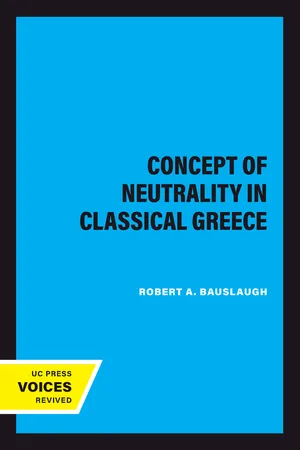
Looking at Classical warfare from the perspective of the non-belligerents, Robert A. Bauslaugh brings together the scattered evidence testifying to neutral behavior among the Greek city-states and their non-Greek neighbors. Were the Argives of 480/479 B.C. really "Medizers, " as many have accused, or were they pursuing a justifiable policy of neutrality as they claimed? On what basis in international law or custom did the Corcyraeans claim non-alignment? Why were the leading belligerent states willing to accept the inclusion of a "neutrality clause" in the Common Peace of 371? These questions have not been asked by historians of international law, and the answers provide a far more complex and sophisticated picture of interstate relations than has so far been available. Despite the absence of exclusively diplomatic language, the concept of respect for neutrals appears early in Greek history and remains a nearly constant feature of Classical wars. The problems confronting uncommitted states, which have clear parallels in modern history, were balanced by widespread acceptance of the need for limitations on the chaos of warfare.
Looking at Classical warfare from the perspective of the non-belligerents, Robert A. Bauslaugh brings together the scattered evidence testifying to neutral behavior among the Greek city-states and their non-Greek neighbors. Were the Argives of 480/479 B.C
- 316 pages
- English
- ePUB (mobile friendly)
- Available on iOS & Android
eBook - ePub
The Concept of Neutrality in Classical Greece
About this book
Trusted by 375,005 students
Access to over 1.5 million titles for a fair monthly price.
Study more efficiently using our study tools.
Information
Publisher
University of California PressYear
2023Print ISBN
9780520066878
Edition
1eBook ISBN
9780520909335
Table of contents
- Cover
- Title
- Copyright
- Contents 1
- Preface
- Abbreviations
- Introduction
- PART ONE The Classical Concept of Neutrality
- CHAPTER ONE Ancient Greek Diplomatic Terminology for Abstention from Conflict
- CHAPTER TWO The Ancient Sources
- CHAPTER THREE The Origins and Background of the Classical Concept of Neutrality
- CHAPTER FOUR The Realities of Remaining Uncommitted
- CHAPTER FIVE From the Earliest Evidence to the Outbreak of the Peloponnesian War (ca. 600-431)
- CHAPTER SIX The Peloponnesian War to the Peace of Nicias (431—421)
- CHAPTER SEVEN From the Peace of Nicias to the End of the Peloponnesian War (421-404)
- CHAPTER EIGHT From the Carthaginian Invasion of Sicily to the Spartan Defeat at Leuctra (406-371)
- CHAPTER NINE From the Battle at Leuctra to the Victory of Philip II at Chaeronea (371-338)
- Conclusion
- Select Bibliography
- General Index
- Index Locorum
Frequently asked questions
Yes, you can cancel anytime from the Subscription tab in your account settings on the Perlego website. Your subscription will stay active until the end of your current billing period. Learn how to cancel your subscription
No, books cannot be downloaded as external files, such as PDFs, for use outside of Perlego. However, you can download books within the Perlego app for offline reading on mobile or tablet. Learn how to download books offline
Perlego offers two plans: Essential and Complete
- Essential is ideal for learners and professionals who enjoy exploring a wide range of subjects. Access the Essential Library with 800,000+ trusted titles and best-sellers across business, personal growth, and the humanities. Includes unlimited reading time and Standard Read Aloud voice.
- Complete: Perfect for advanced learners and researchers needing full, unrestricted access. Unlock 1.5M+ books across hundreds of subjects, including academic and specialized titles. The Complete Plan also includes advanced features like Premium Read Aloud and Research Assistant.
We are an online textbook subscription service, where you can get access to an entire online library for less than the price of a single book per month. With over 1.5 million books across 990+ topics, we’ve got you covered! Learn about our mission
Look out for the read-aloud symbol on your next book to see if you can listen to it. The read-aloud tool reads text aloud for you, highlighting the text as it is being read. You can pause it, speed it up and slow it down. Learn more about Read Aloud
Yes! You can use the Perlego app on both iOS and Android devices to read anytime, anywhere — even offline. Perfect for commutes or when you’re on the go.
Please note we cannot support devices running on iOS 13 and Android 7 or earlier. Learn more about using the app
Please note we cannot support devices running on iOS 13 and Android 7 or earlier. Learn more about using the app
Yes, you can access The Concept of Neutrality in Classical Greece by Robert A. Bauslaugh in PDF and/or ePUB format, as well as other popular books in History & Ancient History. We have over 1.5 million books available in our catalogue for you to explore.