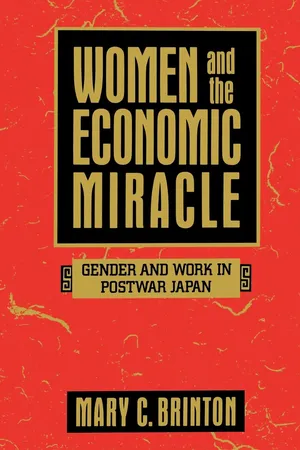
This lucid, hard-hitting book explores a central paradox of the Japanese economy: the relegation of women to low-paying, dead-end jobs in a workforce that depends on their labor to maintain its status as a world economic leader. Drawing upon historical materials, survey and statistical data, and extensive interviews in Japan, Mary Brinton provides an in-depth and original examination of the role of gender in Japan's phenomenal postwar economic growth.
Brinton finds that the educational system, the workplace, and the family in Japan have shaped the opportunities open to female workers. Women move in and out of the workforce depending on their age and family duties, a great disadvantage in a system that emphasizes seniority and continuous work experience. Brinton situates the vicious cycle that perpetuates traditional gender roles within the concept of human capital development, whereby Japanese society "underinvests" in the capabilities of women. The effects of this underinvestment are reinforced indirectly as women sustain male human capital through unpaid domestic labor and psychological support.
Brinton provides a clear analysis of a society that remains misunderstood, but whose economic transformation has been watched with great interest by the industrialized world.
This lucid, hard-hitting book explores a central paradox of the Japanese economy: the relegation of women to low-paying, dead-end jobs in a workforce that depends on their labor to maintain its status as a world economic leader. Drawing upon historical ma
- 320 pages
- English
- ePUB (mobile friendly)
- Available on iOS & Android
eBook - ePub
About this book
Information
Publisher
University of California PressYear
1993Print ISBN
9780520075634
Edition
1eBook ISBN
9780520915473
Table of contents
- Cover
- Title
- Copyright
- Contents 1
- Tables
- Figures
- A Note on Japanese Names
- Acknowledgments
- ONE Introduction
- TWO Women in the Japanese and U.S. Economies
- THREE Human Capital Development Systems
- FOUR The Evolution of a Gendered Employment System
- FIVE Gendered Work Lives
- SIX Gendered Education
- SEVEN Conclusion
- APPENDIX A Research Design for the Three-City Study
- APPENDIX B Supplementary Tables
- References
- Index
Trusted by 375,005 students
Access to over 1.5 million titles for a fair monthly price.
Study more efficiently using our study tools.
Frequently asked questions
Yes, you can cancel anytime from the Subscription tab in your account settings on the Perlego website. Your subscription will stay active until the end of your current billing period. Learn how to cancel your subscription
No, books cannot be downloaded as external files, such as PDFs, for use outside of Perlego. However, you can download books within the Perlego app for offline reading on mobile or tablet. Learn how to download books offline
Perlego offers two plans: Essential and Complete
- Essential is ideal for learners and professionals who enjoy exploring a wide range of subjects. Access the Essential Library with 800,000+ trusted titles and best-sellers across business, personal growth, and the humanities. Includes unlimited reading time and Standard Read Aloud voice.
- Complete: Perfect for advanced learners and researchers needing full, unrestricted access. Unlock 1.5M+ books across hundreds of subjects, including academic and specialized titles. The Complete Plan also includes advanced features like Premium Read Aloud and Research Assistant.
We are an online textbook subscription service, where you can get access to an entire online library for less than the price of a single book per month. With over 1.5 million books across 990+ topics, we’ve got you covered! Learn about our mission
Look out for the read-aloud symbol on your next book to see if you can listen to it. The read-aloud tool reads text aloud for you, highlighting the text as it is being read. You can pause it, speed it up and slow it down. Learn more about Read Aloud
Yes! You can use the Perlego app on both iOS and Android devices to read anytime, anywhere — even offline. Perfect for commutes or when you’re on the go.
Please note we cannot support devices running on iOS 13 and Android 7 or earlier. Learn more about using the app
Please note we cannot support devices running on iOS 13 and Android 7 or earlier. Learn more about using the app
Yes, you can access Women and the Economic Miracle by Mary C. Brinton in PDF and/or ePUB format, as well as other popular books in Social Sciences & Labour Economics. We have over 1.5 million books available in our catalogue for you to explore.