New perspectives on early globalisms from objects and images
Tales Things Tell offers new perspectives on histories of connectivity between Africa, Asia, and Europe in the period before the Mongol conquests of the thirteenth century. Reflected in objects and materials whose circulation and reception defined aesthetic, economic, and technological networks that existed outside established political and sectarian boundaries, many of these histories are not documented in the written sources on which historians usually rely. Tales Things Tell charts bold new directions in art history, making a compelling case for the archival value of mobile artifacts and images in reconstructing the past.
In this beautifully illustrated book, Finbarr Barry Flood and Beate Fricke present six illuminating case studies from the sixth to the thirteenth centuries to show how portable objects mediated the mobility of concepts, iconographies, and techniques. The case studies range from metalwork to stone reliefs, manuscript paintings, and objects using natural materials such as coconut and rock crystal. Whether as booty, commodities, gifts, or souvenirs, many of the objects discussed in Tales Things Tell functioned as sources of aesthetic, iconographic, or technical knowledge in the lands in which they came to rest. Remapping the histories of exchange between medieval Islam and Christendom, from Europe to the Indian Ocean, Tales Things Tell ventures beyond standard narratives drawn from written archival records to demonstrate the value of objects and images as documents of early globalisms.
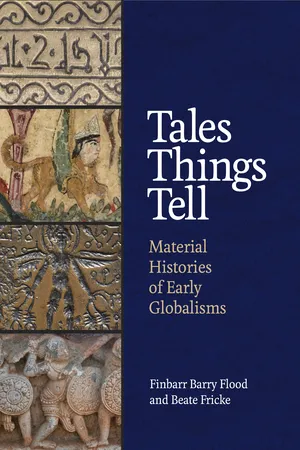
eBook - ePub
Tales Things Tell
Material Histories of Early Globalisms
- 304 pages
- English
- ePUB (mobile friendly)
- Available on iOS & Android
eBook - ePub
About this book
Information
Publisher
Princeton University PressYear
2023Print ISBN
9780691252650
9780691215150
eBook ISBN
9780691252667
Topic
ArtSubtopic
Art GeneralTable of contents
- Cover Page
- Title Page
- Contents
- A Note on Transliteration
- Acknowledgments
- Introduction: Archives, Flotsam, and Tales of Globalism
- Part 1. From al-Andalus to Germany: Objects, Techniques, and Materials
- Part 2. From Iraq to India and Africa: Technologies, Iconographies, and Marvels
- Conclusion: Global, Local, and Temporal
- Notes
- Bibliography
- Index
- Image Credits
- Copyright Page
Trusted by 375,005 students
Access to over 1.5 million titles for a fair monthly price.
Study more efficiently using our study tools.
Frequently asked questions
Yes, you can cancel anytime from the Subscription tab in your account settings on the Perlego website. Your subscription will stay active until the end of your current billing period. Learn how to cancel your subscription
No, books cannot be downloaded as external files, such as PDFs, for use outside of Perlego. However, you can download books within the Perlego app for offline reading on mobile or tablet. Learn how to download books offline
Perlego offers two plans: Essential and Complete
- Essential is ideal for learners and professionals who enjoy exploring a wide range of subjects. Access the Essential Library with 800,000+ trusted titles and best-sellers across business, personal growth, and the humanities. Includes unlimited reading time and Standard Read Aloud voice.
- Complete: Perfect for advanced learners and researchers needing full, unrestricted access. Unlock 1.5M+ books across hundreds of subjects, including academic and specialized titles. The Complete Plan also includes advanced features like Premium Read Aloud and Research Assistant.
We are an online textbook subscription service, where you can get access to an entire online library for less than the price of a single book per month. With over 1.5 million books across 990+ topics, we’ve got you covered! Learn about our mission
Look out for the read-aloud symbol on your next book to see if you can listen to it. The read-aloud tool reads text aloud for you, highlighting the text as it is being read. You can pause it, speed it up and slow it down. Learn more about Read Aloud
Yes! You can use the Perlego app on both iOS and Android devices to read anytime, anywhere — even offline. Perfect for commutes or when you’re on the go.
Please note we cannot support devices running on iOS 13 and Android 7 or earlier. Learn more about using the app
Please note we cannot support devices running on iOS 13 and Android 7 or earlier. Learn more about using the app
Yes, you can access Tales Things Tell by Finbarr Barry Flood,Beate Fricke in PDF and/or ePUB format, as well as other popular books in Art & Art General. We have over 1.5 million books available in our catalogue for you to explore.