- English
- PDF
- Available on iOS & Android
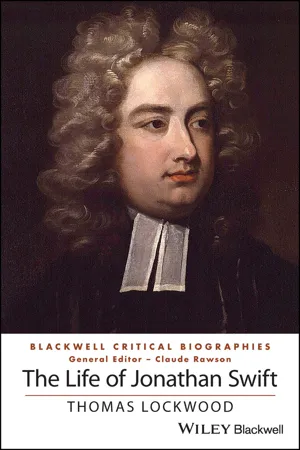
The Life of Jonathan Swift
About this book
Presents a fresh account of the life history and creative imagination of Jonathan Swift
Classic satires such as Gulliver's Travels, A Modest Proposal, and A Tale of a Tub express radical positions, yet were written by the most conservative of men. Jonathan Swift was born in Dublin and spent most of his life in Ireland, never traveling outside the British Isles. An Anglo-Irish Protestant clergyman, he was a major political and religious figure whose career was primarily clerical, not literary. Although much is known about Swift, in many ways he remains an enigma. He was admired as an Irish patriot yet was contemptuous of the Irish. He was both secretive and self-dramatizing. His talent for friendship was matched by his skill for making enemies. He hated the English but yearned to live in England.
The Life of Jonathan Swift explores the writing life and personal history of the foremost satirist in the English language. Accessible and engaging, this critical biography brings Swift's writing and creative sensibility into the narrative of his life. Author Thomas Lockwood provides the historical and modern critical context of Swift's prose satires and poetry, as well as his political journalism, essays, manuscripts, and personal correspondence. Throughout the book, biographically contextualized descriptions of Swift's most famous works help readers better understand both the writing and the writer.
- Provides critical profiles of Gulliver's Travels, An Argument Against Abolishing Christianity, Drapier's Letters, and Swift's other famous works
- Offers insights into Swift's relationships with Esther Johnson, "Stella," and Esther Vanhomrigh, "Vanessa"
- Highlights Swift's poetry and how verse writing was a vital part of his creative being
- Summarizes and contextualizes lesser-known works such as The Conduct of the Allies
- Addresses the historic critical bias against comedy or satire as inferior forms of art, both in Swift's lifetime and the present
The Life of Jonathan Swift is an essential resource for general readers of literature and literary biography, university instructors and researchers, and undergraduate students taking courses in English literature.
Frequently asked questions
- Essential is ideal for learners and professionals who enjoy exploring a wide range of subjects. Access the Essential Library with 800,000+ trusted titles and best-sellers across business, personal growth, and the humanities. Includes unlimited reading time and Standard Read Aloud voice.
- Complete: Perfect for advanced learners and researchers needing full, unrestricted access. Unlock 1.4M+ books across hundreds of subjects, including academic and specialized titles. The Complete Plan also includes advanced features like Premium Read Aloud and Research Assistant.
Please note we cannot support devices running on iOS 13 and Android 7 or earlier. Learn more about using the app.
Information
Table of contents
- Cover
- Title Page
- Copyright Page
- Contents
- Abbreviations and Texts
- Preface
- Chapter 1 Brought over to Ireland in a Band-Box 1667 –1689: Childhood and Schooling
- Chapter 2 Moor Park 1689 –1692: Sir William Temple; Pindaric Odes
- Chapter 3 Into the Church, Without Being Driven 1692 –1698: Ulster; Odes to Congreve, Temple
- Chapter 4 Laracor and London1698 –1704: Death of Temple; Contests and Dissensions; Mrs. Harris’s Petition
- Chapter 5 A Tale of a Tub 1704: Tale of a Tub; Battle of the Books; Mechanical Operation of the Spirit
- Chapter 6 Arguments about Christianity 1704 –1709: Church Diplomacy; Argument against Abolishing Christianity; Church-of-England Man; Mrs. Harris’s Petition; Baucis and Philemon; A Description of the Morning
- Chapter 7 Writing for Power1709 –1712: Into Government Service; The Examiner; Conduct of the Allies
- Chapter 8 The Life of a Spider 1711 –1712: Elusive Patronage; More Writing for the Ministry; Miscellanies (1711); Proposal for Correcting the English Tongue
- Chapter 9 Journal to Stella 1710 –1713: ‘Thinking Aloud’ to Stella; the Poetry of Everyday Swiftian Life; ‘Ragbags of Jottings’; Friendship with Vanessa
- Chapter 10 Preferment, Barely 1712 –1714: Dean of St. Patrick’s; Swift vs. Steele; Four Last Years of the Queen; Public Spirit of the Whigs
- Chapter 11 But Why Obscurely Here Alone? 1713 –1714: Death of the Queen; Scriblerians; Swift and Jacobitism; Horatian Poems to Steele, Oxford; The Author upon Himself
- Chapter 12 Living Out of the World 1714 –1718: Deanery Life; Cadenus and Vanessa; Mary the Cook-Maid’s Letter
- Chapter 13 Second Wind 1719 –1723: Creative Reawakening; Letter to a Very Young Lady on her Marriage; Proposal for Universal Use of Irish Manufactures; ‘Progress’ Poems; Poems to Stella
- Chapter 14 Mr. Drapier 1723 –1725: The Drapier’s Letters
- Chapter 15 Several Remote Nations 1721 –1726: Gulliver’s Travels
- Chapter 16 Poor Floating Isle 1726 –1729: Early Reception of Gulliver; Death of George I; Death of Stella; Holyhead Journal; Short View of the State of Ireland; The Intelligencer; Modest Proposal
- Chapter 17 Market Hill 1728 –1730: ‘Family Verses’ with Swift and Lady Acheson; Journal of a Modern Lady; the Pilkingtons; Freedom of the City of Cork; Traulus
- Chapter 18 A Kind of Knack at Rhyme 1730 –1733: Deanery Life; Scatological Poems; Verses on the Death of Dr. Swift
- Chapter 19 We Are All Slaves and Knaves and Fools 1732 –1735: Death of Gay; Pamphlets against Bishops, Test Act Repeal, Presbyterians; Miscellanies (1732); Beasts Confession, Epistle to a Lady, On Poetry
- Chapter 20 Drawing Room and Back Stairs 1735 –1736: Death of Arbuthnot; Pope’s Letters; The Legion Club; Directions to Servants; Polite Conversation
- Chapter 21 Silence 1737 –1745: A Proposal for Giving Badges to the Beggars; Swift’s Will and Epitaph; Last Years and Death
- Notes
- Bibliography
- Index
- EULA