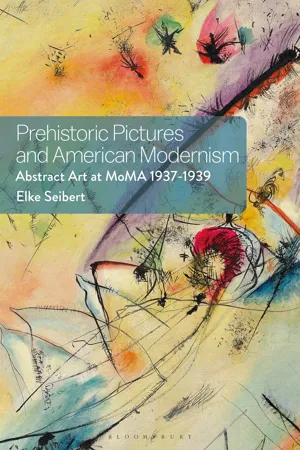
In April 1937, the Museum of Modern Art in New York hosted an exhibition that served as a catalyst for the appropriation of prehistoric rock art in postwar abstract painting. With the title "Prehistoric Rock Pictures in Europe and Africa", it displayed a range of copies from the influential collection of the German ethnologist Leo Frobenius.
Largely disregarded in modern American art history up until now, this book highlights the importance of this exhibition to artists such as Josef Albers, Adolph Gottlieb, David Smith, and The American Abstract Artists group, who sought inspiration from the prehistoric images' primordial creativity. With a transnational scope, this book reveals new facts about the connections between Paris and New York, and the importance of communication and collaboration between them for these artists. In doing so, Seibert shows that this debate was about more than just legitimizing abstract art forms from the past, but about recognizing an autonomous American abstract art.
Presenting unseen archival material, letters, and exhibition documentation, Prehistoric Pictures and American Modernism offers a new reading of the development of modern American abstraction, and will hold an important place in the historiography of the movement, its global traditions, and its legacy.
- 256 pages
- English
- ePUB (mobile friendly)
- Available on iOS & Android
eBook - ePub
About this book
Information
Table of contents
- Cover
- Half-Title Page
- Title Page
- Contents
- List of Illustrations
- Acknowledgments
- Part One Introduction
- 1 Preface
- 2 Prehistory as a Modern Idea in Europe and “Primitivism” as Intertwined Concepts (1900–40)
- Part Two Prehistoric Artifacts, Prints, Painted Copies, and the Genesis of Modern Art in New York (1937)
- 3 Alfred Barr’s View of Prehistory and Modernism as Shown at MoMA—and on Tour throughout the USA
- 4 Barr’s Exhibition Concept: “Prehistoric” Avant-Garde and Lala Eve Rivol’s Federal Art Project
- 5 Leo Frobenius’s Objectives, His Collection in Western Debates—and Henry Moore
- 6 The Making of the MoMA Exhibition Prehistoric Rock Pictures in Europe and Africa (April 28–May 30, 1937)
- Part Three The Art of Copying the Past—in Transatlantic Dialog
- 7 Copies and Copyists: Pictorial Heritage at the Museum of Modern Art
- 8 Copying for the Index of American Design (1935–42)
- Part Four Modern American Abstract Art and the Reappropriation of Prehistoric Rock Paintings
- 9 The Founding of the American Abstract Artists (1936) and their Appropriation of Prehistoric Rock Paintings (1937–40)
- 10 Bridging Time and Space: The Transcontinental AAA Network in the Interwar Period
- 11 The Influence of (Prehistoric) Artistic Concepts from Mexico on the American Abstract Artists
- 12 Prehistorical Modernists: Gottlieb, Lassaw, Schanker, Smith
- Part Five Conclusion
- 13 The “Modernity of Prehistory” in the Thirties in Paris and New York
- Appendix I
- Appendix II
- Notes
- Bibliography
- Index
- Plates
- Copyright
Trusted by 375,005 students
Access to over 1.5 million titles for a fair monthly price.
Study more efficiently using our study tools.
Frequently asked questions
Yes, you can cancel anytime from the Subscription tab in your account settings on the Perlego website. Your subscription will stay active until the end of your current billing period. Learn how to cancel your subscription
No, books cannot be downloaded as external files, such as PDFs, for use outside of Perlego. However, you can download books within the Perlego app for offline reading on mobile or tablet. Learn how to download books offline
Perlego offers two plans: Essential and Complete
- Essential is ideal for learners and professionals who enjoy exploring a wide range of subjects. Access the Essential Library with 800,000+ trusted titles and best-sellers across business, personal growth, and the humanities. Includes unlimited reading time and Standard Read Aloud voice.
- Complete: Perfect for advanced learners and researchers needing full, unrestricted access. Unlock 1.5M+ books across hundreds of subjects, including academic and specialized titles. The Complete Plan also includes advanced features like Premium Read Aloud and Research Assistant.
We are an online textbook subscription service, where you can get access to an entire online library for less than the price of a single book per month. With over 1.5 million books across 990+ topics, we’ve got you covered! Learn about our mission
Look out for the read-aloud symbol on your next book to see if you can listen to it. The read-aloud tool reads text aloud for you, highlighting the text as it is being read. You can pause it, speed it up and slow it down. Learn more about Read Aloud
Yes! You can use the Perlego app on both iOS and Android devices to read anytime, anywhere — even offline. Perfect for commutes or when you’re on the go.
Please note we cannot support devices running on iOS 13 and Android 7 or earlier. Learn more about using the app
Please note we cannot support devices running on iOS 13 and Android 7 or earlier. Learn more about using the app
Yes, you can access Prehistoric Pictures and American Modernism by Elke Seibert in PDF and/or ePUB format, as well as other popular books in Art & Histoire de l'art. We have over 1.5 million books available in our catalogue for you to explore.