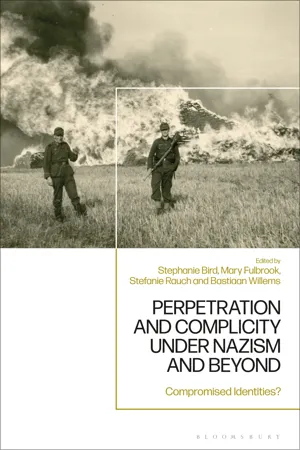
Perpetration and Complicity under Nazism and Beyond analyses perpetration and complicity under National Socialism and beyond. Contributors based in the UK, the USA, Canada, Germany, Israel and Chile reflect on self-understandings, representations and narratives of involvement in collective violence both at the time and later – a topic that remains highly relevant today.
Using the notion of 'compromised identities' to think about contentious questions relating to empathy and complicity, this inter-disciplinary collection addresses the complex relationships between people's behaviours and self-understandings through and beyond periods of collective violence. Contributors explore the compromises that individuals, states and societies enter into both during and after such violence.
Case studies highlight patterns of complicity and involvement in perpetration, and analyse how people's stories evolve under changing circumstances and through social interaction, using varying strategies of justification, denial and rationalisation. Each chapter also considers the ways in which contemporary responses and scholarly practices may be affected by engagement with perpetrator representations.
eBook - ePub
Perpetration and Complicity under Nazism and Beyond
Compromised Identities?
- 304 pages
- English
- ePUB (mobile friendly)
- Available on iOS & Android
eBook - ePub
Perpetration and Complicity under Nazism and Beyond
Compromised Identities?
About this book
Information
Table of contents
- Cover
- Half-Title
- Title
- Contents
- List of Contributors
- Acknowledgements
- 1 Introduction: ‘Compromised Identities?’
- Part I Theorizing ambiguity, compromise and complexity
- 2 ‘Compromised identities?’, ageing perpetrators and compromising forgiveness
- 3 Conformity, compliance and complicity: ‘Ordinary people’ and the Holocaust
- 4 Complicities, re-presented: Literary portrayals in totalitarianism and neoliberalism
- 5 In search of the bystander: Some reflections on the ‘social turn’ in Holocaust studies and its ramifications
- Part II Confrontations with violence
- 6 Studying East European perpetrators: The case of Belarus
- 7 Compromising roles: German actresses in German-occupied Minsk
- 8 Gender and transgressive violence in post-war accounts
- 9 Israeli national narratives, complicity and activism: Noam Chayut’s The Girl Who Stole My Holocaust and Breaking the Silence
- Part III Law, complicity and perpetration
- 10 The constitutive role of Nazi law: Constructing complicity in the Third Reich
- 11 Public execution in your community: The summary courts of 1945 Germany
- 12 Excess and normality: West German and Austrian media and Nazi crimes trials from the 1950s to the 1980s
- 13 Pinochet’s accomplices: Perpetration, civilian complicity and individual versus institutional culpability in domestic atrocity crime accountability
- Part IV Framing the past
- 14 Perpetrator memory and the fascist exile in Argentina: A case study
- 15 Complicity versus cooperation: Zygmunt Bauman’s Modernity and the Holocaust and Claude Lanzmann’s Shoah and its outtakes
- 16 Challenging the museum visitor? Complicity and perpetration during and beyond the Second World War in contemporary museum exhibitions
- 17 Compromised identities? Reflections on perpetration and complicity under Nazi rule: An exhibition
- 18 Conclusion
- Index
- Copyright
Trusted by 375,005 students
Access to over 1.5 million titles for a fair monthly price.
Study more efficiently using our study tools.
Frequently asked questions
Yes, you can cancel anytime from the Subscription tab in your account settings on the Perlego website. Your subscription will stay active until the end of your current billing period. Learn how to cancel your subscription
No, books cannot be downloaded as external files, such as PDFs, for use outside of Perlego. However, you can download books within the Perlego app for offline reading on mobile or tablet. Learn how to download books offline
Perlego offers two plans: Essential and Complete
- Essential is ideal for learners and professionals who enjoy exploring a wide range of subjects. Access the Essential Library with 800,000+ trusted titles and best-sellers across business, personal growth, and the humanities. Includes unlimited reading time and Standard Read Aloud voice.
- Complete: Perfect for advanced learners and researchers needing full, unrestricted access. Unlock 1.5M+ books across hundreds of subjects, including academic and specialized titles. The Complete Plan also includes advanced features like Premium Read Aloud and Research Assistant.
We are an online textbook subscription service, where you can get access to an entire online library for less than the price of a single book per month. With over 1.5 million books across 990+ topics, we’ve got you covered! Learn about our mission
Look out for the read-aloud symbol on your next book to see if you can listen to it. The read-aloud tool reads text aloud for you, highlighting the text as it is being read. You can pause it, speed it up and slow it down. Learn more about Read Aloud
Yes! You can use the Perlego app on both iOS and Android devices to read anytime, anywhere — even offline. Perfect for commutes or when you’re on the go.
Please note we cannot support devices running on iOS 13 and Android 7 or earlier. Learn more about using the app
Please note we cannot support devices running on iOS 13 and Android 7 or earlier. Learn more about using the app
Yes, you can access Perpetration and Complicity under Nazism and Beyond by Mary Fulbrook, Bastiaan Willems, Stephanie Bird, Stefanie Rauch, Mary Fulbrook,Bastiaan Willems,Stephanie Bird,Stefanie Rauch in PDF and/or ePUB format, as well as other popular books in History & 20th Century History. We have over 1.5 million books available in our catalogue for you to explore.