How domestic courts in newly democratized states become willing and able to enforce international human rights law When do domestic courts protect international human rights? By the end of the twentieth century, the world had witnessed an unprecedented flourishing of international human rights law and a growing number of democratic states whose domestic institutions promised to protect those rights. A single institution often became the center of these efforts: the court. Advocates in newly democratized states could look to high courts to demand that their governments comply with international law and bring policy into line with liberal rhetoric.This process, however, put these young courts in a difficult position. With no deep well of historical legitimacy to draw on in new political environments, courts had to weigh high-minded legal principles against the limited resources or political preferences of elected governments. In such situations, how did these courts respond, and what strategies allowed some to successfully build their legitimacy over time while others faltered, succumbing to political pressure or suffering political backlash?In Between Possibility and Peril, Chris Kendall explores this dynamic in three states—Colombia, Mexico, and South Africa—in the twenty years following each country's democratic transition. The case studies reveal a common pattern: what matters most is not international law itself, but a court's ability to control its procedural environment. Control over these "rules of the game" allows a court to selectively engage international human rights issues that can enhance its legitimacy and build public support while avoiding those issues likely to put it in direct conflict with hostile political actors. The result is paradoxical—the most successful courts in the long term are those who in the short term often choose to disappoint rights advocates.
eBook - ePub
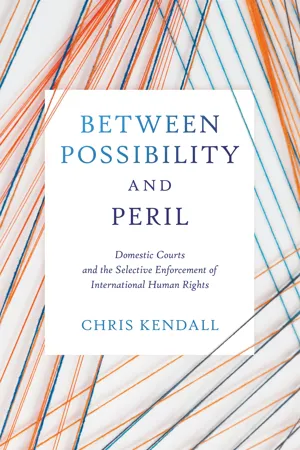
Between Possibility and Peril
Domestic Courts and the Selective Enforcement of International Human Rights
- 288 pages
- English
- ePUB (mobile friendly)
- Available on iOS & Android
eBook - ePub
Between Possibility and Peril
Domestic Courts and the Selective Enforcement of International Human Rights
About this book
Information
Table of contents
- Cover
- Half Title
- Series Page
- Title Page
- Copyright
- Contents
- Chapter 1. International Human Rights, Domestic Courts
- Chapter 2. Three-Dimensional Decision-Making in the Domestic Judiciary
- Chapter 3. Colombia: Balancing Act
- Chapter 4. South Africa: Majoritarian Difficulties
- Chapter 5. Mexico: Rigid Reform
- Chapter 6. Conclusions
- Appendix 1. Transitional States
- Appendix 2. Major International Human Rights Treaty Ratifications
- Notes
- References
- Index
Trusted by 375,005 students
Access to over 1.5 million titles for a fair monthly price.
Study more efficiently using our study tools.
Frequently asked questions
Yes, you can cancel anytime from the Subscription tab in your account settings on the Perlego website. Your subscription will stay active until the end of your current billing period. Learn how to cancel your subscription
No, books cannot be downloaded as external files, such as PDFs, for use outside of Perlego. However, you can download books within the Perlego app for offline reading on mobile or tablet. Learn how to download books offline
Perlego offers two plans: Essential and Complete
- Essential is ideal for learners and professionals who enjoy exploring a wide range of subjects. Access the Essential Library with 800,000+ trusted titles and best-sellers across business, personal growth, and the humanities. Includes unlimited reading time and Standard Read Aloud voice.
- Complete: Perfect for advanced learners and researchers needing full, unrestricted access. Unlock 1.5M+ books across hundreds of subjects, including academic and specialized titles. The Complete Plan also includes advanced features like Premium Read Aloud and Research Assistant.
We are an online textbook subscription service, where you can get access to an entire online library for less than the price of a single book per month. With over 1.5 million books across 990+ topics, we’ve got you covered! Learn about our mission
Look out for the read-aloud symbol on your next book to see if you can listen to it. The read-aloud tool reads text aloud for you, highlighting the text as it is being read. You can pause it, speed it up and slow it down. Learn more about Read Aloud
Yes! You can use the Perlego app on both iOS and Android devices to read anytime, anywhere — even offline. Perfect for commutes or when you’re on the go.
Please note we cannot support devices running on iOS 13 and Android 7 or earlier. Learn more about using the app
Please note we cannot support devices running on iOS 13 and Android 7 or earlier. Learn more about using the app
Yes, you can access Between Possibility and Peril by Chris Kendall in PDF and/or ePUB format, as well as other popular books in Politics & International Relations & Civil Rights in Law. We have over 1.5 million books available in our catalogue for you to explore.