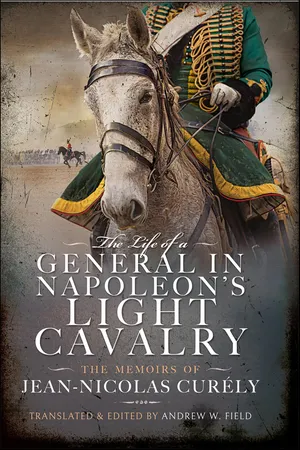
The first English translation of the memoirs a peasant's son who rose through the ranks of the French Army to become a general in Napoleon's Light Cavalry.
Although Jean-Nicolas Curély did not fight in many of the most famous battles of the First Republic and the Napoleonic Wars, this reflects the role of the light cavalry; scouting ahead of the army, conducting reconnaissance to the flanks and launching raids. He did, however, take part in all Napoleon's great campaigns, including Austerlitz, Heilsberg, Essling, Raab, Wagram, Beresina, Wachau, Leipzig, Craonne and Laon, and served as an aide de camp to many of the French army's most famous light cavalry generals.
Curély's memoirs give a unique and detailed glimpse into the day-to-day life of the light cavalry from someone who, although of lowly birth and with no education, became an exceptional General. He was a hussar at nineteen years, second lieutenant at thirty-two, squadron commander at thirty-five, Colonel at thirty-eight and General at forty. He became Cavalier of the Légion d'Honneur in 1806, and was wounded five times in his career.
His account describes in great detail the many actions he was involved in and the many exceptional scrapes he escaped. However, his narrative does not only describe combat but also the lengths he went to for the welfare of his men and horses, particularly during the retreat from Moscow which he survived with a hundred men and nearly all his officers still battleworthy.
Stretching from Curély's enrolment with the Hussars in 1793 to Waterloo, capitulation of Paris and the disbandment of the army, this book is a "must have" for anyone with an interest in the Napoleonic Wars.