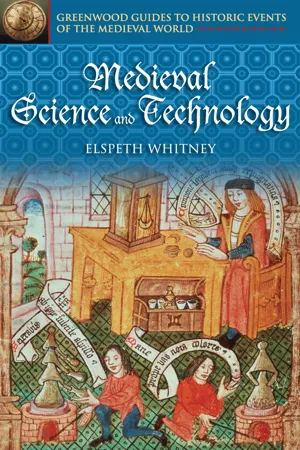
Medieval science and technology was firmly rooted in Aristotelian explanations of the physical world. This book begins by introducing the basic concepts of the classical tradition, and explains how these ideas were promulgated by the ancient Greeks, preserved and commented on by the great Muslim scholars of the early middle ages, and finally transmitted to western Europe as that region began to grow and expand around 1100 C.E. Specific avenues of inquiry such as astronomy and astrology, optics, chemistry and alchemy, zoology, geography, and medicine are described on their own terms. Rounding out the work is a discussion of the many technological innovations of the medieval age, such as mechanical clocks, firearms, and the blast furnace, that profoundly altered the course of European and world history. Biographical sketches provide insight into the lives and accomplishments of 20 men and women, Christian, Muslim, and pagan, whose works profoundly shaped the era's scientific spirit. Eleven annotated key primary documents afford a fascinating glimpse into how the best minds of the time posed their questions and their answers. An annotated timeline, glossary of terms, several illustrations, and an annotated bibliography round out the work.
Medieval scientists, or natural philosophers, as they were then called, were powerfully influenced by the authority of older traditions, including Christianity and scientific ideas dating back to Plato, Aristotle, and Ptolemy. Yet their respect for these traditions was balanced by an equal respect for reason and the spirit of inquiry. Religious faith, far from dampening scientific and technological innovation, actually buttressed their efforts to understand the natural world as it was generally taken for granted that knowledge acquired through reason would harmonize with religious beliefs. While medieval science and technology did not seek to overthrow the prevailing worldviews of the time, their accomplishments did lay the groundwork for the scientific revolution and European global expansion of the early modern age.
- 300 pages
- English
- PDF
- Available on iOS & Android
eBook - PDF
Medieval Science and Technology
Table of contents
- Cover
- Half-title
- Title
- Copyright
- Dedication
- Contents
- Illustrations
- Series Foreword
- Advisory Board
- Preface
- Chronology
- Chapter 1: Overview and History: The Classical Tradition and the Early Middle Ages
- Chapter 2: Institutional History: The High and Late Middle Ages
- Chapter 3: Aristotle, Plato, and the Medieval Scientific Worldview
- Chapter 4: The Exact Sciences
- Chapter 5: The Biological and Earth Sciences
- Chapter 6: Medieval Technology
- Chapter 7: The Impact of Medieval Science and Technology
- Biographies
- Primary Documents
- Glossary
- Annotated Bibliography
- Index
- About the Author
Trusted by 375,005 students
Access to over 1.5 million titles for a fair monthly price.
Study more efficiently using our study tools.
Frequently asked questions
Yes, you can cancel anytime from the Subscription tab in your account settings on the Perlego website. Your subscription will stay active until the end of your current billing period. Learn how to cancel your subscription
No, books cannot be downloaded as external files, such as PDFs, for use outside of Perlego. However, you can download books within the Perlego app for offline reading on mobile or tablet. Learn how to download books offline
Perlego offers two plans: Essential and Complete
- Essential is ideal for learners and professionals who enjoy exploring a wide range of subjects. Access the Essential Library with 800,000+ trusted titles and best-sellers across business, personal growth, and the humanities. Includes unlimited reading time and Standard Read Aloud voice.
- Complete: Perfect for advanced learners and researchers needing full, unrestricted access. Unlock 1.5M+ books across hundreds of subjects, including academic and specialized titles. The Complete Plan also includes advanced features like Premium Read Aloud and Research Assistant.
We are an online textbook subscription service, where you can get access to an entire online library for less than the price of a single book per month. With over 1.5 million books across 990+ topics, we’ve got you covered! Learn about our mission
Look out for the read-aloud symbol on your next book to see if you can listen to it. The read-aloud tool reads text aloud for you, highlighting the text as it is being read. You can pause it, speed it up and slow it down. Learn more about Read Aloud
Yes! You can use the Perlego app on both iOS and Android devices to read anytime, anywhere — even offline. Perfect for commutes or when you’re on the go.
Please note we cannot support devices running on iOS 13 and Android 7 or earlier. Learn more about using the app
Please note we cannot support devices running on iOS 13 and Android 7 or earlier. Learn more about using the app
Yes, you can access Medieval Science and Technology by Elspeth Whitney in PDF and/or ePUB format, as well as other popular books in History & European Medieval History. We have over 1.5 million books available in our catalogue for you to explore.