The Bloomsbury Handbook of Muslims and Popular Culture illustrates how Muslims participate in a broad spectrum of activities. Moving beyond a framework that emphasizes ritual, legal, historical, or theological issues, this book speaks to how Muslims live in the world, in relation to their religion and the realities of the world around them.
The international team of contributors provide in-depth analysis that chronicles Islamic cultural products in regional and transnational contexts, explores dominant and emerging theories about popularization, and offers provocations in the field of religion and popular culture. The handbook is structured in six parts: spaces; appetites; performances; readings; visions; and communities.
The book explores a variety of Muslim societies and communities within the last 100 years, ranging from the Islamic presence in Latin American architecture to Muslim Anglophone hip-hop, and Muslims in modern Indian theatre.
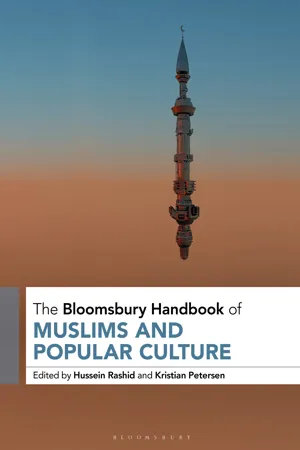
eBook - ePub
The Bloomsbury Handbook of Muslims and Popular Culture
- 416 pages
- English
- ePUB (mobile friendly)
- Available on iOS & Android
eBook - ePub
The Bloomsbury Handbook of Muslims and Popular Culture
About this book
Information
Table of contents
- Cover
- Half-Title Page
- Dedication
- Series Page
- Title Page
- Contents
- List of Figures
- List of Contributors
- Acknowledgments
- Introduction: The Orientations of Muslim Popular Culture
- Part 1 Spaces
- 1 Islamic Presence in Latin American Architecture: Three Periods, Three Ways
- 2 Impact of Shiah Government on Public Spaces’ Morphology of Tehran After the Islamic Revolution
- 3 Sights and Sites of Translocal Islam: Chinese-style Mosques in Malaysia and Indonesia
- 4 Eidgah: Multifunctional Open Architecture as a Shared Space for Memory and Emotion
- 5 Image and Object in Islam: On the Ka’bah and its Popular Representations
- 6 This is Home Now! “Migrating” Mosques as Symbols of Territorial Identity in the Modern Australian Suburban Landscape
- Part 2 Appetites
- 7 Shi‘i Muslim Food Practices in Contemporary Iran: Transformation, Blessing, and Citizenship
- 8 Muslim Butchers, Ethical Practice, and Sensory Politics: The Changing Economy of Meat in Mumbai
- 9 Muslim Foodways and Pop Culture: Beyond Halal, Boundary Maintenance, and SAME cuisine
- Part 3 Performances
- 10 Rai, World Music, and Islam
- 11 Desert Rhythms and Islamic Girl Groups: Making Modern Music for the Muslim Masses in 1970s Southeast Asia
- 12 The Poetics of Resistance in Muslim Anglophone Hip Hop: A Reading of Omar Offendum as a Representative Voice
- 13 What is a Muslim Comedian? Muslim Comedians and Racialization in the United States
- 14 Representation, Identity, and Community: Muslims in Modern Indian Theatre
- 15 Muslims and Cricket
- Part 4 Readings
- 16 Sisters, Skanks, and Jezebels: American Muslim Fiction and the Other Woman
- 17 Towards a Global History of Islamicate Science Fiction
- 18 Counter-Images? The Cultural Transfer of the Caricature into Modern Egyptian Culture
- Part 5 Visions
- 19 Indigeneity and Identity Transmission: Amazigh Cultural Expression Through Film
- 20 Kannywood: An Embattled Hausa Film Industry in “Muslim Northern” Nigeria
- 21 Malaysia’s Popular Malay-Muslim TV Fiction and Fan Narratives
- 22 Islamic Geometric Design in Popular Culture
- 23 Radical Hope in Cultural Subversion: Muslim Women Artists on Space and Identity
- Part 6 Communities
- 24 Consuming Sufism: Rumi and the Making of a Cultural Icon
- 25 Materializing Islam: Fashion Advertisements and the Production of “The Muslim Woman”
- 26 The Prophet Muhammad’s Sandalprint: Muslim Retro-cool and the Product-placed Sermon in Contemporary Turkey
- 27 Muslim Preachers and Mass Media
- Notes
- References
- Index
- Copyright
Trusted by 375,005 students
Access to over 1.5 million titles for a fair monthly price.
Study more efficiently using our study tools.
Frequently asked questions
Yes, you can cancel anytime from the Subscription tab in your account settings on the Perlego website. Your subscription will stay active until the end of your current billing period. Learn how to cancel your subscription
No, books cannot be downloaded as external files, such as PDFs, for use outside of Perlego. However, you can download books within the Perlego app for offline reading on mobile or tablet. Learn how to download books offline
Perlego offers two plans: Essential and Complete
- Essential is ideal for learners and professionals who enjoy exploring a wide range of subjects. Access the Essential Library with 800,000+ trusted titles and best-sellers across business, personal growth, and the humanities. Includes unlimited reading time and Standard Read Aloud voice.
- Complete: Perfect for advanced learners and researchers needing full, unrestricted access. Unlock 1.5M+ books across hundreds of subjects, including academic and specialized titles. The Complete Plan also includes advanced features like Premium Read Aloud and Research Assistant.
We are an online textbook subscription service, where you can get access to an entire online library for less than the price of a single book per month. With over 1.5 million books across 990+ topics, we’ve got you covered! Learn about our mission
Look out for the read-aloud symbol on your next book to see if you can listen to it. The read-aloud tool reads text aloud for you, highlighting the text as it is being read. You can pause it, speed it up and slow it down. Learn more about Read Aloud
Yes! You can use the Perlego app on both iOS and Android devices to read anytime, anywhere — even offline. Perfect for commutes or when you’re on the go.
Please note we cannot support devices running on iOS 13 and Android 7 or earlier. Learn more about using the app
Please note we cannot support devices running on iOS 13 and Android 7 or earlier. Learn more about using the app
Yes, you can access The Bloomsbury Handbook of Muslims and Popular Culture by Hussein Rashid, Kristian Petersen, Hussein Rashid,Kristian Petersen in PDF and/or ePUB format, as well as other popular books in Theology & Religion & Islamic Theology. We have over 1.5 million books available in our catalogue for you to explore.