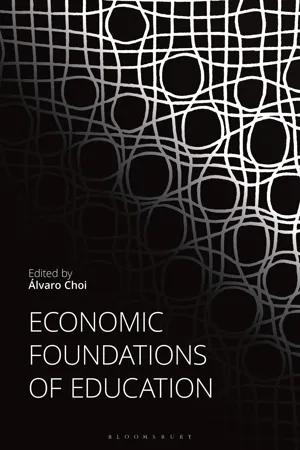
This volume introduces the economics as a foundational discipline in education. It provides economists and non-economists with an accessible grounding in the key concepts and recent developments in the field. The book deals with such themes as human capital theory and its alternatives, the monetary and non-monetary benefits of education, the education production function, equity in education, and the evaluation of education policies. In this volume, students, researchers and policymakers will find an entry point into the way economists think about educational questions and readers will deepen their understanding of the field with state-of-the-art reviews of the main topics that are at the heart of the economist of education today.
About the Educational Foundations series:
Education, as an academic field taught at universities around the world, emerged from a range of older foundational disciplines. The Educational Foundations series comprises six volumes, each covering one of the foundational disciplines of philosophy, history, sociology, policy studies, economics and law. This is the first reference work to provide an authoritative and up-to-date account of all six disciplines, showing how each field's ideas, methods, theories and approaches can contribute to research and practice in education today. The six volumes cover the same set of key topics within education, which also form the chapter titles:
- Mapping the Field
- Purposes of Education
- Curriculum
- Schools and Education Systems
- Learning and Human Development
- Teaching and Teacher Education
- Assessment and Evaluation
This structure allows readers to study the volumes in isolation, by discipline, or laterally, by topic, and facilitates a comparative, thematic reading of chapters across the volumes. Throughout the series, attention is paid to how the disciplines comprising the educational foundations speak to social justice concerns such as gender and racial equality.
- 216 pages
- English
- ePUB (mobile friendly)
- Available on iOS & Android
eBook - ePub
Economic Foundations of Education
About this book
Information
Table of contents
- Cover
- Halftitle Page
- Title Page
- Contents
- List of Figures
- List of Tables
- General Editors’ Preface
- Introduction
- 1 Mapping the Field: The Golden Age of a Young Discipline
- 2 Purposes of Education: The Iterative 5D Model for Sustainable Improvement of Educational Quality
- 3 Curriculum: Exposure to Mathematics in Secondary Education and Its Economic Benefits—The Role of Mathematics Achievement, Attitudes, and Self-Beliefs
- 4 Schools and Education Systems: How Costs and Production Technologies Influence the Structure of Provision
- 5 Learning and Human Development: Educational Achievement—Its Determinants and Long-Term Effects
- 6 Teaching and Teacher Education: What We Know, Who Enters, Stays in, and Thrives in the Classroom
- 7 Assessment and Evaluation: The Uses and Misuses of Test-Based Assessments
- List of Contributors
- Index
- Imprint
Trusted by 375,005 students
Access to over 1.5 million titles for a fair monthly price.
Study more efficiently using our study tools.
Frequently asked questions
Yes, you can cancel anytime from the Subscription tab in your account settings on the Perlego website. Your subscription will stay active until the end of your current billing period. Learn how to cancel your subscription
No, books cannot be downloaded as external files, such as PDFs, for use outside of Perlego. However, you can download books within the Perlego app for offline reading on mobile or tablet. Learn how to download books offline
Perlego offers two plans: Essential and Complete
- Essential is ideal for learners and professionals who enjoy exploring a wide range of subjects. Access the Essential Library with 800,000+ trusted titles and best-sellers across business, personal growth, and the humanities. Includes unlimited reading time and Standard Read Aloud voice.
- Complete: Perfect for advanced learners and researchers needing full, unrestricted access. Unlock 1.5M+ books across hundreds of subjects, including academic and specialized titles. The Complete Plan also includes advanced features like Premium Read Aloud and Research Assistant.
We are an online textbook subscription service, where you can get access to an entire online library for less than the price of a single book per month. With over 1.5 million books across 990+ topics, we’ve got you covered! Learn about our mission
Look out for the read-aloud symbol on your next book to see if you can listen to it. The read-aloud tool reads text aloud for you, highlighting the text as it is being read. You can pause it, speed it up and slow it down. Learn more about Read Aloud
Yes! You can use the Perlego app on both iOS and Android devices to read anytime, anywhere — even offline. Perfect for commutes or when you’re on the go.
Please note we cannot support devices running on iOS 13 and Android 7 or earlier. Learn more about using the app
Please note we cannot support devices running on iOS 13 and Android 7 or earlier. Learn more about using the app
Yes, you can access Economic Foundations of Education by Álvaro Choi in PDF and/or ePUB format, as well as other popular books in Education & Business Education. We have over 1.5 million books available in our catalogue for you to explore.