They are four words that can terrify any parent to the core: Your child has cancer. Each year more than 13,000 children and teenagers are diagnosed with cancer in the United States. The shock and demands of that diagnosis can be overwhelming for the parents, children, family, and friends as they face the emotions, along with the need to understand what the diagnosis means as well as what treatments are available and which are right for them. Parents, family members, friends, and professionals in healthcare will find support in this book. Written by a specialist in Pediatric Oncology, who is herself a cancer survivor as well as the mother of three young children, this book is clearly-stated and offers comprehensive information about the cancers that strike our youngest.
They are four words that can terrify any parent to the core: Your child has cancer. Each year, more than 13,000 children and teenagers in the United States are diagnosed with cancer. The shock and demands of that diagnosis can be overwhelming for the parents, children, family members, and friends, as they face the emotions along with the need to understand what the diagnosis means, what treatments are available and which are right for them. In this book, there is support for all. Written by a specialist in Pediatric Oncology who is herself a cancer patient as well as the mother of three young children, this guide offers clearly stated and comprehensive information about the cancers that strike our youngest.
Dr. Howell explains the 12 types of childhood cancer, with leukemias and tumors of the brain and nervous system most common. She tells us what the overall prognosis is, and how cancers affect children differently than they do adults, as well as what little is known about the causes, and she details the controversies on that subject. Howell explains common procedures and tests before, during, and after therapy, as well as the potential side effects. This compassionate physician does not ignore the vitally important issues of emotion—how to find the calm and strength to help the child or teen and be his or her best advocate, how to tell the child the diagnosis, what questions to anticipate, and how to deal with other family members and friends.
eBook - PDF
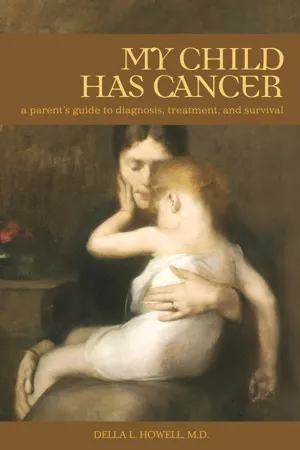
My Child Has Cancer
A Parent's Guide to Diagnosis, Treatment, and Survival
- 217 pages
- English
- PDF
- Available on iOS & Android
eBook - PDF
About this book
Information
Table of contents
- Series Foreword
- Introduction
- Abbreviations
- Chapter 1: Cancer and Children
- Chapter 2: Types of Cancer, Part I—Leukemia
- Chapter 3: Types of Cancer, Part II—Lymphoma
- Chapter 4: Types of Cancer, Part III—Brain Tumors, Neuroblastoma, and Kidney Tumors
- Chapter 5: Types of Cancer, Part IV—Bone Tumors and Muscle Tumors
- Chapter 6: Types of Cancer, Part V—Rare Pediatric Cancer Diagnoses
- Chapter 7: Telling the Child
- Chapter 8: Procedures at Diagnosis, in Therapy, and After Therapy
- Chapter 9: Chemotherapy and Taking Medicines
- Chapter 10: Radiation Therapy
- Chapter 11: Stem Cell and Bone Marrow Transplants
- Chapter 12: Common Side Effects
- Chapter 13: Complementary and Alternative Medicine in Cancer
- Chapter 14: Choosing Among Potential Treatments
- Chapter 15: Understanding the Medical System
- Chapter 16: Understanding Clinical Trials
- Chapter 17: Asking Questions, Finding Answers
- Chapter 18: Helping Family Members and Friends
- Chapter 19: When Cancer Treatments Stop Working
- Conclusion
- Appendix: Resources for Children, Adolescents, and Parents Dealing with Pediatric Cancer
- Notes
- Index
Trusted by 375,005 students
Access to over 1.5 million titles for a fair monthly price.
Study more efficiently using our study tools.
Frequently asked questions
Yes, you can cancel anytime from the Subscription tab in your account settings on the Perlego website. Your subscription will stay active until the end of your current billing period. Learn how to cancel your subscription
No, books cannot be downloaded as external files, such as PDFs, for use outside of Perlego. However, you can download books within the Perlego app for offline reading on mobile or tablet. Learn how to download books offline
Perlego offers two plans: Essential and Complete
- Essential is ideal for learners and professionals who enjoy exploring a wide range of subjects. Access the Essential Library with 800,000+ trusted titles and best-sellers across business, personal growth, and the humanities. Includes unlimited reading time and Standard Read Aloud voice.
- Complete: Perfect for advanced learners and researchers needing full, unrestricted access. Unlock 1.5M+ books across hundreds of subjects, including academic and specialized titles. The Complete Plan also includes advanced features like Premium Read Aloud and Research Assistant.
We are an online textbook subscription service, where you can get access to an entire online library for less than the price of a single book per month. With over 1.5 million books across 990+ topics, we’ve got you covered! Learn about our mission
Look out for the read-aloud symbol on your next book to see if you can listen to it. The read-aloud tool reads text aloud for you, highlighting the text as it is being read. You can pause it, speed it up and slow it down. Learn more about Read Aloud
Yes! You can use the Perlego app on both iOS and Android devices to read anytime, anywhere — even offline. Perfect for commutes or when you’re on the go.
Please note we cannot support devices running on iOS 13 and Android 7 or earlier. Learn more about using the app
Please note we cannot support devices running on iOS 13 and Android 7 or earlier. Learn more about using the app
Yes, you can access My Child Has Cancer by Della L. Howell M.D. in PDF and/or ePUB format, as well as other popular books in Medicine & General Health. We have over 1.5 million books available in our catalogue for you to explore.