Why do the combat capabilities of individual soldiers vary so much? This book seeks to provide an answer to this and other questions about variability in combat performance. Some soldiers flee quickly from the battlefield, while others endure all hardships until the bitter end. Some combat units can perform numerous types of missions, while others cannot keep themselves organized during peacetime. Some militaries armed with obsolete weapons have out fought enemies with the latest weapons, just as some massively outnumbered armies have beaten back much larger opponents. In this first social scientific study of the effectiveness of combat troops, Newsome evaluates competing explanations for the varying combat capabilities and performances.
There are four main explanations, each emphasizing the influence of a single factor. The first focuses on material endowments. How well funded are the troops? Do they have the latest protective gear and the most advanced weaponry? Second, some analysts claim that democracies produce better commanders, superior strategies, more motivated personnel, or better-managed personnel; others, however, associated those characteristics with more authoritarian forms of government. Third is the idea that giving more power to the troops on the ground in individual combat units empowers them with decision-making capability and adaptability to fast-changing situations and circumstances. Newsome presents evidence that decentralized personnel management does correlate with superior combat performance. Fourth, soldier capabilities and performance often are assumed to reflect intrinsic attributes, such as prior civilian values. Newsome argues that the capabilities of combat soldiers are acquired through military training and other forms of conditioning, but he does not entirely discount the role of a soldier's individual character. In the age-old nature vs. nurture argument, he finds that intrinsic qualities do count, but that extrinsic factors, such as training and environment, matter even more.
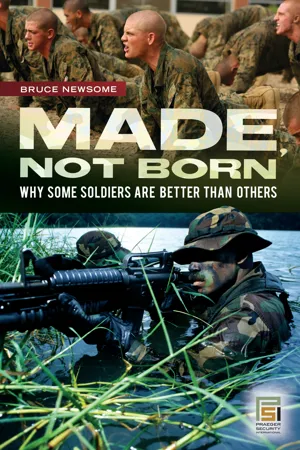
- 217 pages
- English
- PDF
- Available on iOS & Android
eBook - PDF
Table of contents
- Contents
- Introduction
- Chapter 1 Domestic Politics
- Chapter 2 Combat Personnel Management
- Chapter 3 Force Employment, Command, Leadership, and Decision-Making
- Chapter 4 Combat Stress and Cohesion
- Chapter 5 Combat Motivation
- Chapter 6 Athleticism and Special Operations
- Conclusion
- Notes
- Select Bibliography
- Index
Trusted by 375,005 students
Access to over 1.5 million titles for a fair monthly price.
Study more efficiently using our study tools.
Frequently asked questions
Yes, you can cancel anytime from the Subscription tab in your account settings on the Perlego website. Your subscription will stay active until the end of your current billing period. Learn how to cancel your subscription
No, books cannot be downloaded as external files, such as PDFs, for use outside of Perlego. However, you can download books within the Perlego app for offline reading on mobile or tablet. Learn how to download books offline
Perlego offers two plans: Essential and Complete
- Essential is ideal for learners and professionals who enjoy exploring a wide range of subjects. Access the Essential Library with 800,000+ trusted titles and best-sellers across business, personal growth, and the humanities. Includes unlimited reading time and Standard Read Aloud voice.
- Complete: Perfect for advanced learners and researchers needing full, unrestricted access. Unlock 1.5M+ books across hundreds of subjects, including academic and specialized titles. The Complete Plan also includes advanced features like Premium Read Aloud and Research Assistant.
We are an online textbook subscription service, where you can get access to an entire online library for less than the price of a single book per month. With over 1.5 million books across 990+ topics, we’ve got you covered! Learn about our mission
Look out for the read-aloud symbol on your next book to see if you can listen to it. The read-aloud tool reads text aloud for you, highlighting the text as it is being read. You can pause it, speed it up and slow it down. Learn more about Read Aloud
Yes! You can use the Perlego app on both iOS and Android devices to read anytime, anywhere — even offline. Perfect for commutes or when you’re on the go.
Please note we cannot support devices running on iOS 13 and Android 7 or earlier. Learn more about using the app
Please note we cannot support devices running on iOS 13 and Android 7 or earlier. Learn more about using the app
Yes, you can access Made, Not Born by Bruce Newsome in PDF and/or ePUB format, as well as other popular books in History & Military & Maritime History. We have over 1.5 million books available in our catalogue for you to explore.