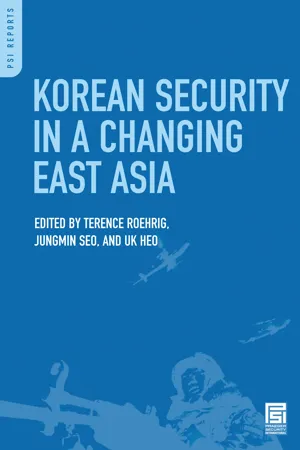
Since its partition in the 1950s, the Korean peninsula has directly or indirectly shaped the broader security relations between regional powerhouses, and the recent test of a nuclear weapon by the North Korean regime has heightened tensions across the world. This study draws upon contributions from a diverse array of experts who offer their perspectives on the region's complex network of alliances and hostilities. The authors discuss the future of the region, the potential for military conflict and a new arms race, and the ways to maintain peace and stability.
Since its partition in the 1950s, the Korean peninsula has directly or indirectly shaped the broader security relations between regional powerhouses, while the recent test of a nuclear weapon by the North Korean regime has heightened tensions across the world. Japan, feeling increasingly threatened by the North Korean regime and China's extravagant military expenditures, has begun questioning Article IX in its Constitution that renounces war and the maintenance of armed forces. Its neighbors, still haunted by Japanese atrocities during World War II, are fearful of a new nuclear arms race in the region. The United States, for its part, has adopted unprecedented hard-line policies in response to 9/11, going so far as to condemn North Korea as part of an axis of evil. It has strengthened its alliance with Japan and alienated its long-time strategic partner South Korea. Add to this the economic entanglements of each of these countries both with each other and with the rest of the world, and the regional security issues become even more paramount.
This study makes sense of these complex alliances and frictions and offers an array of perspectives on the future of the region, the potential for military conflict and a new arms race, and the ways to maintain peace and stability. Topics include big power rivalries, South Korea's sunshine policy, anti-Americanism, and emerging nationalisms.
- 225 pages
- English
- PDF
- Available on iOS & Android
eBook - PDF
Korean Security in a Changing East Asia
About this book
Information
Table of contents
- Contents
- Acknowledgments
- Chapter 1 Introduction
- Part I: North Korea
- Part II: Changing Security Environment in East Asia
- Part III: Shifting U.S.-South Korea Relationship
- Index
- About the Editors and Contributors
Trusted by 375,005 students
Access to over 1.5 million titles for a fair monthly price.
Study more efficiently using our study tools.
Frequently asked questions
Yes, you can cancel anytime from the Subscription tab in your account settings on the Perlego website. Your subscription will stay active until the end of your current billing period. Learn how to cancel your subscription
No, books cannot be downloaded as external files, such as PDFs, for use outside of Perlego. However, you can download books within the Perlego app for offline reading on mobile or tablet. Learn how to download books offline
Perlego offers two plans: Essential and Complete
- Essential is ideal for learners and professionals who enjoy exploring a wide range of subjects. Access the Essential Library with 800,000+ trusted titles and best-sellers across business, personal growth, and the humanities. Includes unlimited reading time and Standard Read Aloud voice.
- Complete: Perfect for advanced learners and researchers needing full, unrestricted access. Unlock 1.5M+ books across hundreds of subjects, including academic and specialized titles. The Complete Plan also includes advanced features like Premium Read Aloud and Research Assistant.
We are an online textbook subscription service, where you can get access to an entire online library for less than the price of a single book per month. With over 1.5 million books across 990+ topics, we’ve got you covered! Learn about our mission
Look out for the read-aloud symbol on your next book to see if you can listen to it. The read-aloud tool reads text aloud for you, highlighting the text as it is being read. You can pause it, speed it up and slow it down. Learn more about Read Aloud
Yes! You can use the Perlego app on both iOS and Android devices to read anytime, anywhere — even offline. Perfect for commutes or when you’re on the go.
Please note we cannot support devices running on iOS 13 and Android 7 or earlier. Learn more about using the app
Please note we cannot support devices running on iOS 13 and Android 7 or earlier. Learn more about using the app
Yes, you can access Korean Security in a Changing East Asia by Terence Roehrig,Jungmin Seo,Uk Heo in PDF and/or ePUB format, as well as other popular books in Politics & International Relations & International Relations. We have over 1.5 million books available in our catalogue for you to explore.