The danger raised by the terrorist threat is real, existential, and vital to the United States. But the attacks on 9/11 have been broadly misunderstood. In assessing the meaning and significance of the war on terror, Tschirgi raises many issues related to the Middle East and American policy toward that area. For example, he debunks the entire exceptionalist approach to the Arab world (the presumption that Arab societies fail to be fathomed by Western social science). While Tschirgi stresses the need for resolving the war on terrorism favorably, he also suggests two broad policy recommendations. First, he argues that while the United States should maintain its firm commitment to Israel's preservation as a Jewish state, it has no corresponding duty to support Israeli expansionism. U.S.-Israeli relations should proceed on this basis and should be informed by a greater American reliance on principles of international law. Second, Tschirgi concludes that an American withdrawal from Iraq must be effected as early as possible.
Tschirgi's provocative thesis is that the attacks of 9/11 were not as unique an event as we commonly believe. Rather, they were understandable—though deplorable—human reactions to a combination of factors that fueled the Arab world's marginalization and led to a generalized feeling among the people of that region that the West (and particularly the United States) posed a mortal threat to their identity. Employing three case studies of marginalized violent conflict—Mexico's Zapatista conflict, Egypt's struggle against the Gama'a al-Islamiyya in Upper Egypt, and Nigeria's fight against the Ogoni people in the Niger Delta—Tschirgi demonstrates the dynamics through which traditional peoples have in modern times opted to wage hopeless struggle against objectively more powerful states. The parallels between the dynamics that informed each of these situations and those marking the international Muslim insurgency against the West are striking, as are the significant differences between the two phenomena. The parallels are found in the mechanics of marginalization and resistance. The differences lie, first, in the Muslim insurgency's identification of the West as a total enemy and the struggle with it as having a zero-sum nature and, second, in the modern terrorists' potential access to lethal means of mass destruction. Both the parallels and differences that mark the two phenomena help deepen a real understanding of the meaning of 9/11.
eBook - PDF
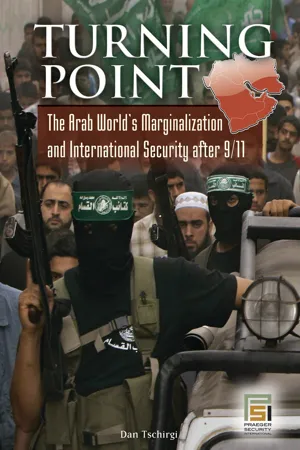
Turning Point
The Arab World's Marginalization and International Security After 9/11
- 249 pages
- English
- PDF
- Available on iOS & Android
eBook - PDF
Turning Point
The Arab World's Marginalization and International Security After 9/11
About this book
Information
Table of contents
- CONTENTS
- PREFACE
- INTRODUCTION
- PART I: THE UNITED STATES AND 9/11
- PART II: A TYPE OF ASYMMETRICAL CONFLICT
- PART III: THE QUEST FOR INTERNATIONAL SECURITY
- NOTES
- FURTHER READING
- INDEX
- ABOUT THE AUTHOR
Trusted by 375,005 students
Access to over 1.5 million titles for a fair monthly price.
Study more efficiently using our study tools.
Frequently asked questions
Yes, you can cancel anytime from the Subscription tab in your account settings on the Perlego website. Your subscription will stay active until the end of your current billing period. Learn how to cancel your subscription
No, books cannot be downloaded as external files, such as PDFs, for use outside of Perlego. However, you can download books within the Perlego app for offline reading on mobile or tablet. Learn how to download books offline
Perlego offers two plans: Essential and Complete
- Essential is ideal for learners and professionals who enjoy exploring a wide range of subjects. Access the Essential Library with 800,000+ trusted titles and best-sellers across business, personal growth, and the humanities. Includes unlimited reading time and Standard Read Aloud voice.
- Complete: Perfect for advanced learners and researchers needing full, unrestricted access. Unlock 1.5M+ books across hundreds of subjects, including academic and specialized titles. The Complete Plan also includes advanced features like Premium Read Aloud and Research Assistant.
We are an online textbook subscription service, where you can get access to an entire online library for less than the price of a single book per month. With over 1.5 million books across 990+ topics, we’ve got you covered! Learn about our mission
Look out for the read-aloud symbol on your next book to see if you can listen to it. The read-aloud tool reads text aloud for you, highlighting the text as it is being read. You can pause it, speed it up and slow it down. Learn more about Read Aloud
Yes! You can use the Perlego app on both iOS and Android devices to read anytime, anywhere — even offline. Perfect for commutes or when you’re on the go.
Please note we cannot support devices running on iOS 13 and Android 7 or earlier. Learn more about using the app
Please note we cannot support devices running on iOS 13 and Android 7 or earlier. Learn more about using the app
Yes, you can access Turning Point by Robert Daniel Tschirgi in PDF and/or ePUB format, as well as other popular books in Politica e relazioni internazionali & Relazioni internazionali. We have over 1.5 million books available in our catalogue for you to explore.