Long before the terrorist attacks of September 11, 2001, awakened the United States and the Western world to the heightened level of the terrorist threat, Southeast Asia had been dealing with this threat. The bombing in Bali that killed 202 people, many of them Australian tourists, was by no means the region's first experience with Islamic extremism, which can be traced back to the 1940s, and the Darul Islam struggle. The most recent group to emerge is Al-Jama'ah Al-Islamiyah (AJAI), the most potent Islamic terrorist organization to date in the region and the group behind the Bali bombing. Understanding the process of Talibanization in Southeast Asia, which was once an oasis of moderate Islam in the modern world, is a key to unraveling the mystery of the increased radicalization in the region.
Essentially, this involved the establishment of a political system that was more Islamic in character, either nationally or within a specific territory of a national state. This book analyzes the increasing Talibanization of Southeast Asia, a relatively new phenomenon that involves the adoption of Islamist doctrines, ideologies, and values that are largely militant in character, and that for some groups includes the adoption of violence to achieve their goals.
This has succeeded in posing one of the most serious security challenges to the region since the end of the Cold War. Jihadists are operating in small and localized cells even though the broad goals remain the same, namely, to spread sharia, establish an Islamic state, and bring down secular regimes. As most governments do not have the credibility or the expertise to diminish the threat posed by Islamist extremism, Wahhabism, and Salafism, Southeast Asia is in danger of being Talibanized in the near future.
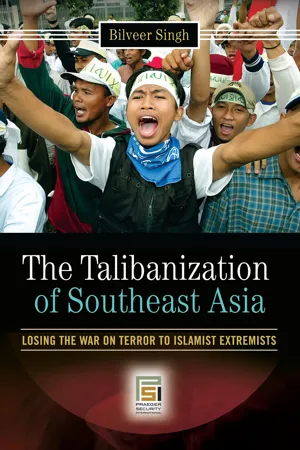
eBook - PDF
The Talibanization of Southeast Asia
Losing the War on Terror to Islamist Extremists
- 265 pages
- English
- PDF
- Available on iOS & Android
eBook - PDF
About this book
Information
Table of contents
- Contents
- Preface
- Acknowledgments
- Abbreviations
- Glossary of Key Islamic Terms
- Chronology: The Al-Jama’ah Al-Islamiyyah in Southeast Asia
- Introduction: Behind the Veil of Successful Counterterrorism
- 1 Religious Extremism and Terrorism: A Conceptual Framework
- 2 Southeast Asia’s Experience with Old and New Islamist Extremism and Jihadism
- 3 The Rise of Al-Jama’ah Al-Islamiyyah as Southeast Asia’s Leading Transnational Terrorist Organization
- 4 Counterterrorism in Southeast Asia: One Step Forward, Two Steps Backward?
- Conclusion: Southeast Asia’s Failure in Its War on Terror against Islamist Extremism and the Road Ahead
- Appendix 1: General Guidelines on the Struggle of Jama’ah Islamiyyah (Excerpts)
- Appendix 2: ASEAN Agreements on Combating Terrorism
- Appendix 3: ASEAN’s AJAI Operatives Who Have Been Detained, Released, or Killed (as of June 2007)
- Notes
- Bibliography
- Index
Trusted by 375,005 students
Access to over 1.5 million titles for a fair monthly price.
Study more efficiently using our study tools.
Frequently asked questions
Yes, you can cancel anytime from the Subscription tab in your account settings on the Perlego website. Your subscription will stay active until the end of your current billing period. Learn how to cancel your subscription
No, books cannot be downloaded as external files, such as PDFs, for use outside of Perlego. However, you can download books within the Perlego app for offline reading on mobile or tablet. Learn how to download books offline
Perlego offers two plans: Essential and Complete
- Essential is ideal for learners and professionals who enjoy exploring a wide range of subjects. Access the Essential Library with 800,000+ trusted titles and best-sellers across business, personal growth, and the humanities. Includes unlimited reading time and Standard Read Aloud voice.
- Complete: Perfect for advanced learners and researchers needing full, unrestricted access. Unlock 1.5M+ books across hundreds of subjects, including academic and specialized titles. The Complete Plan also includes advanced features like Premium Read Aloud and Research Assistant.
We are an online textbook subscription service, where you can get access to an entire online library for less than the price of a single book per month. With over 1.5 million books across 990+ topics, we’ve got you covered! Learn about our mission
Look out for the read-aloud symbol on your next book to see if you can listen to it. The read-aloud tool reads text aloud for you, highlighting the text as it is being read. You can pause it, speed it up and slow it down. Learn more about Read Aloud
Yes! You can use the Perlego app on both iOS and Android devices to read anytime, anywhere — even offline. Perfect for commutes or when you’re on the go.
Please note we cannot support devices running on iOS 13 and Android 7 or earlier. Learn more about using the app
Please note we cannot support devices running on iOS 13 and Android 7 or earlier. Learn more about using the app
Yes, you can access The Talibanization of Southeast Asia by Bilveer Singh in PDF and/or ePUB format, as well as other popular books in Politics & International Relations & Military & Maritime History. We have over 1.5 million books available in our catalogue for you to explore.