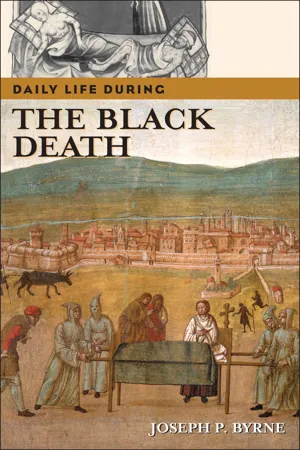
Daily life during the Black Death was anything but normal. When plague hit a community, every aspect of life was turned upside down, from relations within families to its social, political, and economic stucture. Theaters emptied, graveyards filled, and the streets were ruled by the terrible corpse-bearers whose wagons of death rumbled day and night.
Daily life during the Black Death was anything but normal. During the three and a half centuries that constituted the Second Pandemic of Bubonic Plague, from 1348 to 1722, Europeans were regularly assaulted by epidemics that mowed them down like a reaper's scythe. When plague hit a community, every aspect of life was turned upside down, from relations within families to its social, political and economic structure. Theaters emptied, graveyards filled, and the streets were ruled by terrible corpse-bearers whose wagons of death rumbled night and day. Plague time elicited the most heroic and inhuman behavior imaginable. And yet Western Civilization survived to undergo the Renaissance, Reformation, Scientific Revolution, and early Enlightenment.
In Daily Life during the Black Death Joseph Byrne opens with an outline of the course of the Second Pandemic, the causes and nature of bubonic plague, and the recent revisionist view of what the Black Death really was. He presents the phenomenon of plague thematically by focusing on the places people lived and worked and confronted their horrors: the home, the church and cemetary, the village, the pest houses, the streets and roads. He leads readers to the medical school classroom where the false theories of plague were taught, through the careers of doctors who futiley treated victims, to the council chambers of city hall where civic leaders agonized over ways to prevent and then treat the pestilence. He discusses the medicines, prayers, literature, special clothing, art, burial practices, and crime that plague spawned. Byrne draws vivid examples from across both Europe and the period, and presents the words of witnesses and victims themselves wherever possible. He ends with a close discussion of the plague at Marseille (1720-22), the last major plague in northern Europe, and the research breakthroughs at the end of the nineteenth century that finally defeated bubonic plague.
- 341 pages
- English
- PDF
- Available on iOS & Android
eBook - PDF
Daily Life during the Black Death
Table of contents
- Contents
- Acknowledgments
- Chronology
- Introduction
- 1. At Medical School
- 2. At the Doctor’s Office
- 3. At Home with the Plague
- 4. At the Church and Churchyard
- 5. At the Bishop’s Palace and the Monastery
- 6. At the Pest House
- 7. At City Hall
- 8. On the Streets and Roads of Europe
- 9. At the Bookseller’s and the Theater
- 10. In the Village and on the Manor
- 11. In the Medieval Muslim World
- 12. The Plague’s Last Stand in Europe
- Selected Readings
- Index
Trusted by 375,005 students
Access to over 1.5 million titles for a fair monthly price.
Study more efficiently using our study tools.
Frequently asked questions
Yes, you can cancel anytime from the Subscription tab in your account settings on the Perlego website. Your subscription will stay active until the end of your current billing period. Learn how to cancel your subscription
No, books cannot be downloaded as external files, such as PDFs, for use outside of Perlego. However, you can download books within the Perlego app for offline reading on mobile or tablet. Learn how to download books offline
Perlego offers two plans: Essential and Complete
- Essential is ideal for learners and professionals who enjoy exploring a wide range of subjects. Access the Essential Library with 800,000+ trusted titles and best-sellers across business, personal growth, and the humanities. Includes unlimited reading time and Standard Read Aloud voice.
- Complete: Perfect for advanced learners and researchers needing full, unrestricted access. Unlock 1.5M+ books across hundreds of subjects, including academic and specialized titles. The Complete Plan also includes advanced features like Premium Read Aloud and Research Assistant.
We are an online textbook subscription service, where you can get access to an entire online library for less than the price of a single book per month. With over 1.5 million books across 990+ topics, we’ve got you covered! Learn about our mission
Look out for the read-aloud symbol on your next book to see if you can listen to it. The read-aloud tool reads text aloud for you, highlighting the text as it is being read. You can pause it, speed it up and slow it down. Learn more about Read Aloud
Yes! You can use the Perlego app on both iOS and Android devices to read anytime, anywhere — even offline. Perfect for commutes or when you’re on the go.
Please note we cannot support devices running on iOS 13 and Android 7 or earlier. Learn more about using the app
Please note we cannot support devices running on iOS 13 and Android 7 or earlier. Learn more about using the app
Yes, you can access Daily Life during the Black Death by Joseph P. Byrne in PDF and/or ePUB format, as well as other popular books in History & European Medieval History. We have over 1.5 million books available in our catalogue for you to explore.