One of the most familiar features of any high-school chemistry lab is the Periodic Table of Elements. Elegant, informative, useful to any student in the lab - the Periodic Table neatly summarizes our scientific knowledge of the chemical elements from hydrogen to uranium and beyond - atomic number, atomic weight, isotopes, and more. But how did scientists discover all of these features of the elements? How did the Periodic Table come to be? And, even more basically, how did the concept of the chemical element come to dominate how scientists understand chemistry? This book shows readers the answers to these and other questions regarding the scientific understanding of matter.
The Chemical Element, a volume in the Greenwood Guides to Great Ideas in Science, traces the history of this tremendously powerful concept from the ancient philosophers to the present day. The volume covers: the idea of the elements held by Aristotle and the other ancient Greek philosophers; how Chinese, Arabic and other ancient civilizations thought about the elements; Mendeleyev and the creation of the Periodic Table of Elements, the predictive power of which helped in the discovery of dozens of new elements; and the discovery of the artificial elements that are heavier than uranium
Jargon and mathematics is kept to a minimum, and the volumes includes a timeline, a glossary, and a bibliography, making The Chemical Element an ideal resource for students researching chemistry and the history and nature of the scientific understanding of the world around us.
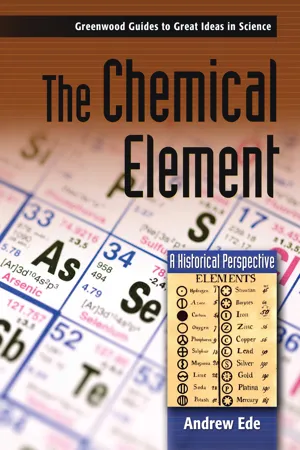
- 201 pages
- English
- PDF
- Available on iOS & Android
eBook - PDF
About this book
Information
Table of contents
- CONTENTS
- Series Foreword
- List of Illustrations
- Introduction
- 1 Ancient Matter Theory
- 2 Greek Matter Theory from Thales to Aristotle
- 3 Matter Theory in China, the Middle East, and India
- 4 Alchemy and the Concept of Elements
- 5 Corpuscles and Atoms
- 6 Bringing Order to Chaos
- 7 Making Elements Elemental
- 8 Seeking Order: The Periodic Table
- 9 The Atomic Elements
- 10 The Elements beyond 92
- Conclusion
- Appendix 1: The Periodic Table
- Appendix 2: History of the Elements
- Appendix 3: The Elements by Alphabetical Order
- Appendix 4: The Elements by Date of Discovery
- Glossary
- Annotated Bibliography
- Bibliography
- Index
- Figure 1. Egyptian god Osiris.
- Figure 2. Geometric solids.
- Figure 3. Zeno’s paradox.
- Figure 4. Aristotle’s model of the Universe.
- Figure 5. Aristotle’s Four Elements and Four Qualities.
- Figure 6. Yin Yang symbol.
- Figure 7. Alchemical symbols for materials and planets.
- Figure 8. The Alchemist by David Teniers the Younger, c. 1645.
- Figure 9. Robert Boyle’s air pump.
- Figure 10. Joseph Priestley’s pneumatic trough used for collecting gases.
- Figure 11. Lavoisier’s constant pressure gas pump and reaction vessels.
- Figure 12. The calorimeter.
- Figure 13. Lavoisier’s table of simple substances from Elements of Chemistry (1790).
- Figure 14. Dalton’s elements and common “atoms.” From John Dalton, New System of Chemical Philosophy (1808).
- Figure 15. Gustav Kirchhoff and Robert Bunsen’s spectrocope, from “Chemical analysis by Observation of Spectra,” (1860).
- Figure 16. Mendeleev’s periodic table from Annalender Chemie, (1872).
- Figure 17. Ceria and yttria isolation.
- Figure 18. Ultramicroscope.
- Figure 19. Fission.
- Figure 20. Fusion.
Trusted by 375,005 students
Access to over 1.5 million titles for a fair monthly price.
Study more efficiently using our study tools.
Frequently asked questions
Yes, you can cancel anytime from the Subscription tab in your account settings on the Perlego website. Your subscription will stay active until the end of your current billing period. Learn how to cancel your subscription
No, books cannot be downloaded as external files, such as PDFs, for use outside of Perlego. However, you can download books within the Perlego app for offline reading on mobile or tablet. Learn how to download books offline
Perlego offers two plans: Essential and Complete
- Essential is ideal for learners and professionals who enjoy exploring a wide range of subjects. Access the Essential Library with 800,000+ trusted titles and best-sellers across business, personal growth, and the humanities. Includes unlimited reading time and Standard Read Aloud voice.
- Complete: Perfect for advanced learners and researchers needing full, unrestricted access. Unlock 1.5M+ books across hundreds of subjects, including academic and specialized titles. The Complete Plan also includes advanced features like Premium Read Aloud and Research Assistant.
We are an online textbook subscription service, where you can get access to an entire online library for less than the price of a single book per month. With over 1.5 million books across 990+ topics, we’ve got you covered! Learn about our mission
Look out for the read-aloud symbol on your next book to see if you can listen to it. The read-aloud tool reads text aloud for you, highlighting the text as it is being read. You can pause it, speed it up and slow it down. Learn more about Read Aloud
Yes! You can use the Perlego app on both iOS and Android devices to read anytime, anywhere — even offline. Perfect for commutes or when you’re on the go.
Please note we cannot support devices running on iOS 13 and Android 7 or earlier. Learn more about using the app
Please note we cannot support devices running on iOS 13 and Android 7 or earlier. Learn more about using the app
Yes, you can access The Chemical Element by Andrew G. Ede in PDF and/or ePUB format, as well as other popular books in Biological Sciences & Science General. We have over 1.5 million books available in our catalogue for you to explore.