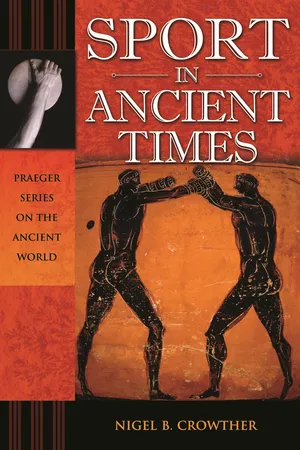
Crowther offers a fascinating look at the role of sport as practiced in several important civilizations in the ancient world. He not only probes the games themselves, but explores the ways in which athletics figured into cultural arenas that extended beyond physical prowess to military associations, rituals, status, and politics. Sport in Ancient Times has four distinct parts: the Prehistoric Age, historic Greece, ancient Italy, and the Byzantine Empire. Beginning with the earliest civilizations, Crowther examines the military and recreational aspects of sports in prehistoric Egypt, with brief references to other river-valley cultures in Sumeria, Mesopotamia, and Persia. He looks at the rituals of Cretan bull-leaping and boxing in the Bronze Age, the high status of sports in Mycenaean Greece, and the funeral games in the Trojan War as described by the epic poet Homer.
In what he terms the historic period, Crowther examines the significance of the ancient Olympic Games, the events of Greek athletics, and the attitude of other civilizations (notably Rome) towards them. He attempts to discover to what extent the Romans believed in the famous ideal of Juvenal, a sound mind in a sound body, and discusses the significance of the famous Baths not only for sport, but also for culture and society. He likewise explores the Roman emphasis on spectator sports and the use of gladiatorial contests and chariot racing for political purposes (the concept of bread and games). The section on the Byzantine Empire focuses, notably, on chariot racing and the riots at sporting contests—riots reminiscent of crowd violence in modern sports such as soccer.
Crowther closes with perspectives that bring to life some of the issues revealed in previous chapters. These include a comparison of the social status and significance of a famous Olympic athlete (Milo), a Roman gladiator (Hermes), and a Byzantine chariot racer (Porphyrius). He also addresses the changing role of women in sports in antiquity. Women were prominent in sport in Egypt, for example, but almost entirely absent from the ancient Olympic Games. The final chapter discusses team sports and ball games. Although these were comparatively rare in the ancient world, one may see in those that did exist the forerunners of modern football and hockey.
eBook - PDF
Sport in Ancient Times
Table of contents
- Contents
- Figures
- Preface
- Timelines for Ancient Civilizations
- Introduction
- 1. The Far East: China, Japan, and Korea
- 2. The Middle East (Excluding Egypt)
- 3. Egypt at the Time of the Pharaohs
- 4. Minoan Civilization
- 5. Mycenae and Homer
- 6. The Ancient Olympic Games
- 7. Ancient Greek Athletics
- 8. The Etruscans in Ancient Italy
- 9. Roman Games and Greek Athletics
- 10. Roman Recreations and Physical Fitness
- 11. Recreational Areas in Rome: The Baths and Campus Martius
- 12. Roman Gladiators
- 13. Roman Chariot Racing
- 14. The Byzantine Empire
- 15. Three Sporting Heroes of the Ancient World
- 16. Women and Sport: Atalanta and the “Gladiator Girl”
- 17. Greco-Roman Ball Games and Team Sports
- 18. Mesoamerican Ball Games
- Further Readings
- Index
- Figure 1.1 Chinese swimming. Wall painting from Xinjiang province, about 500 C.E. Bildarchiv Preussischer Kulturbesitz.
- Figure 1.2 Terra-cotta statuette of a “polo” player from the Tang dynasty. Musée Cernuschi, Paris.
- Figure 1.3 Terra-cotta statuette of a female “polo” player from the eighth century C.E . Musée des Arts Asiatiques-Guimet, Paris.
- Figure 2.1 Early terra-cotta fragment containing part of the text of the Epic of Gilgamesh. Israel Museum (IDAM), Jerusalem, Israel.
- Figure 2.2 Wrestlers take hold of each other’s belts. Copper statuette with offering stand above. Iraq Museum, Baghdad.
- Figure 3.1 Tutankhamon hunting in the desert with chariot and bow. Detail from the lid of a chest. Egyptian Museum, Cairo.
- Figure 3.2 Part of a sequence of wrestling scenes from Beni Hasan (2000 B.C.E.). Beni Hasan, Egypt.
- Figure 3.3 Gaming board of Senet, with pieces, from Saqqara. Egyptian Museum, Cairo.
- Figure 4.1 Bull leaping. Minoan fresco, 1500 B.C.E. Archaeological Museum, Heraklion, Crete.
- Figure 4.2 The “Boxer Vase” from Hagia Triada, Crete.
- Figure 4.3 The “Boy Boxer” fresco from Thera. National Archaeological Museum, Athens.
- Figure 5.1 Portrait bust of Homer. Musei Capitolini, Rome.
- Figure 6.1 Later stadium at Olympia looking toward the Altis.
- Figure 7.1 Relief from the base of a kouros. National Archaeological Museum, Athens.
- Figure 7.2 A vase painting by Epicterus (fifth century B.C.E.). Louvre, Paris.
- Figure 7.3 Roman copy of Myron’s Discobolus. Museo Nazionale Romano (Terme di Diocleziano), Rome.
- Figure 7.4 “Seated Boxer.” Museo Nazionale Romano (Terme di Diocleziano), Rome.
- Figure 7.5 Four-horse chariot race with horses abreast. Black-figured amphora with white glaze (sixth century B.C.E.). Louvre, Paris.
- Figure 8.1 Runners wearing shorts in the Tomb of the Olympiads, Tarquinia, Italy, sixth century B.C.E.
- Figure 8.2 Wrestlers in the Tomb of the Augurs, Tarquinia, Italy, sixth century B.C.E.
- Figure 9.1 Model of the U-shaped stadium of Domitian. Museo della Civiltà Romana, Rome.
- Figure 10.1 Ganymede playing with a hoop. Attic red-figure bell crater, late fifth century B.C.E. Louvre, Paris.
- Figure 11.1 Aerial view of the Baths of Caracalla, Rome, Italy.
- Figure 11.2 An ancient Roman bath in Bath, England.
- Figure 12.1 Roman mosaic of a retiarius. Galleria Borghese, Rome.
- Figure 12.2 Aerial shot of the Colosseum in the center of Rome.
- Figure 13.1 Model of the Circus Maximus in Rome. Museo della Civiltà Romana, Rome.
- Figure 13.2 Terra-cotta relief, first to third century C.E., of the quadriga. Louvre, Paris.
- Figure 14.1 The obelisk in the hippodrome in Istanbul.
- Figure 16.1 Atalanta and Peleus wrestling. Attic black-figure amphora from Nola. Antikensammlung, Staatliche Museen zu Berlin, Berlin.
- Figure 16.2 Part of the “Bikini Mosaic” depicting here a jumper, discus thrower, and runner. Villa del Casale, Piazza Armerina, Sicily.
- Figure 16.3 Marble relief of female gladiators from Halicarnassus, Turkey. British Museum, London.
- Figure 17.1 The “Hockey Relief.” National Archaeological Museum, Athens.
- Figure 17.2 Game of episkyros? A late sixth-century B.C.E. relief. National Archaeological Museum, Athens.
- Figure 18.1 I-shaped ball court at Chichén Itzá, Mexico. Chichén Itzá, Yucatán, Mexico.
- Figure 18.2 Vertical ring in the ball court at Uxmal, Yucatán, Mexico. Maya period, ninth to tenth century C.E.
- Figure 18.3 Hohokam ball court, Wupatki, northern Arizona, twelfth century C.E., Cline Library.
Trusted by 375,005 students
Access to over 1.5 million titles for a fair monthly price.
Study more efficiently using our study tools.
Frequently asked questions
Yes, you can cancel anytime from the Subscription tab in your account settings on the Perlego website. Your subscription will stay active until the end of your current billing period. Learn how to cancel your subscription
No, books cannot be downloaded as external files, such as PDFs, for use outside of Perlego. However, you can download books within the Perlego app for offline reading on mobile or tablet. Learn how to download books offline
Perlego offers two plans: Essential and Complete
- Essential is ideal for learners and professionals who enjoy exploring a wide range of subjects. Access the Essential Library with 800,000+ trusted titles and best-sellers across business, personal growth, and the humanities. Includes unlimited reading time and Standard Read Aloud voice.
- Complete: Perfect for advanced learners and researchers needing full, unrestricted access. Unlock 1.5M+ books across hundreds of subjects, including academic and specialized titles. The Complete Plan also includes advanced features like Premium Read Aloud and Research Assistant.
We are an online textbook subscription service, where you can get access to an entire online library for less than the price of a single book per month. With over 1.5 million books across 990+ topics, we’ve got you covered! Learn about our mission
Look out for the read-aloud symbol on your next book to see if you can listen to it. The read-aloud tool reads text aloud for you, highlighting the text as it is being read. You can pause it, speed it up and slow it down. Learn more about Read Aloud
Yes! You can use the Perlego app on both iOS and Android devices to read anytime, anywhere — even offline. Perfect for commutes or when you’re on the go.
Please note we cannot support devices running on iOS 13 and Android 7 or earlier. Learn more about using the app
Please note we cannot support devices running on iOS 13 and Android 7 or earlier. Learn more about using the app
Yes, you can access Sport in Ancient Times by Nigel B. Crowther in PDF and/or ePUB format, as well as other popular books in History & Ancient History. We have over 1.5 million books available in our catalogue for you to explore.