eBook - PDF
Income and Wealth
About this book
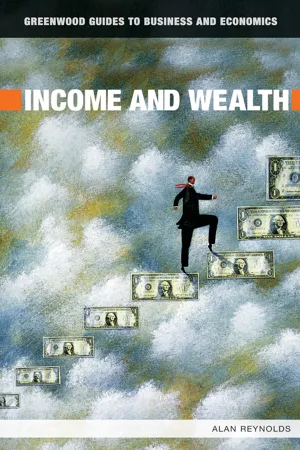
Why some people are rich and others poor can be explained in a number of ways. Income and Wealth focuses on who gets what and why. It explains the dynamics of income generation, how it is measured, and how such dramatic disparities in distribution come about. The book first defines various characteristics of income, with an emphasis on the gap between the rich and the poor, and reviews several theories to explain the disparities. Subsequent chapters discuss such timely topics as the vanishing middle class and the sky-high salaries of CEOs, Hollywood stars, and athletes. The final chapters consider the implications of policies, such as the minimum wage, taxes, immigration, and trade quotas, and expand the discussion to consider international comparisons. Featuring graphs and charts, a glossary of key terms, and a listing of references and resources, Income and Wealth explains the intricate, and often controversial, effects of economic policies on individuals, families, and communities. Moreover, it shows how the numbers can be manipulated by policymakers, pundits, journalists, and academics to promote various agendas—and shows readers how to recognize hyberbole and make better-informed decisions.
Table of contents
- Contents
- Illustrations
- Series Foreword by Wesley B. Truitt
- Introduction
- 1. Concepts and Measures
- 2. Work Matters
- 3. A Vanishing Middle Class?
- 4. The Wage Stagnation Thesis
- 5. The Top 1 Percent
- 6. CEOs and Celebrities
- 7. Wealth Is Not Distributed
- 8. Consumption Inequality, Lifetime Income, and Mobility
- 9. Causes and Cures
- Glossary
- Online Resources
- Index
- TABLES 1.1 Distribution of Persons by Family Type
- TABLES 1.2 Census Bureau Gini Ratios for Pretax, Pretransfer Money Income
- TABLES 1.3 Comparison of Income Distributions Producing the Same Gini Index
- TABLES 1.4 Before-Tax Household Income (in 2004 Dollars)
- TABLES 2.1 Average Household Income by Quintile (and Top 5 Percent) Census Bureau (Estimates in 2004 Dollars)
- TABLES 2.2 Average After-Tax Household Income by Quintile (and Top 5 Percent) Congressional Budget Office (Estimates in 2003 Dollars)
- TABLES 4.1 Full-Time Wage and Salary Workers, 2004
- TABLES 4.2 Ownership of Consumer Goods
- TABLES 5.1 Estimated Income Share of Top 1 Percent
- TABLES 5.2 Dew-Becker and Gordon Estimates of Labor Income (Billions in 2000 Dollars)
- TABLES 5.3 Distribution of Tax-Deferred Account Holders by Marginal Tax Rates, 1998
- TABLES 5.4 Shares of Pretax Personal Income
- TABLES 7.1 Percent of Baby Boomers with Net Worth above $250,000 (in 2001 Dollars)
- TABLES 7.2 The Composition of Household Wealth in 1995 (Percent of Gross Assets)
- TABLES 8.1 Alternative Measures of Inequality (Gini Coefficients)
- TABLES 8.2 Increase in Mean Disposable Income Needed to Move to a Higher Group in 1992–1994
- TABLES 9.1 Number of Manufacturing Jobs (Thousands)
- TABLES 9.2 Average Hourly Earnings in December 2005 by Production or Nonsupervisory Workers
- TABLES 9.3 Maximum Marginal Tax Rates on Individual Income
- FIGURES 1.1 Real Median Income of 4-Person Families and Households, 1975–2003
- FIGURES 1.2 Lorenz Curve for U.S. Households, Pretax and Pretransfer Money Income, 2004
- FIGURES 2.1 Mean Household Income by Number of Earners
- FIGURES 3.1 Minimum Threshold for the Top 20 Percent and Mean Income above That Threshold
- FIGURES 4.1 Real Average Weekly Earnings of Private Nonfarm Production and Nonsupervisory Workers
- FIGURES 4.2 Average Weekly Wages Mislead When Weekly Hours Decline
- FIGURES 4.3 Cumulative Annual Increases in Real Compensation per Hour, Since 1973
- FIGURES 4.4 Real Per Capita Consumption in 2000 dollars, 1929–2004
- FIGURES 5.1 Business Income’s Share of Total Income of Top 1 Percent and Top 0.1 Percent
- FIGURES 6.1 Average CEO Compensation and the S&P 500 Stock Index
- FIGURES 7.1 Average Real Net Worth of Households (Thousands in 2004 Dollars)
- FIGURES 7.2 Share of ‘‘Augmented Wealth’’ Held by the Wealthiest 1 Percent of Households
Trusted by 375,005 students
Access to over 1.5 million titles for a fair monthly price.
Study more efficiently using our study tools.
Frequently asked questions
Yes, you can cancel anytime from the Subscription tab in your account settings on the Perlego website. Your subscription will stay active until the end of your current billing period. Learn how to cancel your subscription
No, books cannot be downloaded as external files, such as PDFs, for use outside of Perlego. However, you can download books within the Perlego app for offline reading on mobile or tablet. Learn how to download books offline
Perlego offers two plans: Essential and Complete
- Essential is ideal for learners and professionals who enjoy exploring a wide range of subjects. Access the Essential Library with 800,000+ trusted titles and best-sellers across business, personal growth, and the humanities. Includes unlimited reading time and Standard Read Aloud voice.
- Complete: Perfect for advanced learners and researchers needing full, unrestricted access. Unlock 1.5M+ books across hundreds of subjects, including academic and specialized titles. The Complete Plan also includes advanced features like Premium Read Aloud and Research Assistant.
We are an online textbook subscription service, where you can get access to an entire online library for less than the price of a single book per month. With over 1.5 million books across 990+ topics, we’ve got you covered! Learn about our mission
Look out for the read-aloud symbol on your next book to see if you can listen to it. The read-aloud tool reads text aloud for you, highlighting the text as it is being read. You can pause it, speed it up and slow it down. Learn more about Read Aloud
Yes! You can use the Perlego app on both iOS and Android devices to read anytime, anywhere — even offline. Perfect for commutes or when you’re on the go.
Please note we cannot support devices running on iOS 13 and Android 7 or earlier. Learn more about using the app
Please note we cannot support devices running on iOS 13 and Android 7 or earlier. Learn more about using the app
Yes, you can access Income and Wealth by Alan Reynolds in PDF and/or ePUB format, as well as other popular books in Economics & Business General. We have over 1.5 million books available in our catalogue for you to explore.