Conventional research suggests that news coverage of terrorism is a tool of the terrorist to gain public support and recognition. Based on an analysis of more than 200 evening newscasts aired during the first six years of the Reagan administration, Tales of Terror offers a detailed account of the ways in which news media escalate public panic about terrorism and encourage support for specific U.S. policy objectives, rather than build sympathy for terrorists. Bethami Dobkin explores similarities between news media and government portrayals of terrorism, combining textual criticism with an interpretation of official U.S. policy statements, and argues that government depictions and news presentations of terrorism reproduce an ideology that supports military strength and intervention.
Dobkin examines several specific features of news coverage: the dramatic format of television news and the political interests that this format serves; the narrative construction of enemies by television journalists and public officials and the political significance of the terrorist label; the use and significance of testimony, particularly that of people affected by crisis; the mutual exploitation of political crisis by both television news producers and public officials; the function of journalism in shaping the conduct of public diplomacy and public perceptions of foreign conflict; and the creation of consensus about the need for military responses to political violence. This revealing study will be of particular interest to scholars of communications and political science.
eBook - PDF
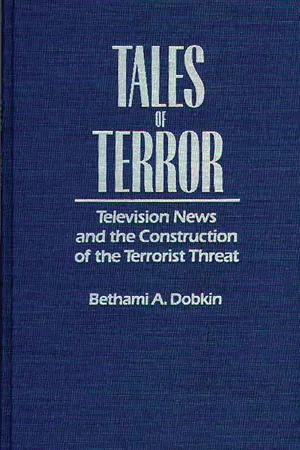
Tales of Terror
Television News and the Construction of the Terrorist Threat
- 146 pages
- English
- PDF
- Available on iOS & Android
eBook - PDF
About this book
Information
Table of contents
- Preface
- 1 Introduction: Television, Terrorism, and Public Reality
- 2 The Television Terrorist
- 3 The Interpretation of Television News
- 4 What’s in a Name? “Terrorism” as Ideograph
- 5 Paper Tigers and Video Postcards: Narrative Framing in Network News
- 6 Official Discourse in the “Age of the Terrorist”
- 7 Conclusions: Political Violence in a Video Age
- Bibliography
- Index
Trusted by 375,005 students
Access to over 1.5 million titles for a fair monthly price.
Study more efficiently using our study tools.
Frequently asked questions
Yes, you can cancel anytime from the Subscription tab in your account settings on the Perlego website. Your subscription will stay active until the end of your current billing period. Learn how to cancel your subscription
No, books cannot be downloaded as external files, such as PDFs, for use outside of Perlego. However, you can download books within the Perlego app for offline reading on mobile or tablet. Learn how to download books offline
Perlego offers two plans: Essential and Complete
- Essential is ideal for learners and professionals who enjoy exploring a wide range of subjects. Access the Essential Library with 800,000+ trusted titles and best-sellers across business, personal growth, and the humanities. Includes unlimited reading time and Standard Read Aloud voice.
- Complete: Perfect for advanced learners and researchers needing full, unrestricted access. Unlock 1.5M+ books across hundreds of subjects, including academic and specialized titles. The Complete Plan also includes advanced features like Premium Read Aloud and Research Assistant.
We are an online textbook subscription service, where you can get access to an entire online library for less than the price of a single book per month. With over 1.5 million books across 990+ topics, we’ve got you covered! Learn about our mission
Look out for the read-aloud symbol on your next book to see if you can listen to it. The read-aloud tool reads text aloud for you, highlighting the text as it is being read. You can pause it, speed it up and slow it down. Learn more about Read Aloud
Yes! You can use the Perlego app on both iOS and Android devices to read anytime, anywhere — even offline. Perfect for commutes or when you’re on the go.
Please note we cannot support devices running on iOS 13 and Android 7 or earlier. Learn more about using the app
Please note we cannot support devices running on iOS 13 and Android 7 or earlier. Learn more about using the app
Yes, you can access Tales of Terror by Bethami A. Dobkin in PDF and/or ePUB format, as well as other popular books in Sciences sociales & Commerce Général. We have over 1.5 million books available in our catalogue for you to explore.