The proverbial American dream of owning a home has become an all-too-real nightmare for a growing number of families. The most vulnerable segments of our society—including minorities, the elderly, and working families—are being victimized by financiers who lure them into commitments they cannot fulfill. Collectively known as predatory lending, these practices include offering higher interest rates than can be justified by the risk, high pre-payment penalties that lock families into exploitative loans, and monstrous balloon payments that often result in default and the loss of the home. The net result can be disastrous: damage to one's credit rating, bankruptcy, and even the loss of lifelong savings.
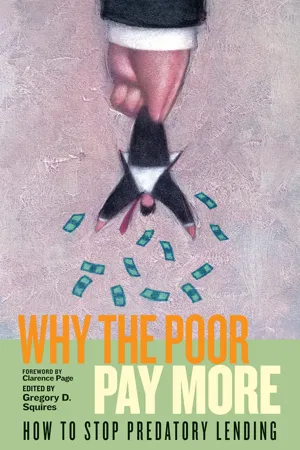
Why the Poor Pay More is an incisive exposure of these practices: how they have evolved, why they have become so prevalent in recent years, and how their negative effects can be quantified. It features in-depth analysis from prominent scholars, legal experts, and community leaders, who shed new light on the social, political, and economic consequences of predatory lending. Why the Poor Pay More is much more than an indictment of these insidious discriminatory practices. It is a call to arms for anyone concerned about how the financial-political system can be corrupted to serve the needs of the wealthy. Highlighting community initiatives already underway to combat predatory lending and an extensive listing of practical resources, Why the Poor Pay More outlines active roles that individuals, advocacy groups, financial and legal service providers, and policymakers can play in reversing this destructive trend.
- 249 pages
- English
- PDF
- Available on iOS & Android
eBook - PDF
Table of contents
- Foreword: Loan Sharks in Pinstripes Clarence Page
- 1. The New Redlining Gregory D. Squires
- 2. The Targets of Predatory and Discriminatory Lending: Who Are They and Where Do They Live? John Taylor, Josh Silver, and David Berenbaum
- 3. The Economic Consequences of Predatory Lending: A Philadelphia Case Study Ira Goldstein
- 4. Predatory Lending Practices: De.nition and Behavioral Implications Patricia A. McCoy
- 5. Legal and Economic Inducements to Predatory Practices Keith Ernst, Deborah N. Goldstein, and Christopher A. Richardson
- 6. Community Organizing and Advocacy: Fighting Predatory Lending and Making a Difference Maude Hurd and Lisa Donner, with Camellia Phillips
- 7. Designing Federal Legislation That Works: Legal Remedies for Predatory Lending John P. Relman, Fred Rivera, Meera Trehan, and Shilpa S. Satoskar
- 8. Predatory Lending Goes Global: Consumer Protection in a Deregulation Network Economy Matthew Lee
- 9. Predatoriness, and What We Can Do About It Chester Hartman
- Appendix: Resources on Predatory Lending
- Index
- About the Editor and Contributors
Trusted by 375,005 students
Access to over 1.5 million titles for a fair monthly price.
Study more efficiently using our study tools.
Frequently asked questions
Yes, you can cancel anytime from the Subscription tab in your account settings on the Perlego website. Your subscription will stay active until the end of your current billing period. Learn how to cancel your subscription
No, books cannot be downloaded as external files, such as PDFs, for use outside of Perlego. However, you can download books within the Perlego app for offline reading on mobile or tablet. Learn how to download books offline
Perlego offers two plans: Essential and Complete
- Essential is ideal for learners and professionals who enjoy exploring a wide range of subjects. Access the Essential Library with 800,000+ trusted titles and best-sellers across business, personal growth, and the humanities. Includes unlimited reading time and Standard Read Aloud voice.
- Complete: Perfect for advanced learners and researchers needing full, unrestricted access. Unlock 1.5M+ books across hundreds of subjects, including academic and specialized titles. The Complete Plan also includes advanced features like Premium Read Aloud and Research Assistant.
We are an online textbook subscription service, where you can get access to an entire online library for less than the price of a single book per month. With over 1.5 million books across 990+ topics, we’ve got you covered! Learn about our mission
Look out for the read-aloud symbol on your next book to see if you can listen to it. The read-aloud tool reads text aloud for you, highlighting the text as it is being read. You can pause it, speed it up and slow it down. Learn more about Read Aloud
Yes! You can use the Perlego app on both iOS and Android devices to read anytime, anywhere — even offline. Perfect for commutes or when you’re on the go.
Please note we cannot support devices running on iOS 13 and Android 7 or earlier. Learn more about using the app
Please note we cannot support devices running on iOS 13 and Android 7 or earlier. Learn more about using the app
Yes, you can access Why the Poor Pay More by Gregory D. Squires in PDF and/or ePUB format, as well as other popular books in Business & Business General. We have over 1.5 million books available in our catalogue for you to explore.