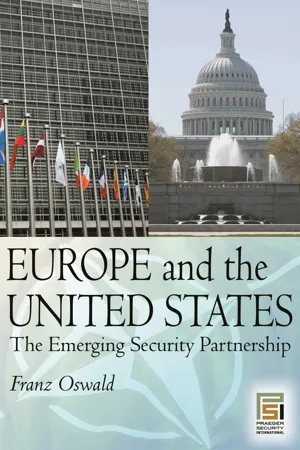
Oswald argues that European security autonomy will lead to a more balanced transatlantic partnership, even though American military might will remain far superior. As U.S. leaders indicate a willingness to disengage from their former European protectorate, the Europeanization of Europe's own security needs—their ability to take care of their own crises—will proceed apace. An understanding of this process is key to an American foreign policy that recognizes Europe as a strategic actor in its own right, an indispensable ally with its own military and nonmilitary instruments of crisis management.
At the end of the Cold War with the collapse of the Soviet Union in 1991, and the postcommunist transformation of Central and Eastern Europe, the U.S.-led NATO alliance found itself without its erstwhile primary enemy. While NATO found new purpose as guarantor of stability for an increasing membership and crisis manager in Southeast Europe, the alliance's expansion also advanced its transformation from a collective defense organization into a security community. While NATO was redefining itself, the European Union created the institutional and political prerequisites for a European security and defense policy. In his analysis of Europe's emancipation from security dependence on the United States, Oswald expects the economic strength of the European bloc to translate into responsibility for regional security.
Yet this is not to say that the EU is emerging as the primary challenger to U.S. hegemony. Instead, Oswald argues, European security autonomy will lead to a more balanced transatlantic partnership, even though American military might will remain far superior. As U.S. leaders indicate a willingness to disengage from their former European protectorate, the Europeanization of Europe's own security needs—their ability to take care of their own crises—will proceed apace. An understanding of this process is key to an American foreign policy that recognizes Europe as a strategic actor in its own right, an indispensable ally with its own military and nonmilitary instruments of crisis management.
- 201 pages
- English
- PDF
- Available on iOS & Android
eBook - PDF
About this book
Information
Table of contents
- Contents
- Preface
- Abbreviations
- Introduction: Recasting Transatlantic Relations—New Roles for the United States and Europe
- Chapter 1. Why Europe Matters: Roles inthe Transatlantic Relationship
- Chapter 2. Europe’s Uneven Emancipation: Economic Giant under U.S. Umbrella
- Chapter 3. How Long Do Alliances Last? Explaining NATO’s Longevity
- Chapter 4. Limited New Lease on Life: NATO’s Tasks after 1991
- Chapter 5. The Europeanization of European Security
- Chapter 6. Transatlantic Relations under Presidents Bill Clinton and George W. Bush
- Chapter 7. Emancipated Europe—United States without European Entanglements
- Notes
- Bibliography
- Index
Trusted by 375,005 students
Access to over 1.5 million titles for a fair monthly price.
Study more efficiently using our study tools.
Frequently asked questions
Yes, you can cancel anytime from the Subscription tab in your account settings on the Perlego website. Your subscription will stay active until the end of your current billing period. Learn how to cancel your subscription
No, books cannot be downloaded as external files, such as PDFs, for use outside of Perlego. However, you can download books within the Perlego app for offline reading on mobile or tablet. Learn how to download books offline
Perlego offers two plans: Essential and Complete
- Essential is ideal for learners and professionals who enjoy exploring a wide range of subjects. Access the Essential Library with 800,000+ trusted titles and best-sellers across business, personal growth, and the humanities. Includes unlimited reading time and Standard Read Aloud voice.
- Complete: Perfect for advanced learners and researchers needing full, unrestricted access. Unlock 1.5M+ books across hundreds of subjects, including academic and specialized titles. The Complete Plan also includes advanced features like Premium Read Aloud and Research Assistant.
We are an online textbook subscription service, where you can get access to an entire online library for less than the price of a single book per month. With over 1.5 million books across 990+ topics, we’ve got you covered! Learn about our mission
Look out for the read-aloud symbol on your next book to see if you can listen to it. The read-aloud tool reads text aloud for you, highlighting the text as it is being read. You can pause it, speed it up and slow it down. Learn more about Read Aloud
Yes! You can use the Perlego app on both iOS and Android devices to read anytime, anywhere — even offline. Perfect for commutes or when you’re on the go.
Please note we cannot support devices running on iOS 13 and Android 7 or earlier. Learn more about using the app
Please note we cannot support devices running on iOS 13 and Android 7 or earlier. Learn more about using the app
Yes, you can access Europe and the United States by Franz Oswald in PDF and/or ePUB format, as well as other popular books in Politics & International Relations & International Relations. We have over 1.5 million books available in our catalogue for you to explore.